During the rapid growth of Brazil’s offshore industry in the 2000s, offshore support vessels became an essential part of the country’s operational backbone.
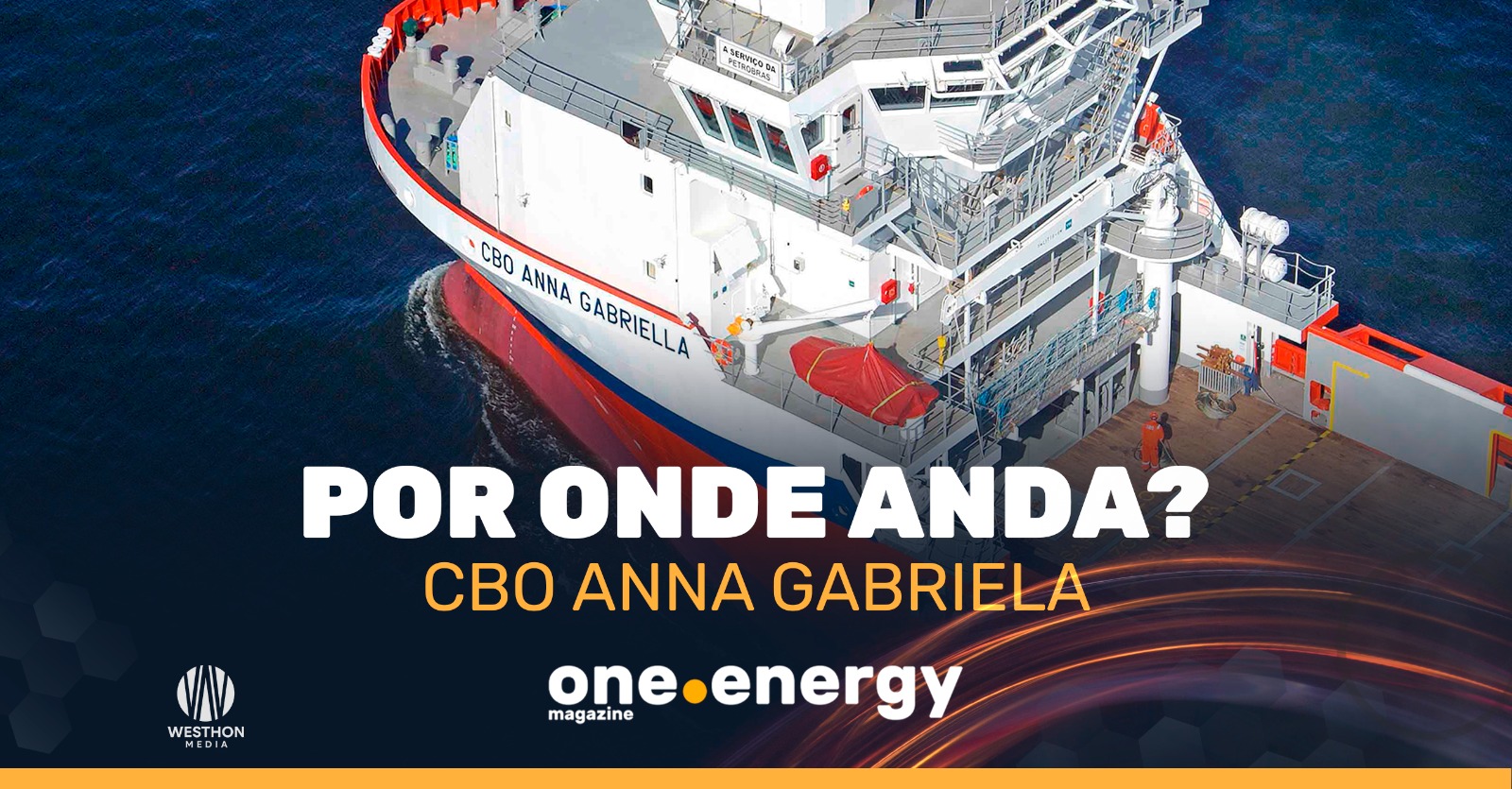
CBO Anna Gabriella was one of them.
Built in 2006 under IMO number 9364306, the vessel emerged during one of the most important expansion periods ever experienced by Brazil’s offshore industry. Constructed at Estaleiro Aliança, joined the Brazilian offshore market at a time when Petrobras operations were expanding rapidly across deepwater fields in the Campos Basin and beyond.
The vessel commenced operations for Petrobras shortly after delivery, becoming part of a generation of offshore support vessels that helped sustain the operational intensity of Brazil’s growing offshore sector.
At approximately 71 meters in length and with the robust profile characteristic of the Ulstein P-series designs, CBO Anna Gabriella was never built to attract headlines.
She was built to work.
And for years, vessels like her became essential links between ports, offshore bases, platforms, and supply chains operating far from the Brazilian coastline. While floating production units often captured public attention, offshore support vessels quietly handled the logistics that made those operations possible.
That is precisely what makes vessels like CBO Anna Gabriella so representative of an important chapter in Brazil’s marine and offshore history.
They were not necessarily the largest vessels offshore. But they were among the most necessary.
Today, however, public AIS activity involving the vessel appears significantly quieter than in previous years. Open vessel tracking platforms indicate limited recent movement, with the vessel still referenced in maritime databases and remaining listed as active and commissioned under the Brazilian flag.
Industry observers suggest the vessel may currently be between contracts after many years supporting offshore operations.
And perhaps that is what makes her story even more interesting.
Because unlike many offshore vessels that completely disappear from records, CBO Anna Gabriella still remains present — carrying with her the memory of a generation of Brazilian-built support vessels that helped sustain one of the largest offshore development cycles in the South Atlantic.
So the question remains.
Where is CBO Anna Gabriella now? Waiting for a new offshore assignment? Preparing for another operational chapter? Or simply resting quietly after years supporting Brazil’s offshore industry far from shore?
For now, the answers remain somewhere between ports, databases, memories, and the constant movement of the offshore world.
But one thing remains certain.
Vessels like CBO Anna Gabriella helped build the operational backbone of Brazil’s offshore industry — even when few people noticed.
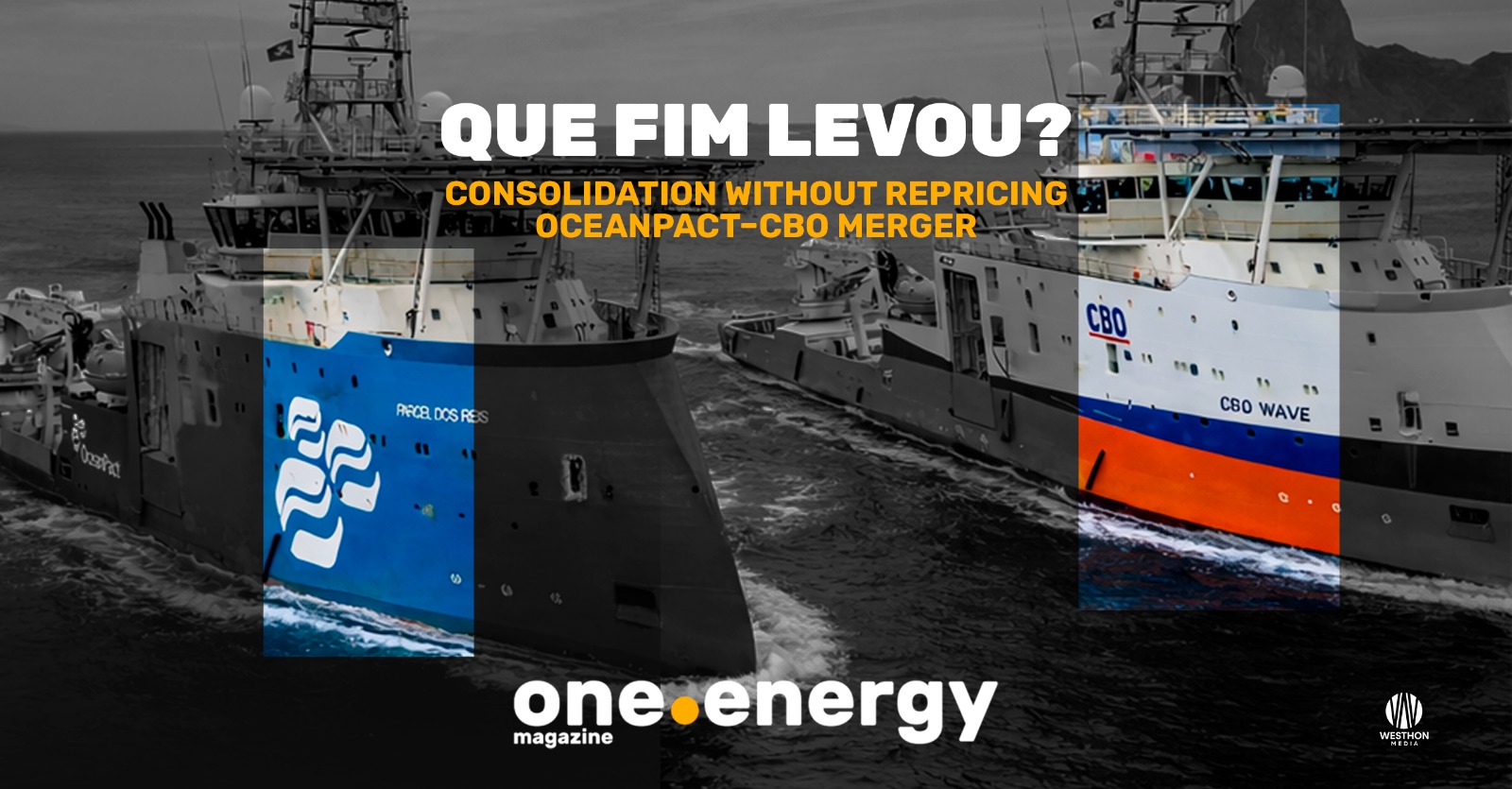
Consolidation Without Repricing OceanPact–CBO merger
Bigger, But Not Yet Richer The OceanPact–CBO merger and the economics behind the market’s restraint
Brazil’s offshore sector has produced a bigger company. What it has not yet produced is a richer one.
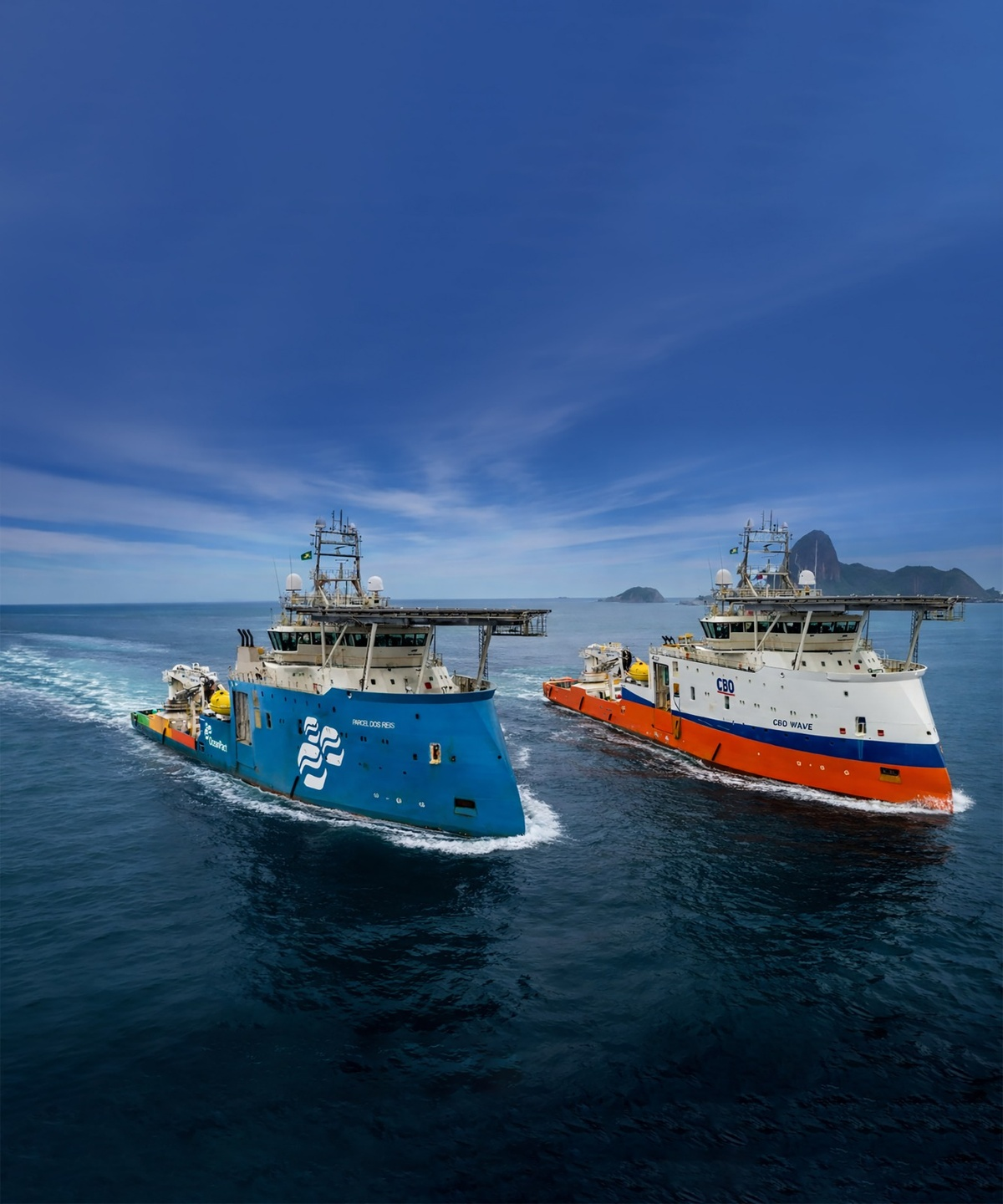
The merger between OceanPact and CBO represents one of the most consequential consolidation moves in the Brazilian offshore services industry in recent years. The combined company will operate a fleet of 73 vessels, generate revenues exceeding R$4 billion annually, and carry a backlog estimated at roughly R$14 billion. By operational standards, the platform that emerges from this combination is substantial, placing the group firmly among the most significant offshore service providers in the Brazilian market.
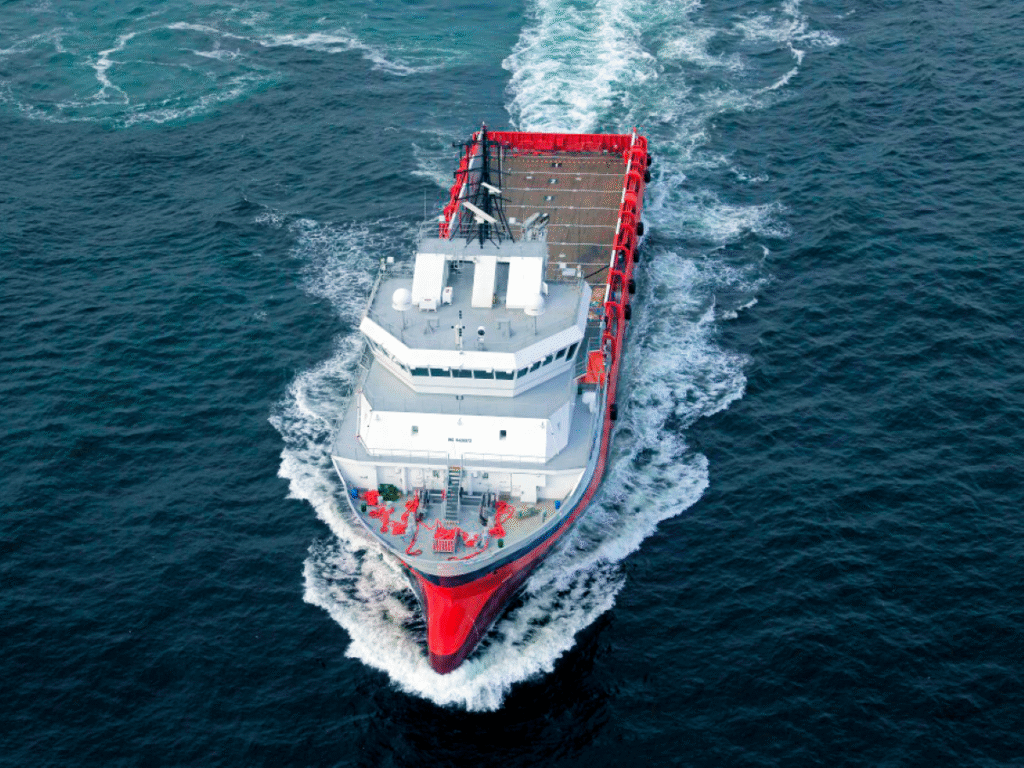
CBO Bianca (Source: CBO)
Yet the reaction of the equity market has been notably restrained. OceanPact’s share price, which had already appreciated in anticipation of consolidation in the sector, has not experienced the type of re-rating that often accompanies transactions of this magnitude. The explanation appears to lie not in the strategic logic of the merger — which is widely understood — but in the underlying economics of the two companies and in the structural realities of the offshore services business.
The valuation multiples that framed the transaction initially appear balanced. Market commentary surrounding the deal points to an implied valuation of roughly 5.3x EV/EBITDA for CBO compared with approximately 4.9x for OceanPact, figures that fall broadly within the range typically observed for offshore support vessel operators. Yet multiples alone rarely capture the deeper dynamics of capital intensity and cash generation that ultimately shape investor perception. Globally, offshore vessel operators seldom sustain valuations far above 6x to 7x EBITDA, even in favorable cycles, precisely because a meaningful portion of operating cash flow must continually be reinvested into fleet maintenance, regulatory upgrades and eventual replacement.
OceanPact’s financial profile prior to the merger already reflected the challenges of operating a diversified offshore services platform. The company’s integrated model — combining environmental response, subsea support and offshore logistics services — requires continuous reinvestment in specialized equipment and operational capabilities. Financial statements for recent periods revealed instances in which capital expenditures exceeded operating cash generation, resulting in negative free cash flow before financing. In a capital-intensive industry, that dynamic inevitably raises questions about long-term cash conversion.
CBO, by contrast, historically demonstrated stronger financial discipline. Its operations remained anchored in the traditional offshore vessel market, where fleet management and contract stability tend to produce more predictable financial outcomes. EBITDA margins near 50%, compared with approximately 30% for OceanPact, reflected both operational efficiency and the relative simplicity of a vessel-centric business model.
The merger therefore combines two companies with distinct financial characteristics. While CBO contributes stronger cash generation from its fleet operations, that discipline alone may not fully offset the capital demands embedded in OceanPact’s integrated services platform. The combined entity inherits broader operational capabilities, but it does not fundamentally alter the capital dynamics that investors have been scrutinizing.
Fleet structure adds another dimension to the equation. Although the merged company commands a larger number of vessels, the transaction does little to change the average age profile of the fleet, which remains in the mid-teen range. Offshore support vessels typically approach the limits of their economic life near thirty years, after which maintenance, propulsion upgrades and regulatory compliance requirements become prohibitive. With an estimated fleet age around 16 to 17 years, roughly half of the combined fleet may approach that threshold within the next decade. Even conservative replacement economics illustrate the scale of the issue. Replacing twenty vessels over time at prices between $30 million and $50 million per unit, typical for modern offshore tonnage, implies a long-term capital requirement approaching $600 million to $1 billion. And building takes time.
Source: Courtesy/CBO + Oceanpact
Neither OceanPact nor CBO has recently pursued a major program of new vessel construction. Fleet expansion in recent years has instead relied primarily on acquisitions of existing tonnage in the secondary market. While this strategy preserves capital in the short term, it also compresses the timeline for fleet renewal and increases dependence on maintenance investment to extend vessel life.
At the same time, the offshore market itself may be evolving in ways that complicate the strategic narrative surrounding integrated service platforms. For much of the past decade, the industry assumed that oil companies would increasingly favor bundled service solutions combining vessels, engineering and subsea operations. Yet the Brazilian market appears to be moving along a somewhat different trajectory. Petrobras has recently taken a more cautious stance toward certain integrated contracting structures. Activities such as pre-laid mooring systems for FPSO installations have increasingly returned to the domain of EPCI contractors or Petrobras’ own engineering resources, while the backbone of offshore logistics continues to rely on the familiar categories of offshore tonnage: PSVs, AHTS vessels, OSRVs, RSVs and PLSVs.
In this sense, the offshore market continues to function largely as a fleet-driven commodity business, where vessel availability, reliability and pricing remain the central competitive variables. That environment tends to reward the financial discipline associated with operators such as Tidewater, whose strategy emphasizes fleet efficiency, controlled capital expenditure and consistent free cash flow generation.
Integrated offshore platforms can certainly succeed, but historically they have done so when accompanied by substantial technological investment, as illustrated by companies such as DOF, which built their position through specialized subsea vessels and significant capital programs. The OceanPact–CBO combination appears to pursue a somewhat different path, expanding operational scope while relying primarily on existing fleet assets rather than embarking on a new generation of specialized vessels.
For investors, the central question therefore becomes less about the logic of consolidation and more about its financial implications. A larger fleet and broader service offering may strengthen commercial positioning, but scale alone does not automatically translate into improved economics. The market is ultimately asking whether the combined company will be able to convert its expanded operational footprint into consistent free cash flow after fleet investment and operational reinvestment.
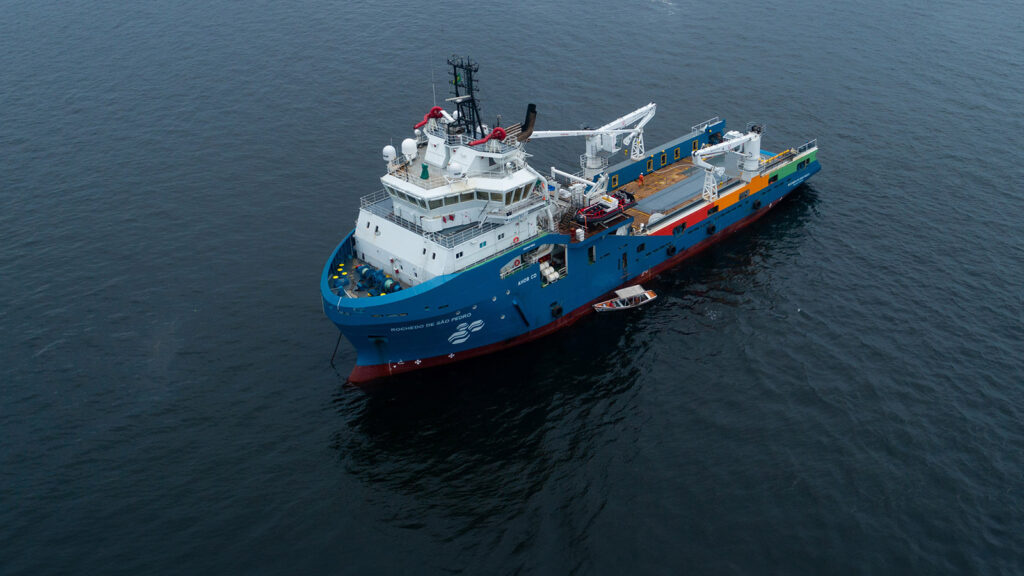
Rochedo de São Pedro (Source: Oceanpact)
Until that question is answered, the market’s restraint may be less a sign of skepticism than a reflection of experience.
In offshore services, larger fleets often signal stronger operational capability. But in the eyes of investors, value is measured less by the number of vessels a company controls than by the cash those vessels ultimately generate.
Tidewater Inc. announced the acquisition of 100% of Wilson Sons Ultratug Offshore Participações S.A. and Atlantic Offshore Services S.A. in an all-cash transaction valued at US$ 500 million, expanding its operational scale in Brazil’s offshore support vessel market.
The transaction includes a fleet of 22 Brazilian-flagged platform supply vessels, 19 of which were built in Brazil, positioning Tidewater as one of the main providers of Brazilian-built PSVs in the country. The acquired fleet holds an estimated US$ 441 million backlog, with approximately 88% linked to Petrobras contracts.
The acquisition will be financed through available cash and the assumption of approximately US$ 261 million in long-term debt provided by BNDES and Banco do Brasil, with an average annual cost of about 3.6%. Closing is expected in late Q2 2026, subject to customary regulatory approvals, including Conselho Administrativo de Defesa Econômica authorization and creditor consent.
Following completion, Tidewater’s global fleet is expected to reach approximately 231 vessels, including OSVs and other support assets, while its Brazilian fleet will expand from 6 to 28 vessels, becoming the third largest of the country. The company projects around US$ 220 million in annual revenue contribution from the acquired assets, with an estimated gross margin near 58% in the first year after closing.
The transaction reflects ongoing consolidation dynamics in Brazil’s PSV segment, where operators including CBO and other local players compete in a market shaped by scale, financing structure and Brazilian-built tonnage availability.
This will not be the last Merger & Acquisition (M&A) movement in the marine & offshore market in 2026.
Stay informed on key offshore developments — visit wsb-one. com, our data platform trusted by leading offshore companies.
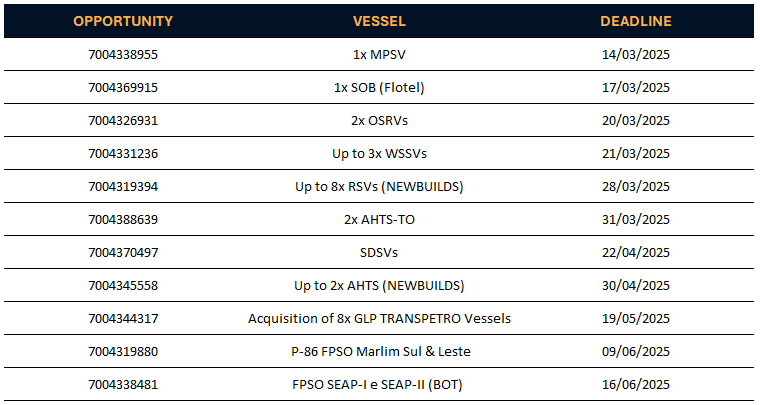
WSB is pleased to provide an update on the current long-term tenders that are open to offer.
Open tenders:
What has changed?
Petrobras 2x OSRVs: Opportunity 7004326931 new deadline Mar 20th, 2025;
Petrobras 1x MPSV: Opportunity 7004338955 still closes today 17:00h LT.
What else is happening?
A busy week full of good news. Brazilian market is on fire! 🔥
WSUT has started two 4-year firm PSV contracts with Petrobras.
Bramextended three contracts with Petrobras until the end of Q2 2025, started a PSV contract and is mobilizing several vessels that will soon be on hire.
The AHTS market is booming and CBO is dominating the spot market for Oil Companies with its Terra Brasilis series.
Camorim is ready to expand its strong presence in port support to the offshore sector as well. In addition to starting the Aegis contract and mobilizing the S178, they’re aiming to bring more vessels by taking advantage of their vast tonnage.
The 10x OSRVs newbuilding contract is still pending. What could be delaying it?
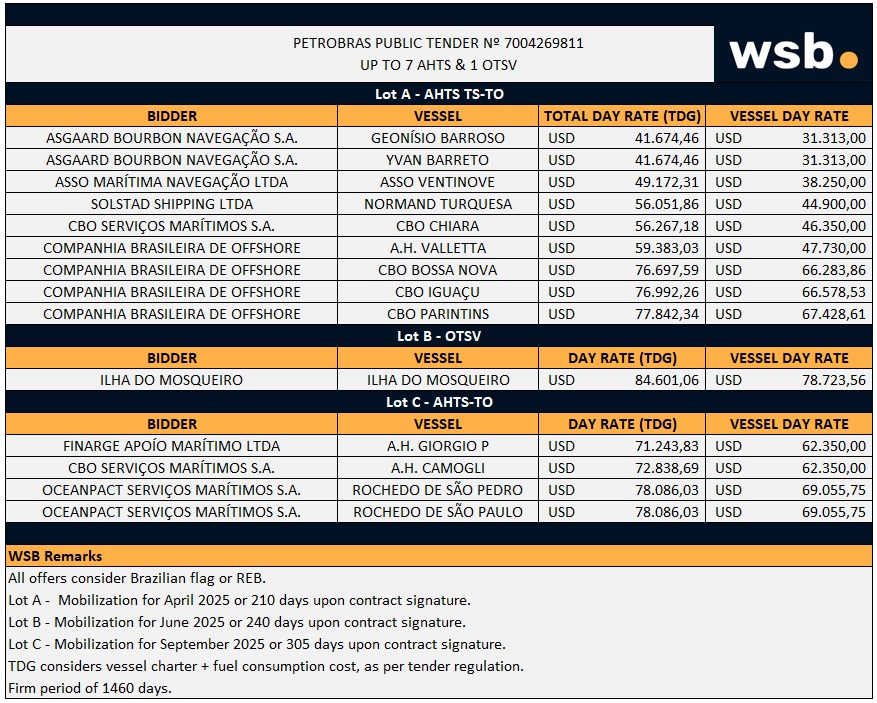
Petrobras closed the AHTS tender, with plans to hire up to 7 AHTSs and one OTSV. The amplitude on rates is worth noting.
TS: Asgaard with AHTSs offered at USD 31k, for comparison below the last OSRV average rates.
Asso Marítima Navegação Ltda (Augusta Offshore S.p.A.) just below USD 40k, with Solstad Offshore ASA and GRUPO CBO – Companhia Brasileira de Offshore in the mid-40s set the marketplace trend for now. CBO offered their largest AHTSs, out-priced for this category.
TO/OTSV: CBO and OceanPact Serviços Marítimos rates are not far apart for similar-sized AHTSs, mid to high USD 60’s. However, compared to the TS rates, they are nearly double and not far from the OTSV rate at USD 78k for a much more complex unit.
Results expertly compiled by the WSB Advisors team, bringing you the latest updates on this significant development.
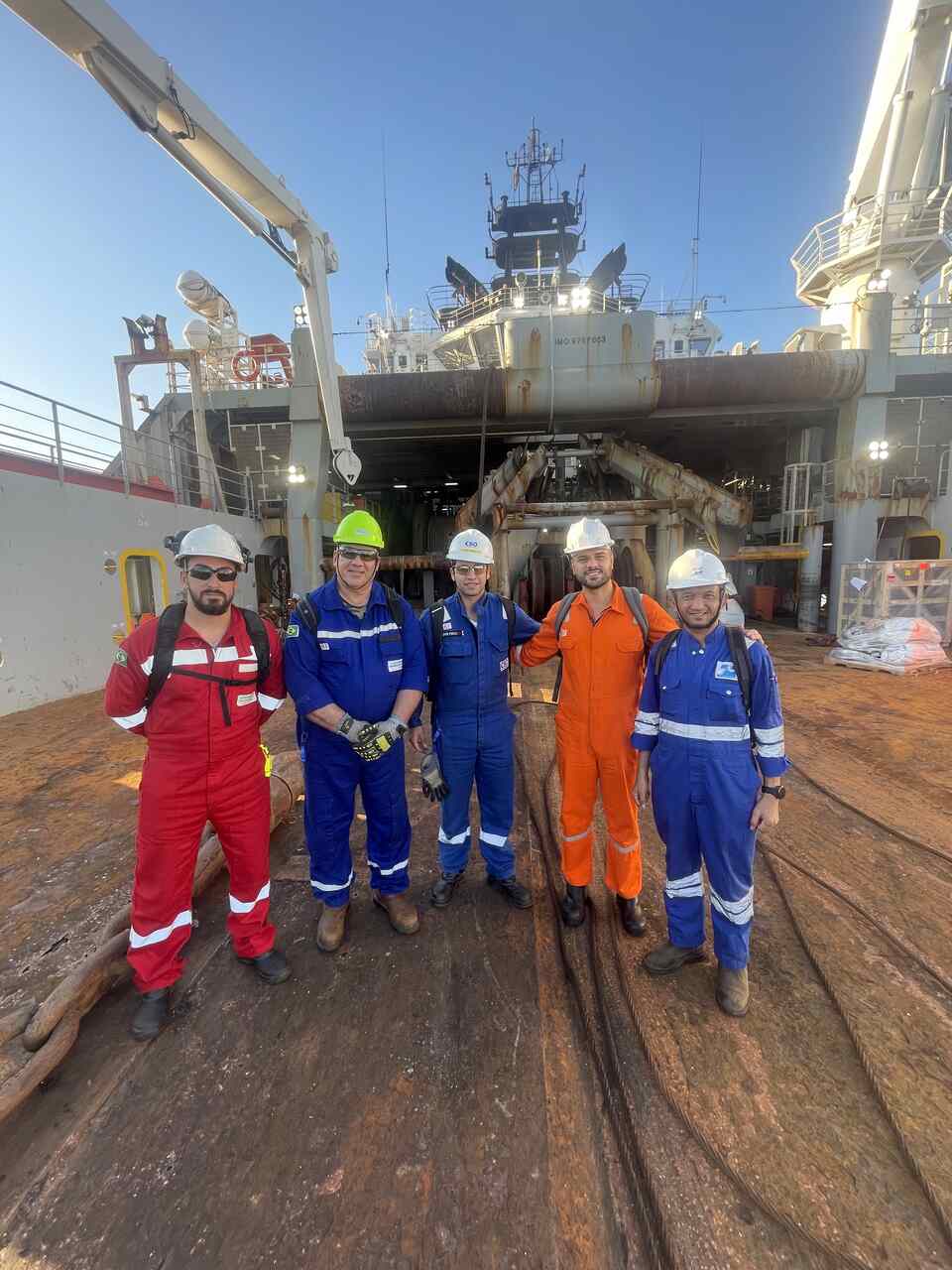
Integrated effort commissioned by MISC: CBO vessels AH Valletta and CBO Parintins have now been inspected and approved for the Sea Water Intake Riser (SWIR) installation at FPSO Marechal Duque de Caxias having Andre Oliveira and Marco Antonio Tejero as lead DNV MWS (Marine Warranty Surveyors), and Raphael Montes from WSB Advisors as Coordinator of the inspections.
Wärtsilä and Grupo CBO have signed an “Agreement for Decarbonization Modelling” aiming to support and accelerate the decarbonization of CBO’s offshore supply fleet. The scope of the agreement includes a detailed analysis of the potential benefits to CBO of short and long-term solutions. These include digitization, energy efficiency and energy saving devices, hybridization and future alternative marine fuels with a particular focus on the viability of fuel Ethanol. In connection with this announcement, Equinor informed this week that it has signed an agreement with CBO for the conversion of up to three PSVs to the hybrid model. The intention of the Norwegian major is to have the first vessel ready and adapted by the first quarter of 2023. According to CBO, the PSV CBO Wiser will be the first vessel of their fleet to go through such modifications and receive the battery packs.
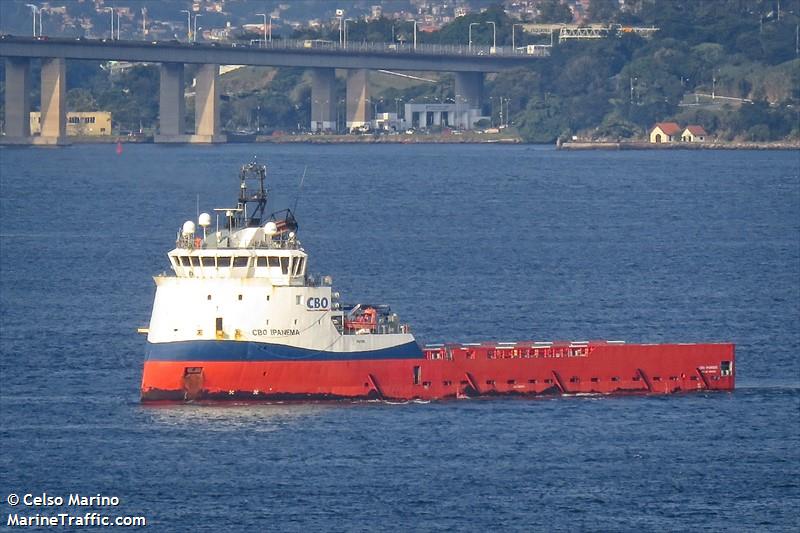
PSV 4500 CBO Ipanema has recently been awarded a long term contract with Enauta. She is currently under charter with Petrobras and upon conclusion will go on an adaption period in preparation for its new charter. The vessel will operate in Atlanta field which will soon have its expansion together with the arrival of Yinson’s FPSO Atlanta. CBO Ipanema was originally built for Petrobras’ fleet renewal program (Prorefam) and is concluding its 8 year charter.