Maritime officers and electricians employed by Oceânica have voted in favour of strike action after months of unsuccessful collective bargaining negotiations, marking a significant escalation in one of Brazil’s largest offshore support operators.
According to Sindmar, 97% of those attending the extraordinary general assembly approved the measure following the rejection of three company proposals. The union said Oceânica will be formally notified on Thursday, after which the legal procedures required before any work stoppage will be observed. Operations continue normally at this stage.
The dispute centres on food allowance levels, differences between offshore and shore-based remuneration, length-of-service recognition and other employment conditions.
While negotiations officially remain open, the vote significantly increases pressure on both parties to reach an agreement before industrial action affects offshore operations.
One Energy News has approached Oceânica for comment and will update this story upon receipt of the company’s position.
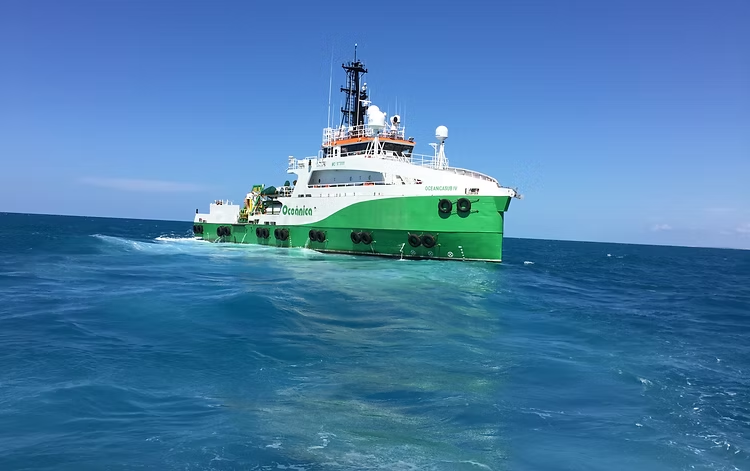
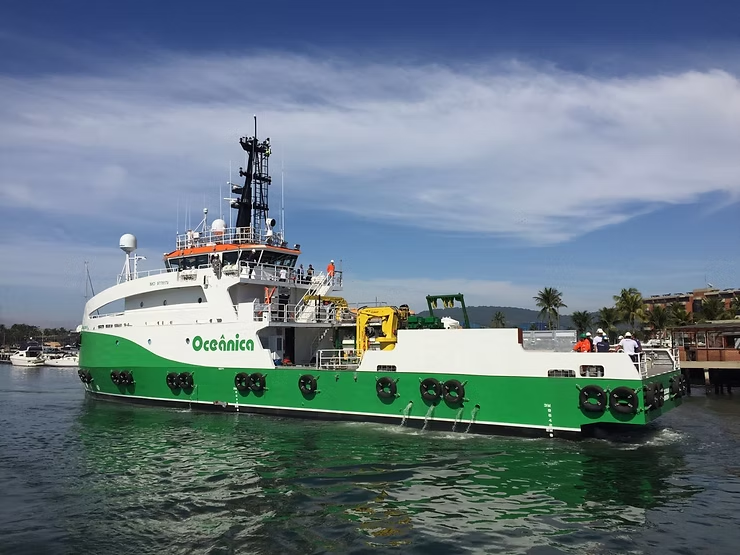
Oceânica Engenharia has signed a series of subsea service contracts with Petrobras totaling approximately US$736 million, according to company disclosures. Agreements have a four-year duration, with offshore operations expected to begin in the first half of 2027 and extend through 2031.
Contracts include renewal of charter agreements for several vessels in Oceânica’s diving support fleet, which will continue providing inspection, maintenance and subsea intervention services across Petrobras’ offshore production systems.
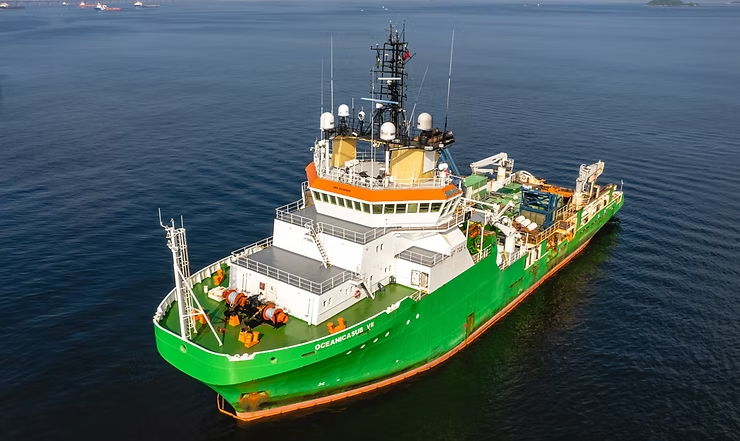
Oceanicasub VII (Source: Ocêanica)
Fleet scope
SDSV vessels (Shallow Diving Support Vessels): Oceanicasub IV, V, VII and IX
Services: inspection, maintenance and subsea intervention
Assets deployed: workclass ROVs, electric ROVs and diving systems
RSV segment: contract renewal for Oceanicasub VIII
Company also announced addition of Oceanicasub VI to its subsea fleet, expanding operational capacity.
According to Oceânica, agreements increase backlog to around R$12 billion. Earlier in January 2026, company had already secured contract for Oceanicasub XV, valued at approximately R$500 million.
Our view: What’s behind these developments
A new contracting cycle is underway
Brazil is entering a new subsea contracting cycle. A significant share of vessel contracts signed between 2018 and 2021 is reaching expiration between 2025 and 2027, triggering a wave of renewals and new tenders.
Market is now seeing:
renewal of existing vessel contracts
extension of ongoing offshore campaigns
gradual addition of new vessels
This cycle is expected to sustain demand for subsea support services through the end of the decade.
Pre-salt growth continues to drive demand
Expansion of infrastructure in Santos Basin remains the primary demand driver.
Each new development adds complex subsea systems, including:
subsea trees
manifolds
flowlines
injection and control systems
As this network grows, operators require continuous vessel support for inspection, maintenance and intervention.
Demand becomes structural — not tied only to new field start-ups.
Positioning of SDSVs
Recent tenders highlight consistent utilization of SDSVs (Shallow Diving Support Vessels) in shallow and mid-depth intervention scopes.
These vessels combine:
ROV capability
diving systems
direct subsea intervention capability
This configuration allows operators to execute maintenance campaigns with lower mobilization costs and faster response times, particularly for less complex intervention scopes.
Petrobras shifting back to longer contracts
Another clear trend is return to longer contract durations.
After a period of shorter agreements (2–3 years), recent tenders from Petrobras are increasingly structured around four-year terms or longer.
Longer contracts:
secure vessel availability
provide revenue visibility for contractors
support fleet upgrades and operational planning
Fleet expansion in a concentrated market
Brazil is consolidating one of the largest subsea support vessel clusters globally, concentrated in Santos Basin.
Key hubs include:
Búzios Field
Mero Field
Sépia Field
Atapu Field
Each new FPSO increases subsea complexity and reinforces long-term demand for vessel support.
Backlog reflects scale of the cycle
Oceânica’s R$12 billion backlog highlights scale and visibility of current cycle.
Multi-year contracts are providing:
predictable cash flow for contractors
sustained fleet utilization
support for continued offshore expansion
Brazil is consolidating its position as one of the largest global markets for subsea support vessels, supported by scale of its pre-salt infrastructure.
Oceanica has contracted with Norwegian shipyard Green Yard Kleven for the retrofit of two PSVs. The assignment consists of the convertion of two units for operations with ROV and offshore crane, commonly categorized in Brazil as RSV (ROV Support Vessel). The vessels, which are Marin Teknikk design MT6009, have recently been purchased by Oceanica. The first vessel is already at Green Yard Kleven, while the other will arrive at the shipyard in the next few days. Suitably, earlier this year Oceanica participated in Petrobras’ tender for the contracting of RSVs being placed first in two lots (A and D) after the reverse auction. For lot A, Oceanica shall provide a vessel with one Work Class ROV and a 10t capacity crane while lot D requires the same crane capacity but one additional ROV. It is anticipated however not yet officially confirmed that these vessels undergoing modifications in Norway are to fill in the awarded positions. In total, considering other two previously acquired vessels (Far Saga and Far Scout from Solstad) Oceanica has incorporated 4 foreign flagged vessels into their fleet.