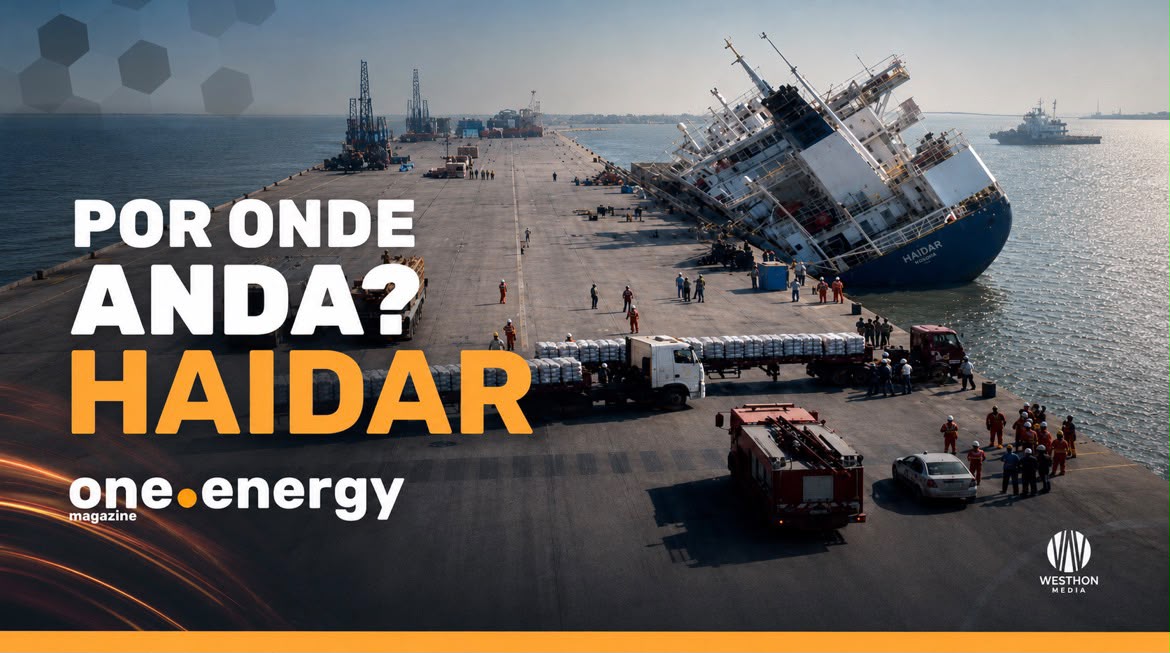
At around 8:45 a.m. on October 6, 2015, the Haidar, moored portside at Pier 302 in the Port of Vila do Conde, Barcarena, Pará, lost stability, listed and eventually sank. On board were nearly 5,000 live cattle bound for Venezuela. Although there were no human casualties, the accident became one of the worst socio-environmental disasters ever recorded in the state of Pará.
Built in 1994, the Haidar (IMO 9083067) sailed under the Lebanese flag and measured 116.96 metres in length, with a gross tonnage of 6,419. Originally built as a containership, the vessel was later converted into a livestock carrier. It was owned by Lebanese shipowner Hussein Ahmad Sleiman, operated by Tamara Shipping, and was carrying cargo belonging to Minerva S/A.
Nearly all of the animals drowned inside the vessel’s livestock pens, while an estimated 700,000 litres of fuel and diesel products spilled into the Pará River, contaminating beaches, aquatic ecosystems and disrupting the daily lives of riverside communities in Barcarena and Abaetetuba. The social impact was severe: beaches remained closed for weeks, local fishing activities declined sharply, and many residents temporarily left their homes for Belém and Abaetetuba to escape the overwhelming odour caused by the decomposition of thousands of animal carcasses.
In 2018, a Conduct Adjustment Agreement (TAC) secured compensation for affected families. However, another oil leak detected months later revealed that residual fuel remained trapped inside the wreck. An attempt to remove the vessel, awarded to Superpesa in 2019 under a BRL 44.6 million contract, also failed to move forward. The company was ultimately fined and suspended by Brazil’s National Department of Transport Infrastructure (DNIT) in 2022 for failing to complete the project. In the United Kingdom, a claim filed by the law firm Pogust Goodhead on behalf of more than 18,000 local residents against Salic (UK) Limited, an investor linked to Minerva, was dismissed in May 2026, not on the merits of the case, but over questions surrounding the legal standing of the claimants’ representation.
Por Onde Anda?
Ten years later, Haidar remains submerged at the same location in the Port of Vila do Conde. In November 2025, Brazil’s Federal Public Prosecutor’s Office (MPF) filed a new civil lawsuit seeking the permanent removal of the wreck, warning that as much as 215,000 litres of oil may still be trapped inside the hull. The MPF argues that the wreck continues to pose environmental risks while restricting port operations in the surrounding berths. While the Federal Court has yet to issue a final decision, Haidar remains on the riverbed, where it has been since October 2015.
The Future of Data Has Everything to Do with CDs and DVDs — Just Not the Way You Think
Project Silica and the Future of Cold Data Storage
By Romulo Bacchiega
CDs and DVDs use lasers to write and read information on a physical medium. Project Silica, Microsoft’s long-term storage initiative, does something conceptually similar: it uses laser pulses to encode data inside glass plates. The technology is entirely different, the scale is vastly greater, and the durability is in another league altogether, but the underlying principle remains the same: storing information in physical matter.
Image generated by AI (ChatGPT)
There is an interesting irony in the digital age. The more advanced our technology becomes, the more dependent we are on storage systems that require continuous maintenance. Hard drives fail, magnetic tapes degrade, and the cloud—while highly effective—still relies on vast physical infrastructure consuming significant amounts of energy and resources to keep data available.
The question remains remarkably simple: where do we store, safely and for the long term, the information that simply cannot be lost?
A Principle That Hasn’t Changed
For thousands of years, humanity has preserved knowledge by recording it on durable physical media. In the maritime industry, there is a fitting parallel. Archimedes’ principle, discovered more than two millennia ago, remains the fundamental law that keeps every vessel afloat, from ancient ships to modern FPSOs. Technology evolves, but certain physical principles remain timeless.
Project Silica follows the same logic: using the unique properties of glass to address a distinctly modern challenge—long-term digital preservation.
How It Works
Developed by Microsoft’s research team in Cambridge and detailed in Nature in February 2026, the technology uses femtosecond laser pulses to write data directly inside glass plates. These pulses create microscopic structures known as voxels, distributed across multiple layers within the material.
Image generated by AI (ChatGPT)
One of the project’s most significant breakthroughs was extending the technology from expensive fused silica to borosilicate glass—the same material commonly used in laboratory equipment and household cookware. Beyond the scientific achievement, this represents an important step toward commercial viability.
The numbers are impressive. A single glass plate just two millimeters thick can store up to 7 terabytes of data. Once written, the information requires no cooling, humidity control, or periodic migration, and the projected lifespan exceeds 10,000 years.
Cold Data: An Overlooked Challenge
Not every piece of information needs to be instantly available. In IT terminology, so-called cold data refers to information that is rarely accessed but must remain preserved and retrievable for decades.
For the energy, oil and gas, and marine sectors, this includes historical contracts, well records, seismic surveys, inspection reports, regulatory documentation, patents, and strategic intelligence. The volume of this information continues to grow, and so do the challenges associated with preserving it.
The issue is not simply storage cost. It is long-term reliability. Tapes deteriorate, disks fail, and cloud providers change policies, architectures, or business models. Ensuring data integrity over multiple decades remains one of the industry’s most persistent challenges.
There is also a growing factor that cannot be ignored: artificial intelligence. The rapid expansion of AI workloads is driving demand for larger data centers, greater computing capacity, and significantly higher energy consumption across the digital infrastructure ecosystem. As a result, technologies designed specifically for long-term archival storage are becoming increasingly relevant.
Project Silica was created precisely for this purpose. It is not intended to compete with high-performance storage systems. Instead, it aims to provide a reliable, ultra-long-term preservation layer with virtually no ongoing energy consumption.
Warner Bros. was among the first organizations to test the concept, storing the film Superman on a glass plate as part of a pilot project with Microsoft. The objective was straightforward: evaluate a storage medium capable of preserving large digital archives for extremely long periods without the operational burden of traditional infrastructure.
The Challenges Ahead
Despite its promise, Project Silica remains far from becoming a mainstream storage solution.
Writing costs remain high, data retrieval requires specialized equipment, and read/write speeds are nowhere near those of conventional storage technologies. In its current form, the platform is unsuitable for applications requiring frequent or real-time access.
However, technology history offers plenty of examples of innovations that began as expensive and impractical before becoming widely accessible through scale and maturation.
In February 2026, Microsoft officially concluded Project Silica’s research phase and indicated that the findings will contribute to future storage solutions within the Azure ecosystem.
Looking Forward
It would be premature to suggest that glass-based storage will become the dominant industry standard anytime soon. Significant economic and operational hurdles still need to be overcome.
But perhaps that misses the larger point.
The true significance of Project Silica lies in demonstrating that digital information can be preserved for millennia without continuous power consumption or recurring maintenance cycles. More than a product, it represents a new technological foundation for long-term data preservation.
Image generated by AI (ChatGPT)
Perhaps one day energy companies will be able to purchase archival storage services with century-scale preservation guarantees. Perhaps an organization’s most valuable information will no longer depend exclusively on active servers housed in climate-controlled facilities, but instead reside on silent glass plates designed to outlast generations.
Whether or not that future arrives exactly as envisioned remains to be seen. What science has already proven, however, is that such a future is possible—and that alone makes Project Silica worth watching.
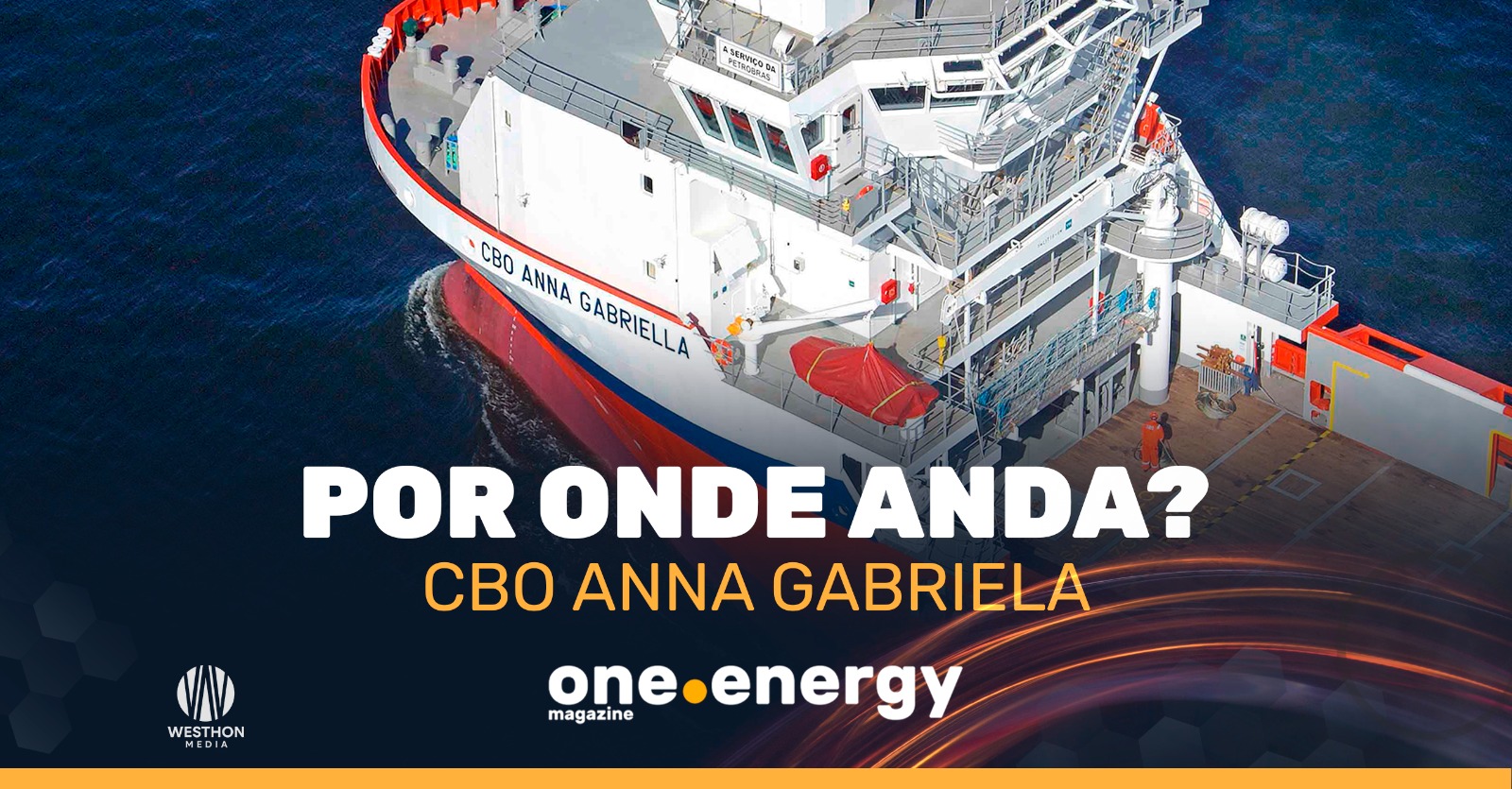
During the rapid growth of Brazil’s offshore industry in the 2000s, offshore support vessels became an essential part of the country’s operational backbone.
CBO Anna Gabriella was one of them.
Built in 2006 under IMO number 9364306, the vessel emerged during one of the most important expansion periods ever experienced by Brazil’s offshore industry. Constructed at Estaleiro Aliança, joined the Brazilian offshore market at a time when Petrobras operations were expanding rapidly across deepwater fields in the Campos Basin and beyond.
The vessel commenced operations for Petrobras shortly after delivery, becoming part of a generation of offshore support vessels that helped sustain the operational intensity of Brazil’s growing offshore sector.
At approximately 71 meters in length and with the robust profile characteristic of the Ulstein P-series designs, CBO Anna Gabriella was never built to attract headlines.
She was built to work.
And for years, vessels like her became essential links between ports, offshore bases, platforms, and supply chains operating far from the Brazilian coastline. While floating production units often captured public attention, offshore support vessels quietly handled the logistics that made those operations possible.
That is precisely what makes vessels like CBO Anna Gabriella so representative of an important chapter in Brazil’s marine and offshore history.
They were not necessarily the largest vessels offshore. But they were among the most necessary.
Today, however, public AIS activity involving the vessel appears significantly quieter than in previous years. Open vessel tracking platforms indicate limited recent movement, with the vessel still referenced in maritime databases and remaining listed as active and commissioned under the Brazilian flag.
Industry observers suggest the vessel may currently be between contracts after many years supporting offshore operations.
And perhaps that is what makes her story even more interesting.
Because unlike many offshore vessels that completely disappear from records, CBO Anna Gabriella still remains present — carrying with her the memory of a generation of Brazilian-built support vessels that helped sustain one of the largest offshore development cycles in the South Atlantic.
So the question remains.
Where is CBO Anna Gabriella now? Waiting for a new offshore assignment? Preparing for another operational chapter? Or simply resting quietly after years supporting Brazil’s offshore industry far from shore?
For now, the answers remain somewhere between ports, databases, memories, and the constant movement of the offshore world.
But one thing remains certain.
Vessels like CBO Anna Gabriella helped build the operational backbone of Brazil’s offshore industry — even when few people noticed.
The offshore industry has lost one of its true pioneers.
Johannes Solstad, founder of Solstad Offshore, passed away peacefully at nearly 96 years of age — leaving behind a legacy that helped shape the modern offshore shipping industry.
His life story mirrored the evolution of Norwegian maritime history itself.
From sailing as a chief officer on transatlantic passenger routes between Norway and the United States, to serving as a merchant fleet captain and later founding Solstad Rederi at just 34 years old, Johannes Solstad belonged to a generation that transformed maritime entrepreneurship into global offshore leadership.
As Norway’s offshore era emerged alongside the development of the North Sea oil industry, Solstad became one of the companies that helped define the sector’s operational standards, vessel capabilities, and long-term vision.
What stands out most, however, is not only the scale of the company he built — but the fact that, until very recently, he still maintained a genuine daily interest in vessels, seafarers, operations, and the market itself.
That kind of connection to the industry cannot be manufactured. It comes from a lifetime at sea.
At WSB Advisors, we recognize the importance of figures like Johannes Solstad to the global marine and offshore community. Leaders whose stories became part of the industry’s own history.
Our thoughts are with the Solstad family, friends, and the entire Solstad organization during this moment of loss.
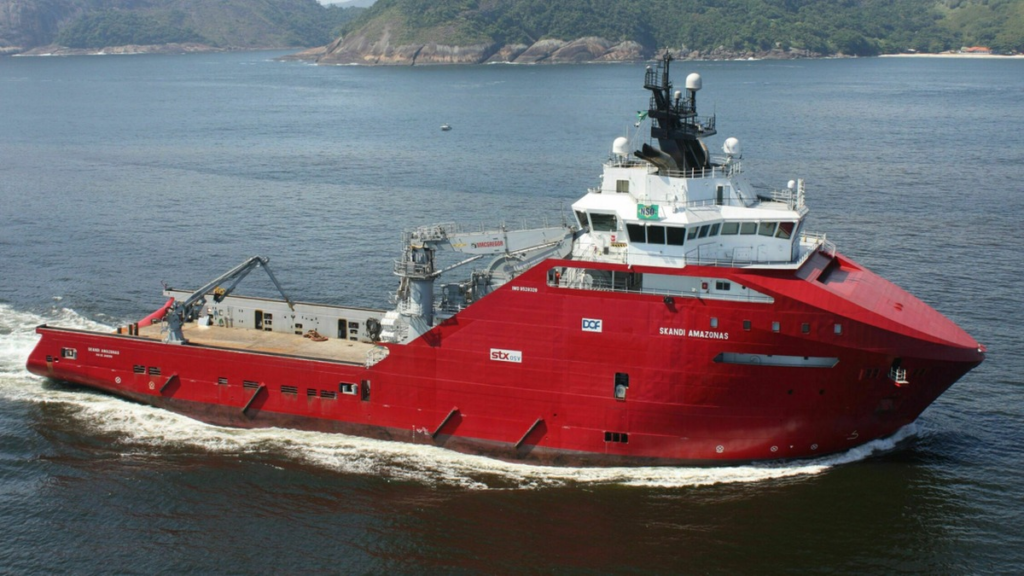
A vessel that deserves more respect than speculation
Some vessels become known because they disappear from the radar, change names, lose purpose, or end up as footnotes in the offshore market.
Skandi Amazonas is the opposite.
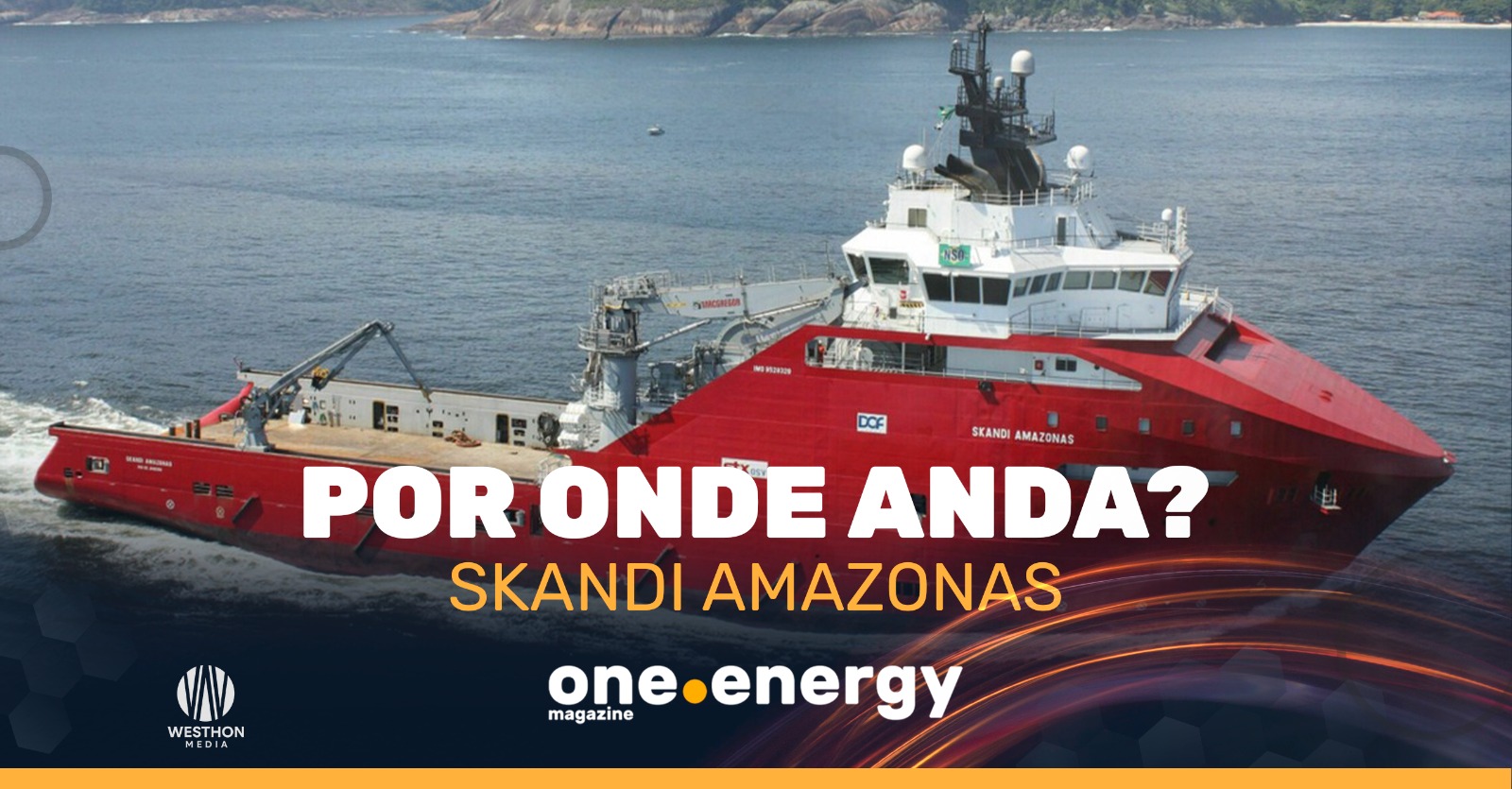
This is not a story about a forgotten vessel. It is a story about one of the most remarkable offshore support vessels ever built in Brazil — and about a crew that, when faced with a real emergency, did exactly what highly trained seafarers are expected to do.
I have a personal connection with this vessel.
I was there when Skandi Amazonas was built, at the shipyard then known as STX Brazil, on Ilha da Conceição, in Niterói. I worked in the Supply Chain department and was directly involved in procurement, inspections, equipment deliveries, and the complex chain of systems and materials that gradually transformed steel plates into one of the most powerful AHTS vessels ever delivered by a Brazilian yard.
I saw the vessel take shape from the beginning: steel cutting, block assembly, launch, outfitting, commissioning, sea trials, and delivery to DOF Navegação in 2010.
At the time, Skandi Amazonas was a Brazilian shipbuilding milestone. At 95 meters in length, with 300 tons of continuous bollard pull, hybrid diesel-mechanical-electric propulsion, DNV class, and a design developed by STX Norway Design, she was not an ordinary vessel. During trials, she exceeded her own specifications, reaching a maximum bollard pull of 343 tons.
More importantly, she then went to work.
For more than fifteen years, Skandi Amazonas operated in Brazil doing exactly what she was built to do. Quietly, consistently, and under some of the most demanding offshore conditions in the world. In plain language: she became a battle horse.
Then came the incident near Macaé.
The vessel reportedly struck a rocky formation near the Santana Archipelago while approaching the anchorage area. The hull was damaged, water ingress followed, and the situation required immediate decision-making.
Skandi Amazonas (Source: DOF)
That is where the tone of the story should change.
What some people rushed to describe as failure may, in fact, become a case study in emergency response.
The master diverted the vessel to a safer position and executed a controlled grounding maneuver to prevent a worse outcome. Non-essential personnel were evacuated. Essential crew remained on board. There were no reported injuries. No pollution was recorded. The vessel remained under control.
This is not luck. This is training.
And it is precisely here that the public narrative around the incident became unfair.
In the days that followed, social media did what social media usually does: it converted a complex maritime event into simplified outrage. Some used the episode to speak about royalties. Others used it to attack offshore activity. Some tried to turn it into a labor issue. Others treated the image of a grounded vessel as proof of systemic negligence.
That is not serious analysis.
Offshore operations are not risk-free. They never were. Ships are not supposed to hit rocks, just as aircraft are not supposed to encounter runway excursions and cars are not supposed to crash. Yet incidents happen in every serious industry involving machines, weather, human judgment, geography, and operational pressure.
The question is not whether an incident occurred.
The question is what happened after it occurred.
And in this case, what happened after the incident was exactly what should happen: command decision, emergency procedure, evacuation of non-essential personnel, preservation of life, environmental control, technical assessment, and mobilization of support resources.
That is the part many people chose not to see.
The causes still need to be investigated. Was there an issue with charted seabed information? Did tide conditions play a role? Was the vessel returning through the same safe track previously used? Was there a navigational error, a distraction, or a combination of factors? These questions belong to the formal investigation — not to social media tribunals.
Until then, speculation is not expertise.
There is also an important point about DOF.
Anyone who knows the offshore market knows that DOF is not a casual operator. It is one of the most respected names in the sector, with high standards on board, strong safety culture, and a long track record in complex subsea and offshore operations. To use this incident as a shortcut to attack the company, the crew, or the profession says more about the critics than about the facts.
Working offshore is demanding. It requires discipline, competence, and resilience. But it is also a profession supported by rules, training, classification standards, audits, emergency procedures, and a level of operational structure that many land-based activities simply do not have.
Let us be honest: is the controlled evacuation of a well-managed offshore vessel, with trained personnel, support craft, emergency protocols, and no pollution, necessarily more dangerous than a truck driver crossing the Rio–São Paulo Dutra at night? More dangerous than driving through Linha Vermelha? More dangerous than the daily risks people accept without reflection on Brazilian roads?
Risk exists everywhere. The difference is that offshore, risk is managed professionally.
The sea can be dangerous. So can a highway. So can a construction site. So can, frankly, a bathroom shower on the wrong day. The presence of risk does not make an activity reckless. It makes competence essential.
And competence was visible here.
Skandi Amazonas hit a rock. That should not have happened. But once it did, the response protected lives, prevented pollution, and preserved the vessel for recovery and repair.
That matters.
This vessel was proudly built in Brazil. It was a complex project, extremely well executed, and it has served the Brazilian offshore industry for more than a decade and a half. It deserves better than lazy conclusions.
Skandi Amazonas will be assessed, repaired, and returned to service if technically viable. As it should be.
She had no disaster named after her. No inquiry. No memorial. No court case running twenty years later. Just steel. Just sea. Just oil — for decades, in 300 meters of South Atlantic waters.
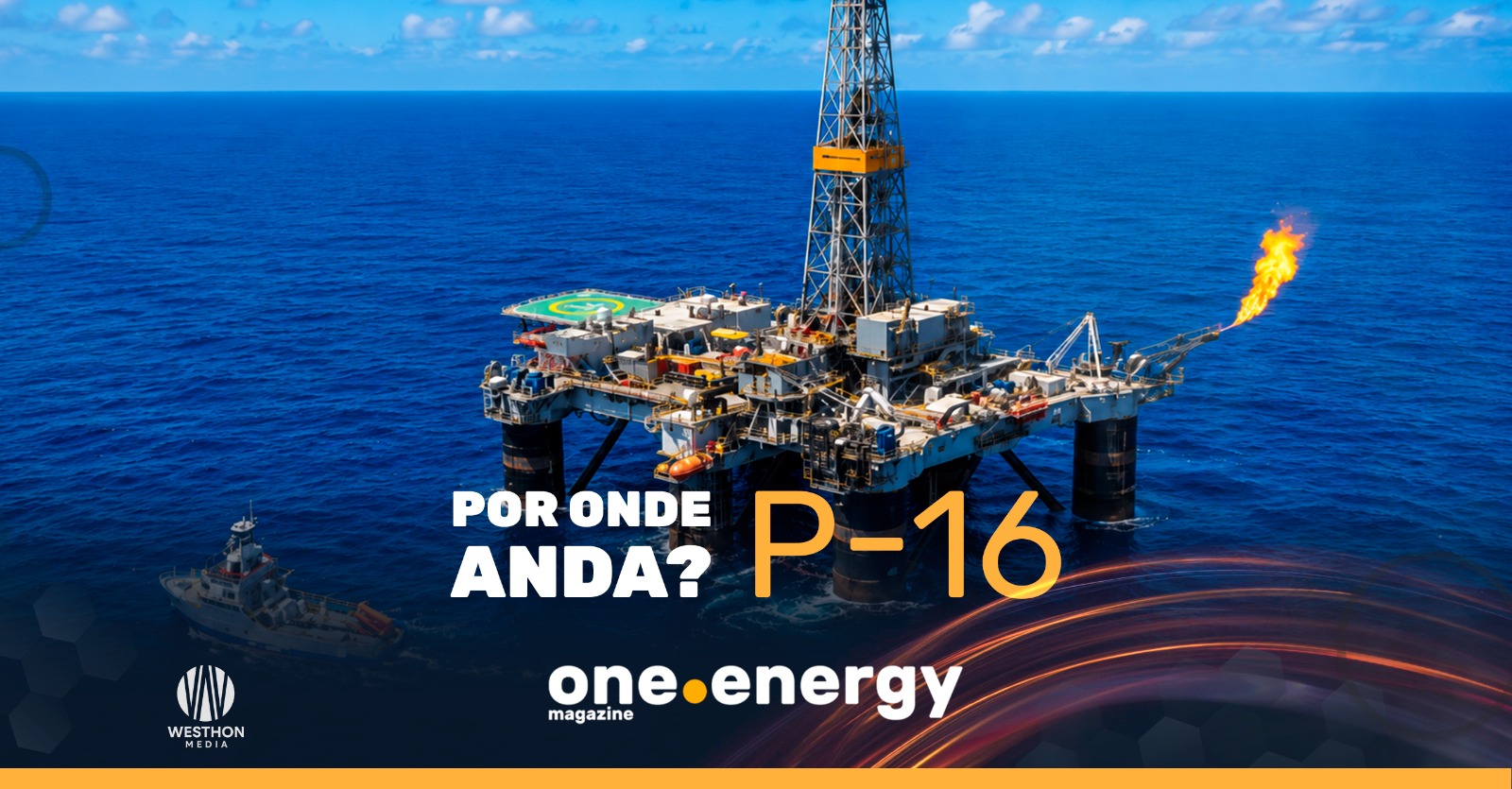
Platform P-16 — Petrobras XVI — was a semi-submersible of the pioneering Roman-numeral generation that quietly built Brazil’s offshore industry. Processing up to 20,000 barrels a day. Displacing 18,000 tonnes of seawater. Floating on two submerged pontoons, anchored to the Campos Basin floor, holding position while the South Atlantic did its worst.
She was a laboratory as much as a platform. Flexible risers tested on her flanks. Subsea manifolds connected below her. Engineering knowledge that would later carry Brazil into 1,500 meters — into 2,000 — into the pre-salt layer that changed global energy.
She didn’t go there. But the engineers who did learned their craft on her.
In 2017, Petrobras auctioned her alongside six sister platforms at the Port of Aratu, Bahia. Seven units. US$ 83.5 million combined. The P-16 left with a new owner, without her name, headed most likely to a breaking yard.
An estimated 10,000 tonnes of steel. Returned to the market. Recycled into other things.
Where is P-16 now?
She isn’t anywhere. She is everywhere steel goes when the sea is done with it.
— WSB Advisors tracks the vessels the industry forgets.
There’s a scene that has become routine in the corporate world. You’ve probably seen it. Maybe you are that guy. The other day, I was sitting at a crowded airport terminal — the kind that smells like bad coffee and collective anxiety — when I noticed an executive cutting across the hall with that fast, purposeful walk of someone who believes he’s saving the world. Suit perfectly fitted, shoes polished, what looked like a Rolex on his wrist — the kind that doesn’t just tell time, it tells people you’ve “made it.” Phone glued to his ear, another screen buzzing in his hand, and then the line, delivered almost automatically: “This week is chaos… I have no time for anything.” — and I just thought: of course.
What struck me wasn’t the chaos. It was the pride. There was something almost satisfying about it, as if exhaustion itself had become an achievement. That’s exactly what it was: a quiet proof that he was too important to have time.
For a long time, this is how we learned to recognize success. It came with visible signals — cars, watches, travel, hotels. Things that didn’t need explanation. You just knew. Always busy. Always solving. Always putting out fires. Not necessarily in debt, but almost always under pressure, living with the constant feeling that if he stops, something will fall apart. Over time, this stops being a phase and becomes a personality. Chaos becomes necessary, because chaos validates, urgency validates, overload validates. It’s as if someone has to hold the world together — and, of course, that someone always ends up being… you know.
Source: Pixabay
The corporate narcissist is still there, but he’s no longer necessarily the most put-together person in the room. A different profile has started to emerge — someone who doesn’t look busy all the time, who doesn’t keep repeating how overloaded they are, and who doesn’t need to prove every five minutes that they’re indispensable. At first, that’s uncomfortable, because it breaks the script. This person doesn’t talk about a packed schedule. They’re simply not available all the time. They train, they sleep, they disappear when needed. And, contrary to what common sense used to suggest — and in some places still does — this doesn’t make them less productive. It makes them less chaotic.
2026 trends are already reflecting this shift. Reports from Bain & Company and Exame point to luxury moving away from display and into what is now called “quiet luxury”: premium athleisure like Lululemon and On Running, Louis Vuitton spas, curated retreats. Brands have figured out that the ultra-wealthy are spending more on recovery than on possessions. Wellness has become the new Rolex. And in business, this is no longer a trend — it’s a requirement. Regulations like NR-01 now place mental health and fatigue management at the center of operations, because exhausted teams miss checklists, misread data, and turn fatigue into operational risk. Exercise is no longer a hobby — it sharpens focus, reduces errors, and can increase productivity by 20–30%, as recent studies suggest.
Fitness culture has become the billboard of this new luxury. Not because of aesthetics, but because of what it signals. The person showing up at a high-end gym at 7 a.m., wearing premium gear, isn’t just working out. They’re communicating something much deeper: they control their schedule, they don’t live at the mercy of chaos, they have time. And today, time is rarer than money.
While many people spend their days reacting, a few are actually designing their days. While many claim they don’t have time, others simply refuse to live without it. In the end, this isn’t about money not mattering. It does. Money is what gets you into the game in the first place. But for a long time, we confused having money with looking like we had it. People leveraged themselves to the edge just to display success — watches, cars, lifestyles built more on pressure than on stability. That version still exists, but it’s not the one that lasts.
Because real wealth doesn’t just show up in what you can buy. It shows up in what you don’t have to prove anymore. The person who truly has money doesn’t need chaos to justify it, doesn’t need to look busy to feel important, and doesn’t need to trade all their time just to sustain the image. They have something much harder to fake: balance — the ability to generate, sustain, and protect, financially, physically, and mentally. Because having money and having control are not the same thing. And the second is what determines whether the first actually means anything.
Time doesn’t show up. Time is imposed. And the people who can impose it usually aren’t the ones trying to look rich. They’re the ones who actually are.
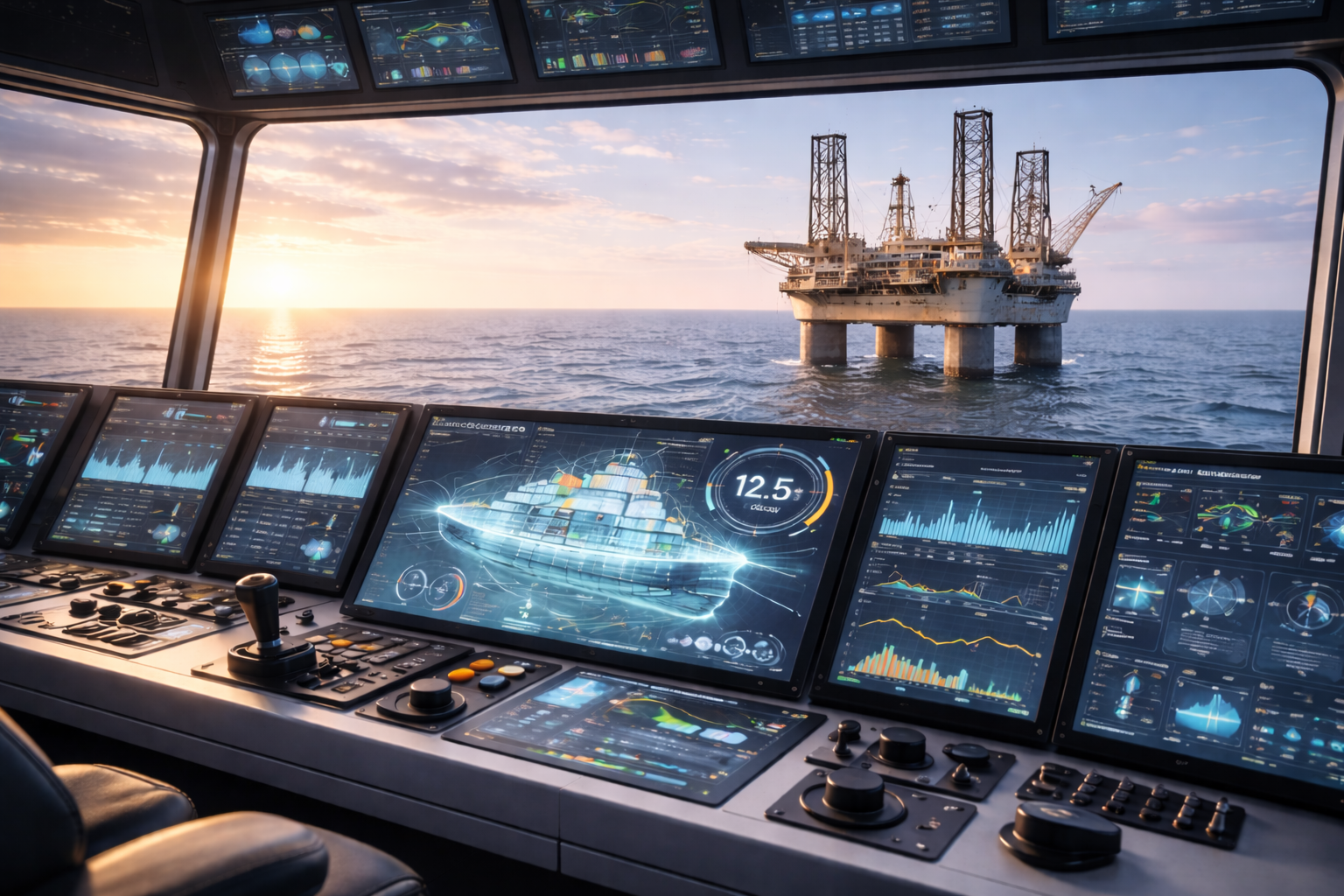
In offshore operations, fuel consumption and energy demand are high-impact costs—well-known and often dreaded fixtures of any OPEX spreadsheet. The novelty today lies not in identifying these costs, but in how we manage them. Energy efficiency, which for a long time lived in the realm of aspirational goals—or served merely as “eye candy” for sustainability reports—has undergone a reality check. With the tightening of IMO regulations, what was once a marketing narrative has become a technical prerequisite for commercial viability. Today, an asset is either efficient, or it becomes a financial and environmental liability.
At the heart of this transition, next-generation automation systems are doing the heavy lifting. Solutions like Wärtsilä’s Fleet Optimisation Solutions (FOS) exemplify this shift by integrating data intelligence into physical navigation. By cross-referencing variables such as weather, currents, and real-time hull performance, the system enables route management that prioritizes actual fuel savings over theoretical estimates. On the electrical side, systems like Metizoft Powersave target the invisible waste within auxiliary loads. By controlling the frequency of motors and pumps, the technology ensures that the load on the auxiliary engines is strictly proportional to the operational demand, directly reducing the fuel burn that significantly impacts the year-end balance sheet.
Direct Impact on OPEX: Precision in Every Cent
When analyzing the implementation of these technologies, the focus remains squarely on cost reduction. Fine-tuning auxiliary systems—components that have historically run at full capacity even under minimal demand—can yield fuel savings between 5% and 15%. According to industry performance benchmarks and data from manufacturers such as Metizoft, while these figures vary based on the vessel’s operational profile, they represent a direct recovery of profit margins that were previously dissipated through unnecessary mechanical effort.
Compliance and Asset Attractiveness
Adherence to international regulations is often viewed as an administrative burden. However, integrated systems transform compliance into a passive process. By automating the collection of performance data, technology acts as a guardian of regulatory standards (such as the CII), streamlining audits and reporting. Furthermore, in the chartering market, end-clients are increasingly scrutinizing the carbon footprint of their sub-contractors. A technologically superior vessel is a lower-risk asset, translating into better utilization rates and longer-term contracts.
Strategy Beyond Engineering
Investing in energy management is no longer about adopting experimental tech; it is about integrating proven solutions that address immediate economic challenges. The high-performance offshore market no longer accepts waste as a “cost of doing business.” When energy management systems take center stage, the conversation shifts from purely technical specifications to strategic financial management.
Looking at the bridge and the engine room through the lens of efficiency is the first step in ensuring an asset remains competitive in an increasingly demanding landscape. However, the intelligence that optimizes consumption at sea is only half of the equation. In our next column, we will explore how this same data foundation is allowing operational control to transcend the physical limits of the vessel, connecting the onshore office to the heart of the asset in real time.
Event brought together naval sector executives at Fogo de Chão in Botafogo to discuss decarbonization, geopolitics, and new IMO requirements
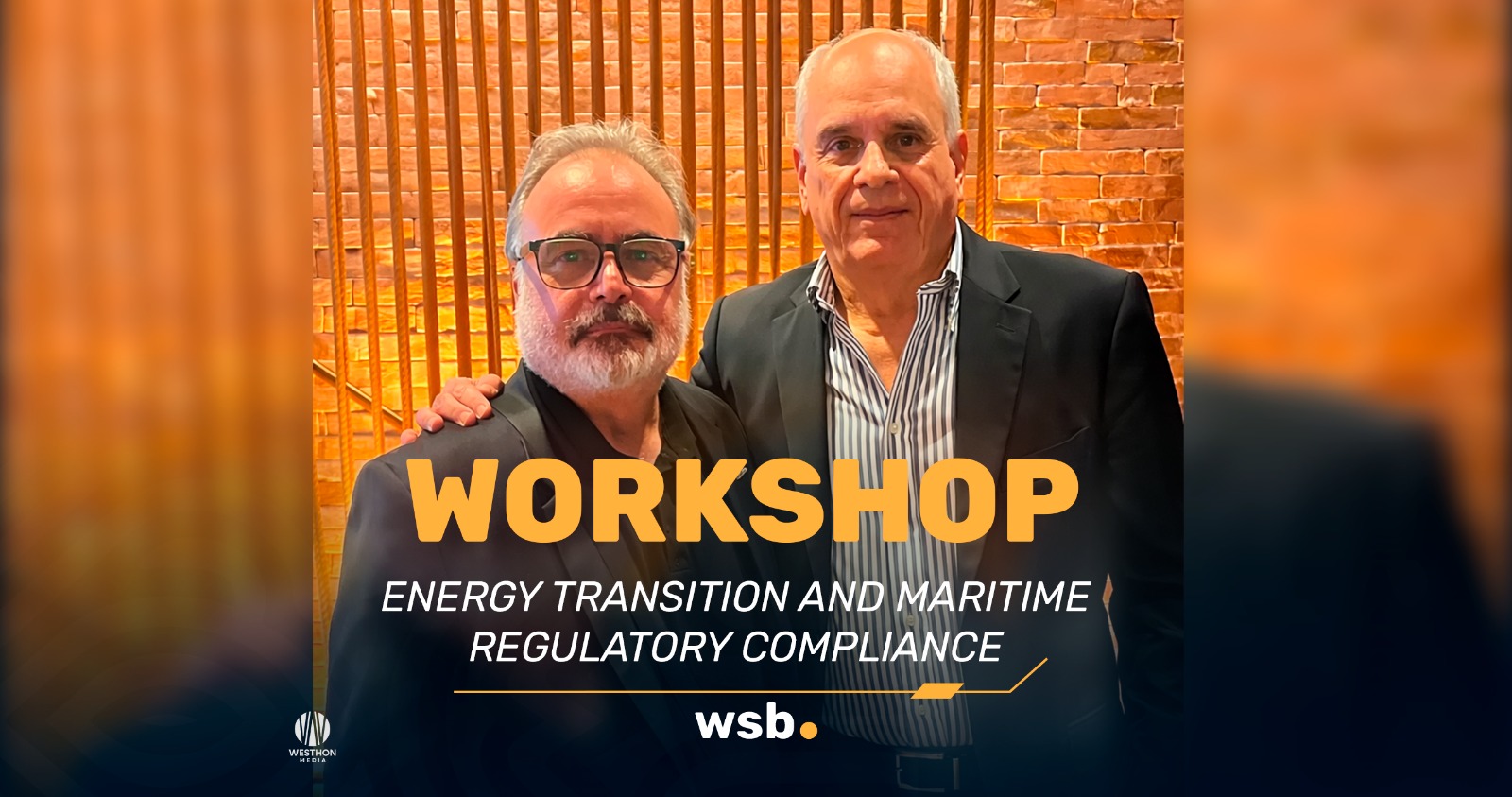
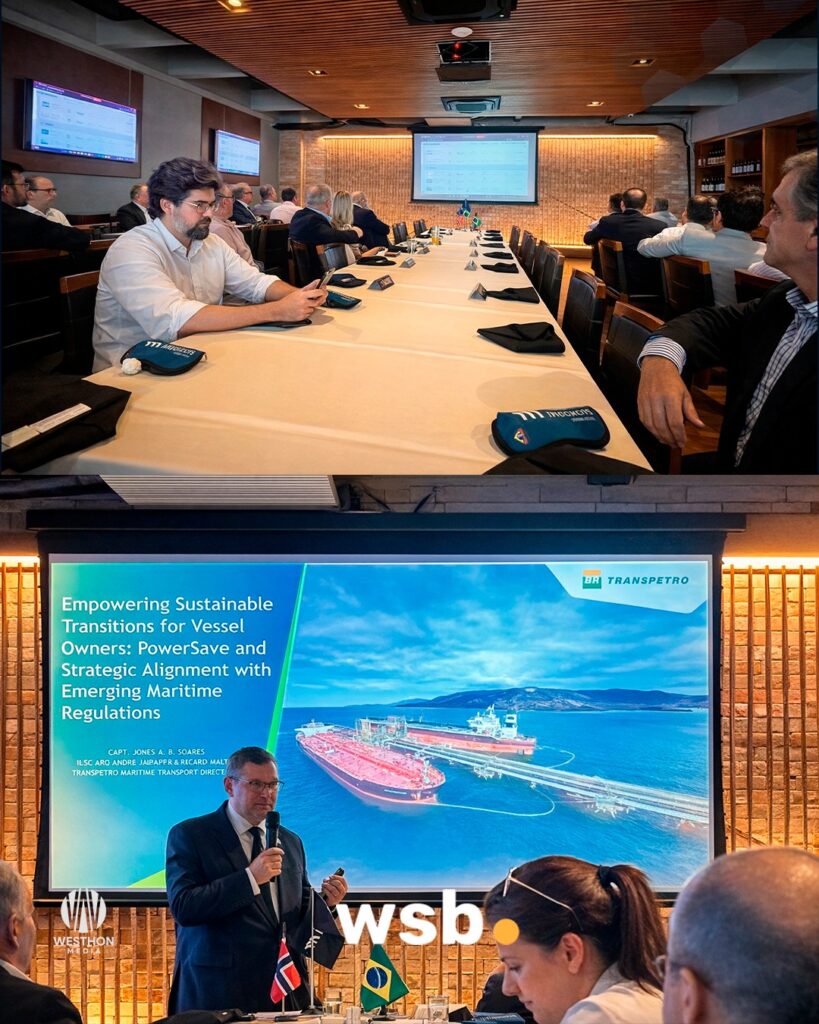
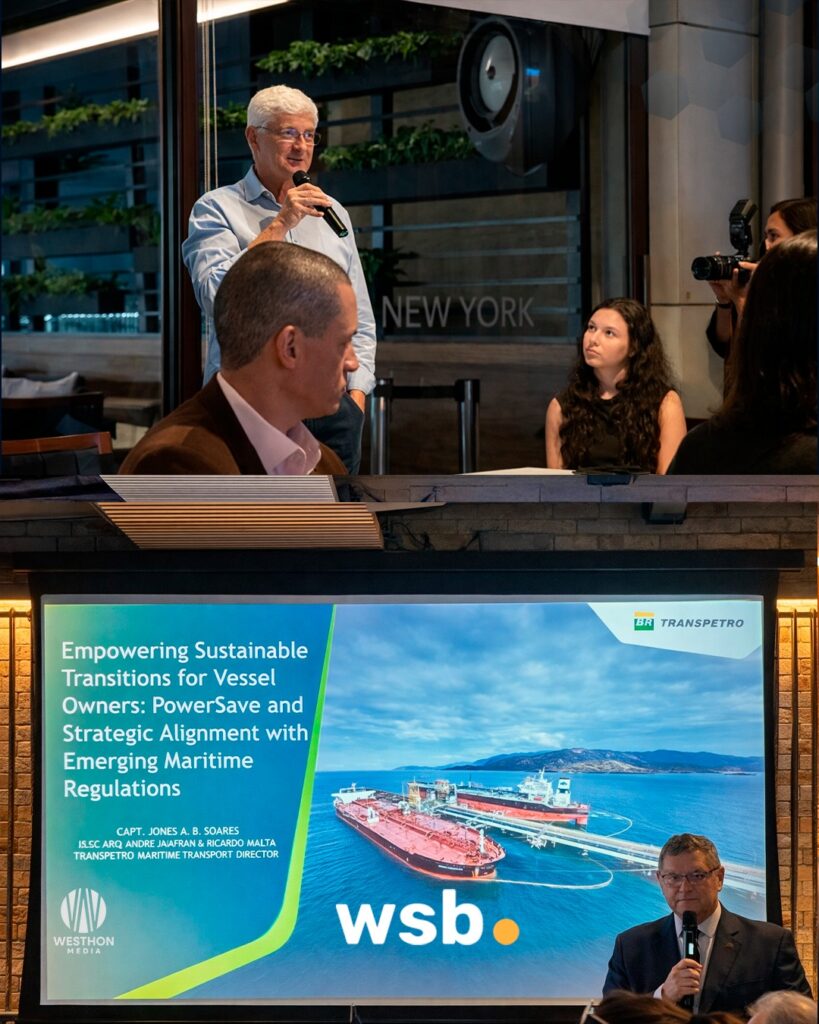
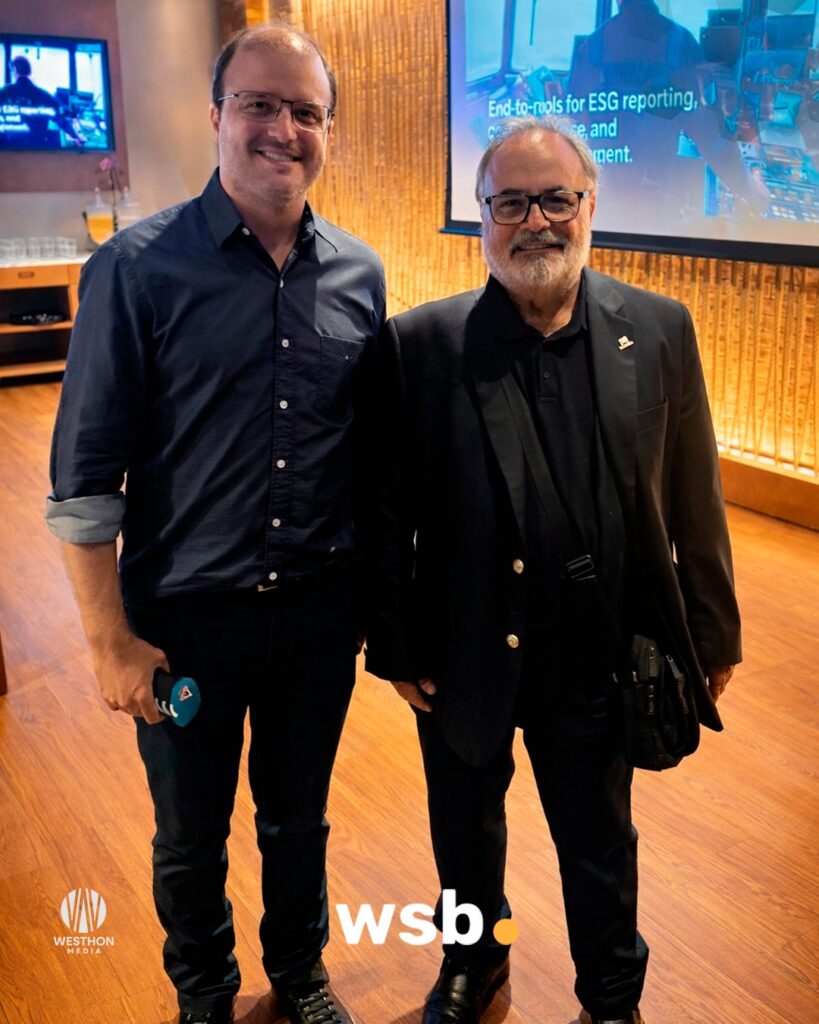
On the evening of March 12th, WSB Advisors was present at the workshop “Promoting a Sustainable Transition for Shipowners and Charterers: Metizoft PowerSave and Strategic Alignment with New Maritime Sector Regulations,” hosted by Vitor Máximo of Norwegian company Metizoft. The event gathered prominent executives in one of the rooms at the renowned Fogo de Chão restaurant in Botafogo, Rio de Janeiro.
The agenda was substantive and well-managed, balancing technical presentations with strategic discussions about the challenges shipowners and charterers will face in the coming years—and in many cases, are already facing today.
A Tool for the Times We Live In
Metizoft opened the proceedings by presenting PowerSave, their online platform designed for energy management, fuel consumption control, and pollutant emissions monitoring on cabotage and offshore vessels. Through a real-time visual demonstration, attendees were able to follow the tool’s functionalities and, above all, its ease of use—a decisive factor for adoption by shipowners.
The Weight of Regulation
Next, Commander Fernando Alberto of the Brazilian Navy delivered a presentation on the implications of IMO resolution MEPC.377(80), adopted in 2023 as part of the global fleet decarbonization program through 2030. It was a necessary discussion, still laden with practical questions about its implementation.
Geopolitics, Oil, and Innovation at Sea
Captain Jones A. B. Soares, director of maritime transport at Transpetro, delivered one of the most anticipated presentations of the evening. With a comprehensive and well-grounded perspective, Jones contextualized the current geopolitical landscape—including the impacts of the Middle East conflict on the oil supply chain and long-term price projections in the international market.
He also presented an overview of Transpetro’s current fleet and shared a thought-provoking figure: maritime transport accounts for approximately 3% of global pollutant emissions. While a small slice, it’s one the sector has been working to reduce. Jones highlighted the advances already achieved by the company, including new hull designs, the use of cutting-edge anti-fouling paints, and the adoption of onboard equipment with lower energy consumption—technologies that, together, are already changing the fleet’s consumption profile.
Networking and Closing
To close out the evening, guests were invited to a relaxed networking cocktail hour, which allowed for deeper conversations begun during the presentations and strengthened connections within the sector. In attendance were several important names in shipping, including engineer Djalma from Transpetro, Commander Resano from Syndarma, and members of FIRJAN and the Naval Technology Cluster.
Engineer Paulo Rolim, consultant and board member at WSB Advisors, and Romulo Bacchiega, head of content and sales at Westhon Media, left the event with the clear sense that the energy transition in the maritime sector is no longer a future discussion—it’s happening now, with regulations in force, technologies available, and decisions that need to be made. Being present at these gatherings, alongside the key players in the naval market, is an essential part of our commitment to closely monitoring the transformations shaping the market in which we operate.
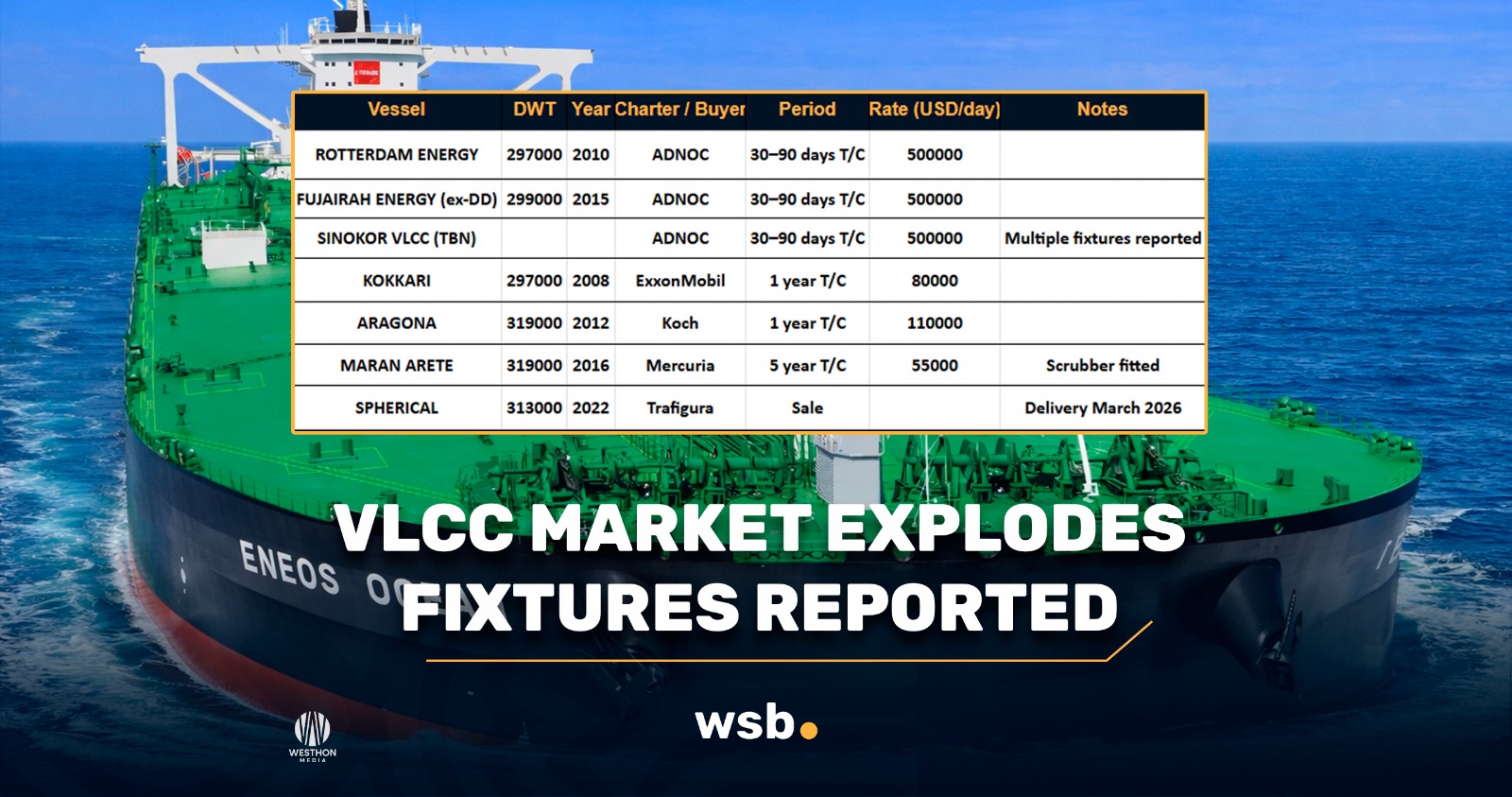
The VLCC freight market has entered extraordinary territory, with several short-term fixtures reportedly concluded at US$500,000 per day for periods of 30–90 days.
Much of the activity appears linked to ADNOC Group, suggesting a sudden tightening in available prompt tonnage.
Short-term fixtures reported
* ROTTERDAM ENERGY (297k dwt, 2010) – 30–90 days T/C to ADNOC @ US$500,000/day * FUJAIRAH ENERGY ex-DD (299k dwt, 2015) – 30–90 days T/C to ADNOC @ US$500,000/day * SINOKOR VLCC (TBN) – several fixtures reported @ US$500,000/day
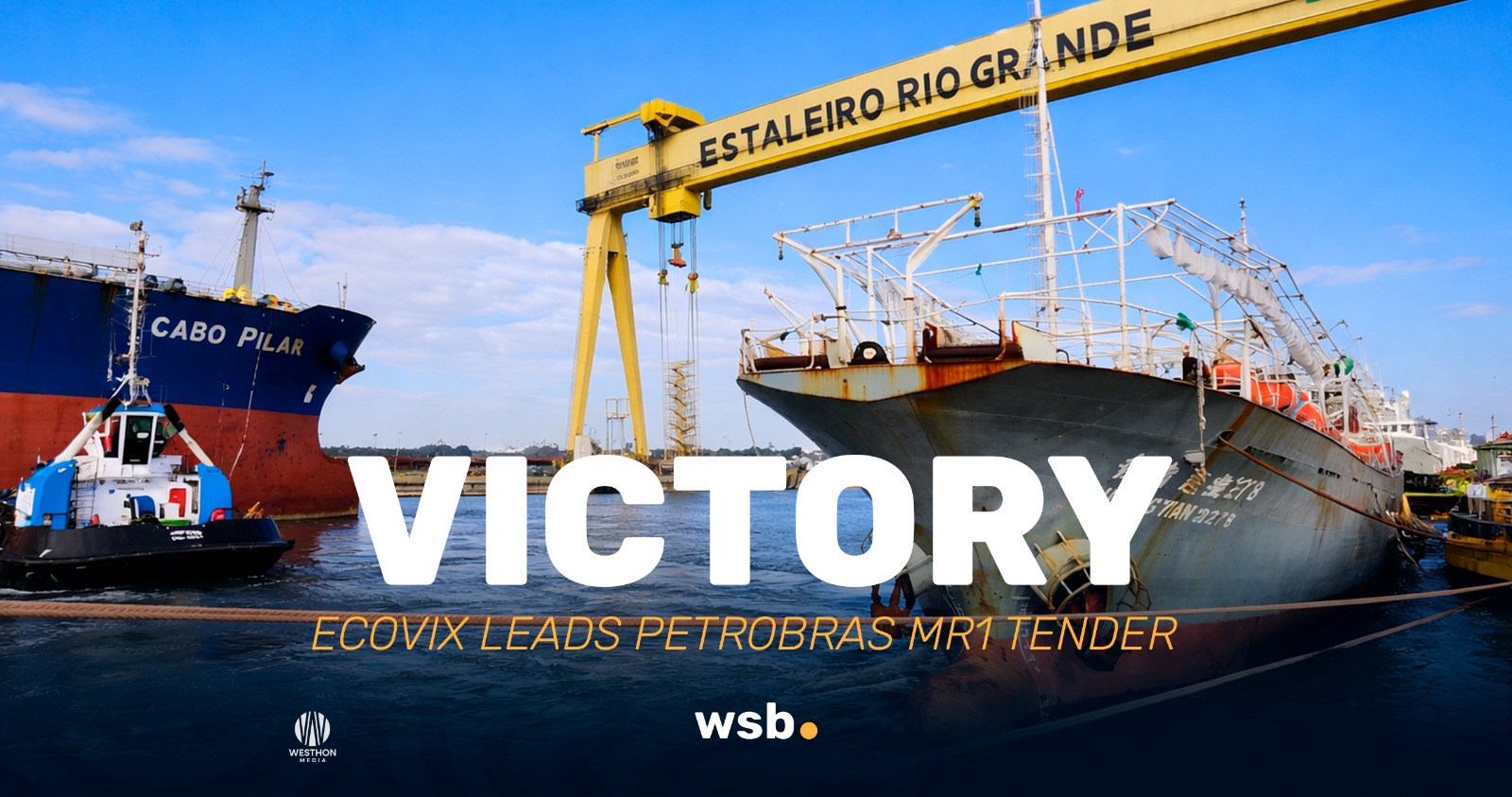
With the best equalized rate per vessel, ECOVIX leads the opening round in the dispute for the Transpetro MR1 tanker package, outbidding India’s SDHI and China’s DSOC (Dalian Shipbuilding Offshore).
Once again, the Brazilian industry demonstrates that, under clear and transparent equalization criteria, local shipbuilding can compete head-to-head with major international yards.
This marks the first stage of the tender process, where commercial proposals are opened and equalized. The qualification phase now follows.
Scale matters. With nine large vessels already underway for Transpetro, ECOVIX continues to build momentum and reinforce Brazil’s shipbuilding capability — with solid market alignment behind the project.
An encouraging signal for the Brazilian shipbuilding industry.
Agreement aims to accelerate the energy transition of maritime transport, focusing on sustainable fuels and logistics innovation
Brazil and Panama announced last Wednesday (January 28) the signing of a strategic agreement to develop studies for the creation of a Green Maritime Corridor between the two countries. The initiative is intended to promote the use of sustainable fuels in shipping and to advance the decarbonization of one of the most important logistics routes in the hemisphere.
The agreement, formalized at the conclusion of the Brazilian government’s official mission to Panama, is structured around four key pillars of cooperation: competitiveness and new trade routes, decarbonization of maritime transport, technological modernization through the use of artificial intelligence and Big Data, and workforce training and capacity building for the sector.
The route between Brazil and the Panama Canal handles an average of 5.8 million tonnes of cargo per year, standing out as one of the most relevant corridors in international maritime logistics. The commitment aligns both countries with global greenhouse gas reduction targets and with the broader energy transition agenda of the maritime sector.
In Brazil, this movement is already supported by regulatory and operational initiatives. A survey conducted by the National Waterway Transportation Agency (Antaq) shows that at least five Brazilian ports currently offer incentives for vessels with a lower carbon footprint: Itaqui (MA), the Pecém Private Use Terminal (CE), Paranaguá (PR), Santos (SP), and the Açu Private Use Terminal (RJ).
The agreement also positions Brazil at the forefront of the maritime energy transition agenda in Latin America. Globally, maritime transport accounts for approximately 3% of total greenhouse gas emissions, underscoring the strategic importance of initiatives such as green corridors to decarbonize ocean shipping and support the achievement of net-zero emissions targets by 2050.
Stay informed on key offshore developments — visit wsb-one.com, our data platform trusted by leading offshore companies.