Tag: Petrobras

  • Petrobras sets production record

    Petrobras sets production record

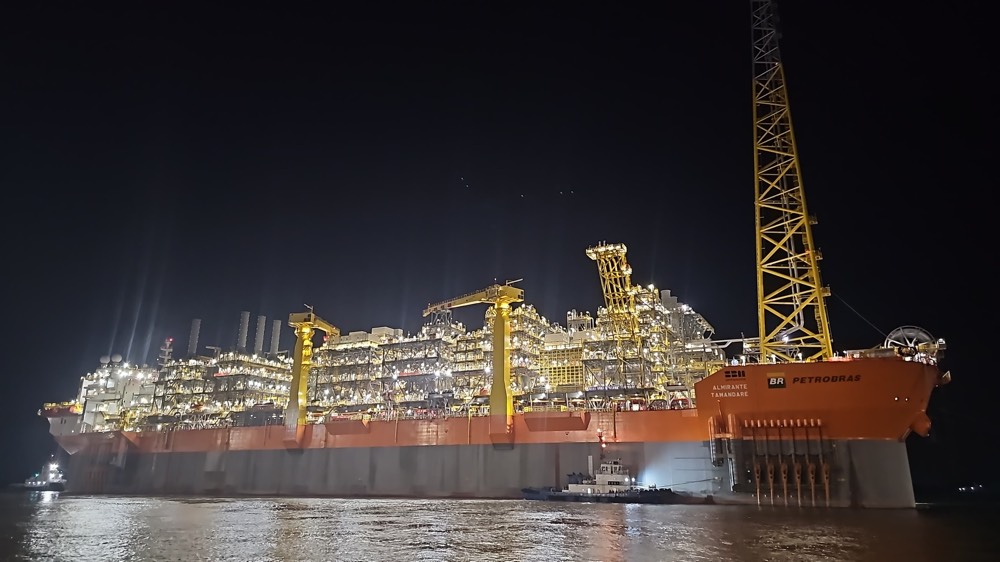
    Petrobras’ Almirante Tamandaré unit, part of the Búzios 7 Project, reached a record output of 225,000 barrels of oil per day — the highest production ever achieved by a single unit in the company’s history and three months before of the expected. Located in the massive Búzios field in the Santos Basin pre-salt, the FPSO began operations in February and hit full capacity with just five wells.

    The milestone confirms Búzios’ potential to become Petrobras’ top-producing field, with projections of reaching 1.5 million bpd by 2030. The company highlighted sustainable technologies onboard, such as a closed flare system and heat recovery solutions, which earned the unit ABS’s Sustainability Seal.

    Stay informed on key offshore developments — visit wsb-one.com, our data platform trusted by leading offshore companies.
  • Equatorial Margin: new step

    Equatorial Margin: new step

    Petrobras and Instituto Brasileiro do Meio Ambiente e dos Recursos Naturais Renováveis – Ibama have reached an agreement to soon carry out a Pre-Operational Assessment (APO) in the Foz do Amazonas Basin, specifically in block FZA-M-59, off the coast of Amapá. This exercise is a simulated emergency designed to test oil spill response protocols, including wildlife protection measures and is expected to take place on August 24.

    Planned to last three to four days, Petrobras’ performance in this simulation will be a decisive factor in obtaining the environmental license required to drill the exploratory well, a process the company has pursued for years, facing regulatory resistance.

    According to Petrobras’ Director of Exploration and Production, Sylvia dos Anjos, technical teams from both institutions met this week to finalize the simulation details. While the official start date of the APO still awaits IBAMA’s confirmation, the tone is optimistic. “We are closer than we were before. I’m optimistic,” she said during an industry event in Rio de Janeiro.

    The upcoming APO will be a key moment not just for Petrobras, but for Brazil’s offshore exploration roadmap. If successful, it could unlock a new frontier in the Foz do Amazonas Basin, opening opportunities for the supply chain and reinforcing Brazil’s position in the global energy market.

    Stay informed on key offshore developments — visit wsb-one.com, our data platform trusted by leading offshore companies.
  • Open Tenders

    Open Tenders

    By Maria Eduarda Camba

    Dear all,

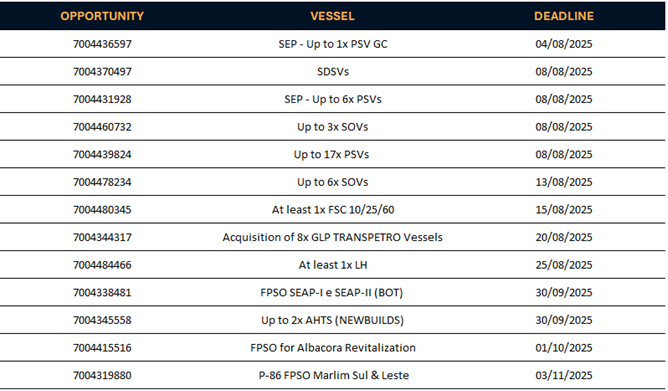
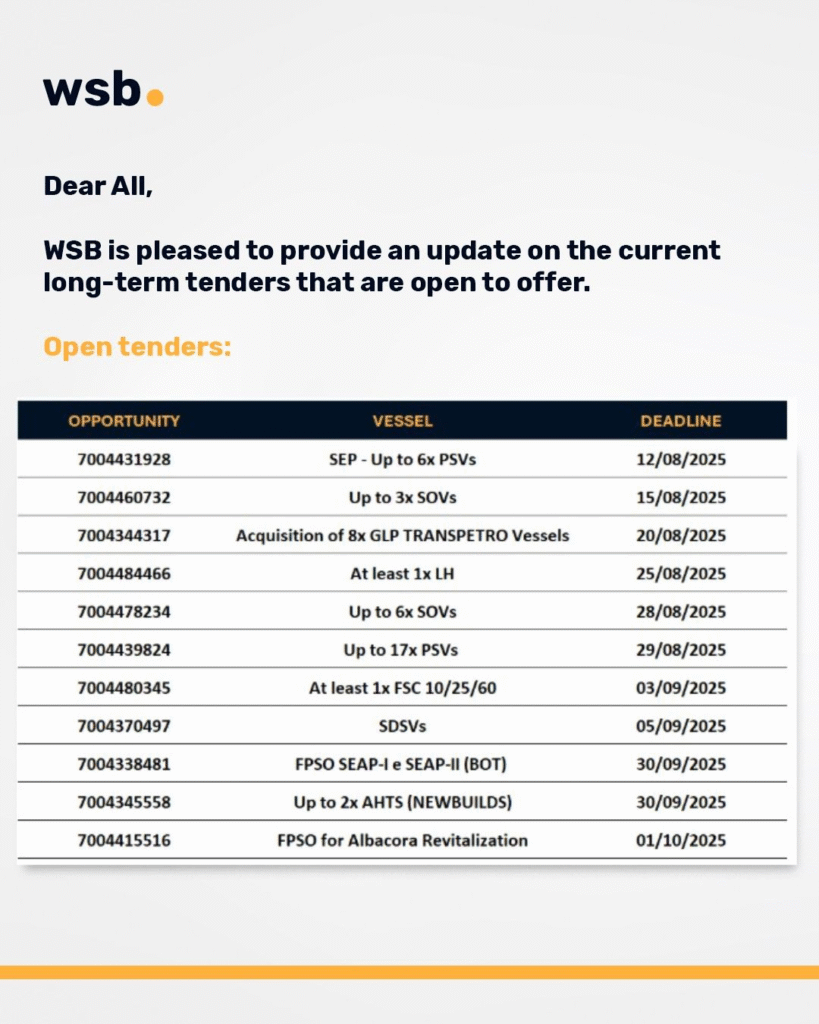
    WSB Advisors is pleased to provide an update on the current long-term tenders that are open to offer.


    What has changed?

    Petrobras has extended the deadline for opportunity no. 7004460732, which refers to the potential charter of up to three SOVs. The new submission deadline is August 15th, 2025.

    – Petrobras has extended the deadline for opportunity no. 7004478234, which refers to the potential charter of up to six SOVs. The new submission deadline is August 28th, 2025.

    – Petrobras has extended the deadline for opportunity no. 7004370497, which refers to the potential charter of SDSVs. The new submission deadline is September 5th, 2025.

    – Petrobras has extended the deadline for opportunity no. 7004431928, which refers to the potential charter of up to six PSVs under the SEP program. The new submission deadline is August 15th, 2025.

    What else happening:

    DOF secured two firm 4-year RSV contracts with Petrobras, adding Skandi Carla and Geoholm to its Brazilian fleet, with both vessels scheduled to begin operations in December 2025.

    Stay informed on key offshore developments — visit our website cms.oneenergynews.com and wsb-one.com, our data platform trusted by leading offshore companies

  • Offshore highlights

    Offshore highlights


    BRAVA has completed, earlier than planned, the full and final settlement of FPSO Atlanta receivables with Yinson Offshore. The transaction totalled approximately US$ 260 million including US$ 4.5 million paid upfront in July 2025 and now the balance plus interest. Brava projects a positive impact on operating cash flow exceeding US$ 40 million (present value) over the next three years. The move forms a strategic component of its ongoing liability management efforts aimed at reducing leverage and optimizing capital structure.

    Transpetro has become the first Brazilian company to carry out ultrasonic inspections of tanker cargo tanks using drone-mounted technology. Certified by the American Bureau of Shipping (ABS), this inspection method was applied to the tanker João Cândido, marking a major milestone in digital asset integrity and operational safety in Brazil’s maritime sector.

    Axess Group has secured a regulatory compliance contract with Seatrium for six Petrobras-bound FPSOs: P78, P80, P82, P83, P84, and P85. Axess will oversee adherence to Brazil’s technical and legal standards throughout the construction phase in Singapore having started with the P 78, already underway en route to Brazil.

  • Petrobras Revoked Key Tender in Campos Basin Revitalization Plan

    Petrobras Revoked Key Tender in Campos Basin Revitalization Plan

    Petrobras has formally revoked Tender No. 7004319880 for the FPSO P 86, originally intended to support the revitalization of the Marlim Sul and Marlim Leste fields. Citing Article 62 of Brazilian Law No. 13,303/2016, the company deemed the project concept inviable under all evaluated economic scenarios, reinforcing its commitment to efficiency, cost control and long term fiscal sustainability.

    The FPSO P 86 was meant to operate under a Build Operate Transfer (BOT). Initial plans projected a capacity of approximately 140,000 barrels of oil per day. However, system and economic feasibility assessments prompted this revision.

    Petrobras emphasized that the cancellation aligns with its strategic approach to liability management while reaffirming its dedication to the Marlim Sul / Marlim Leste revitalization project. Staff originally assigned to the FPSO P‑86 initiative will be reassigned to other company operations.

    Stay informed on key offshore developments — visit wsb-one.com, our data platform trusted by leading offshore companies.
  • BP’s Bumerangue Discovery: more details

    BP’s Bumerangue Discovery: more details

    BP’s recent announcement of a major oil and gas discovery in Brazil’s Santos Basin, the largest global find in 25 years as we posted on July 30, has put the spotlight on the Bumerangue block. Located near the productive pre-salt cluster, the area holds significant potential, but uncertainties around its high CO₂ content have triggered technical and strategic caution within Petrobras.

    According to sources interviewed by Reuters, Petrobras has not yet been formally approached by BP regarding potential collaboration. However, insiders confirm that any decision to partner would hinge on further data, particularly around the CO₂ composition of the reservoir. The company remains wary after past experiences with high-CO₂ assets like the Jupiter field, which was ultimately deemed unviable due to the technical and economic challenges of gas separation and reinjection.

    While BP’s Head of Operations, Gordon Birrell, stated that the CO₂ levels are “manageable,” Petrobras executives stress that they have not received complete data and that the field’s commercial viability depends on future clarifications. Without new technical disclosures, any progress toward development, or a potential partnership, remains speculative.

    This scenario underscores a broader reality in Brazil’s offshore sector: the presence of CO₂ in pre-salt discoveries is not uncommon, but its volume and treatment costs can make or break a project. Bumerangue now becomes a case study in how technological readiness and strategic alignment shape the future of exploratory efforts.

    More importantly, it reflects Petrobras’s critical role in setting the pace for offshore innovation in Brazil. With its legacy of deepwater expertise, the company holds the technical and political weight to determine which assets move forward and under what terms.

    Key takeaways for the offshore market:

    • CO₂ content is increasingly becoming a defining factor in evaluating exploration assets.
    • New discoveries in the pre-salt continue to attract global attention, but economic viability remains tightly linked to processing technologies.
    • Petrobras’s selective stance reinforces its position as a technology-driven operator with a long-term view on project economics and carbon exposure.

    Stay informed on key offshore developments — visit wsb-one.com, our data platform trusted by leading offshore companies.
  • Release Frigate F201

    Release Frigate F201

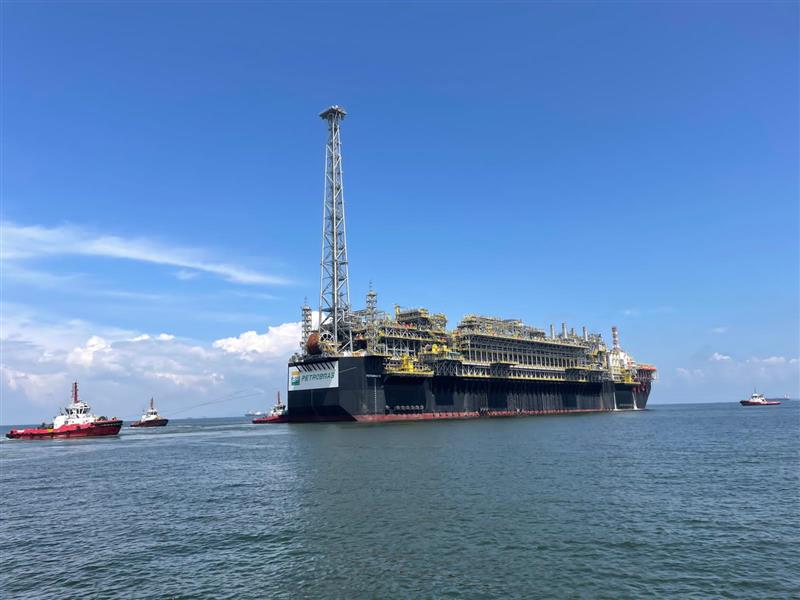
    This Friday, August 8th, the Brazilian Navy will hold the christening and launch ceremony of the Jerônimo de Albuquerque (F201), the second frigate of the Tamandaré Class. The ceremony will take place at TKMS Estaleiro Brasil Sul, in Itajaí, Santa Catarina, marking a major milestone for Brazil’s naval modernization strategy.

    The F201 is being built by Águas Azuis Construções Navais SPE, a joint venture formed by TKMS, Embraer Defense & Security and Atech, based on the German MEKO A100 design. With a displacement of 3,380 tons, a length of 107 meters and autonomy of up to 5,500 nautical miles, the vessel is designed for high-endurance missions and houses a crew of approximately 130.

    Beyond its technical capabilities, the frigate represents a strategic leap in Brazil’s ability to project maritime security and industrial capacity. The Tamandaré Class is expected to replace legacy vessels such as the Niterói and Type 22 frigates, supporting critical defense of the country’s “Amazônia Azul” and offshore infrastructure.

    With delivery scheduled for early 2027, the Jerônimo de Albuquerque reinforces the role of national and international partnerships in shaping the future of Brazil’s naval industry.

  • Perenco acquires Cherne and Bagre fields

    Perenco acquires Cherne and Bagre fields

    Petrobras has finalized the sale of the Cherne and Bagre fields to Perenco for approximately BRL 10 million. Located in shallow waters of the Campos Basin, these fields have been idle since March 2020, when production was officially halted. The facilities remain in hibernation and the assets were originally awarded to Petrobras during ANP’s Round Zero. Both fields are positioned about 73 kilometers off the coast, at depths ranging from 108 to 150 meters.

    According to Petrobras, the transfer agreement includes compensation adjustments to be paid by the company related to the asset’s integrity. The deal also creates an opportunity for production to resume under a new operator, replacing Petrobras’ earlier plan for full decommissioning. Company employees previously assigned to these assets will be relocated to other operations.

    Perenco plans to restart production and reach 15,000 barrels per day from Cherne and Bagre in the medium term. When combined with the Pargo Cluster, this could increase its total output in Brazil to 35,000 barrels per day. The goal is to revitalize the fields and unlock more than 50 million barrels in reserves.

    Stay informed on key offshore developments — visit wsb-one.com, our data platform trusted by leading offshore companies.

  • Three New Offshore Vessel Charter Contracts

    Three New Offshore Vessel Charter Contracts

    This week began with strong momentum in the offshore support vessel market, as three new charter contracts were officially announced.

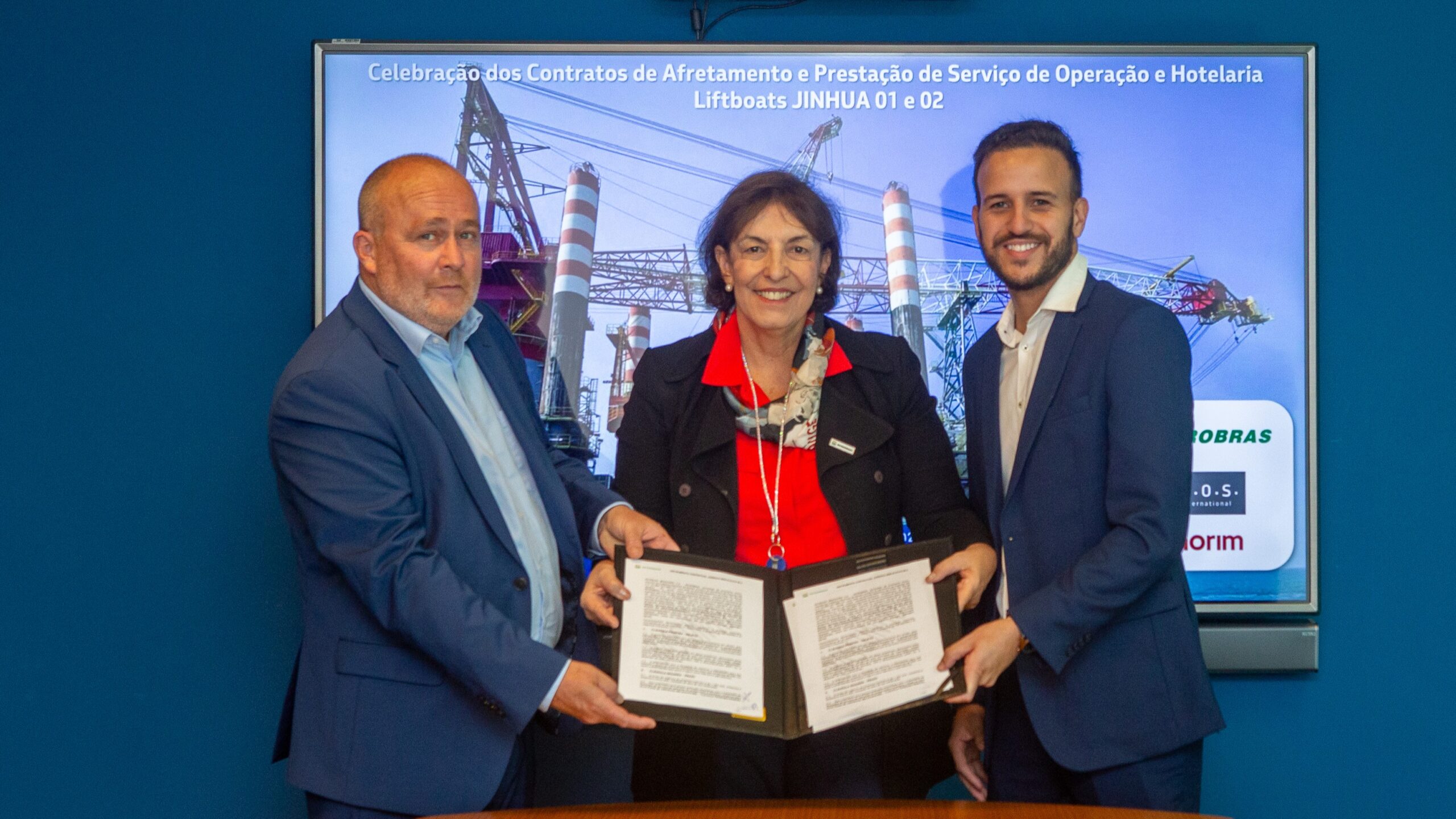
    Camorim has signed a BRL 1.2 billion agreement with Petrobras to deploy the liftboats Jin Hua 01 and Jin Hua 02 in partnership with OOS International B.V.

    These vessels will support maintenance and readiness campaigns for fixed platforms in the Sergipe-Alagoas and Rio Grande do Norte-Ceará basins. The contract will run for three years, with the official start date yet to be confirmed.

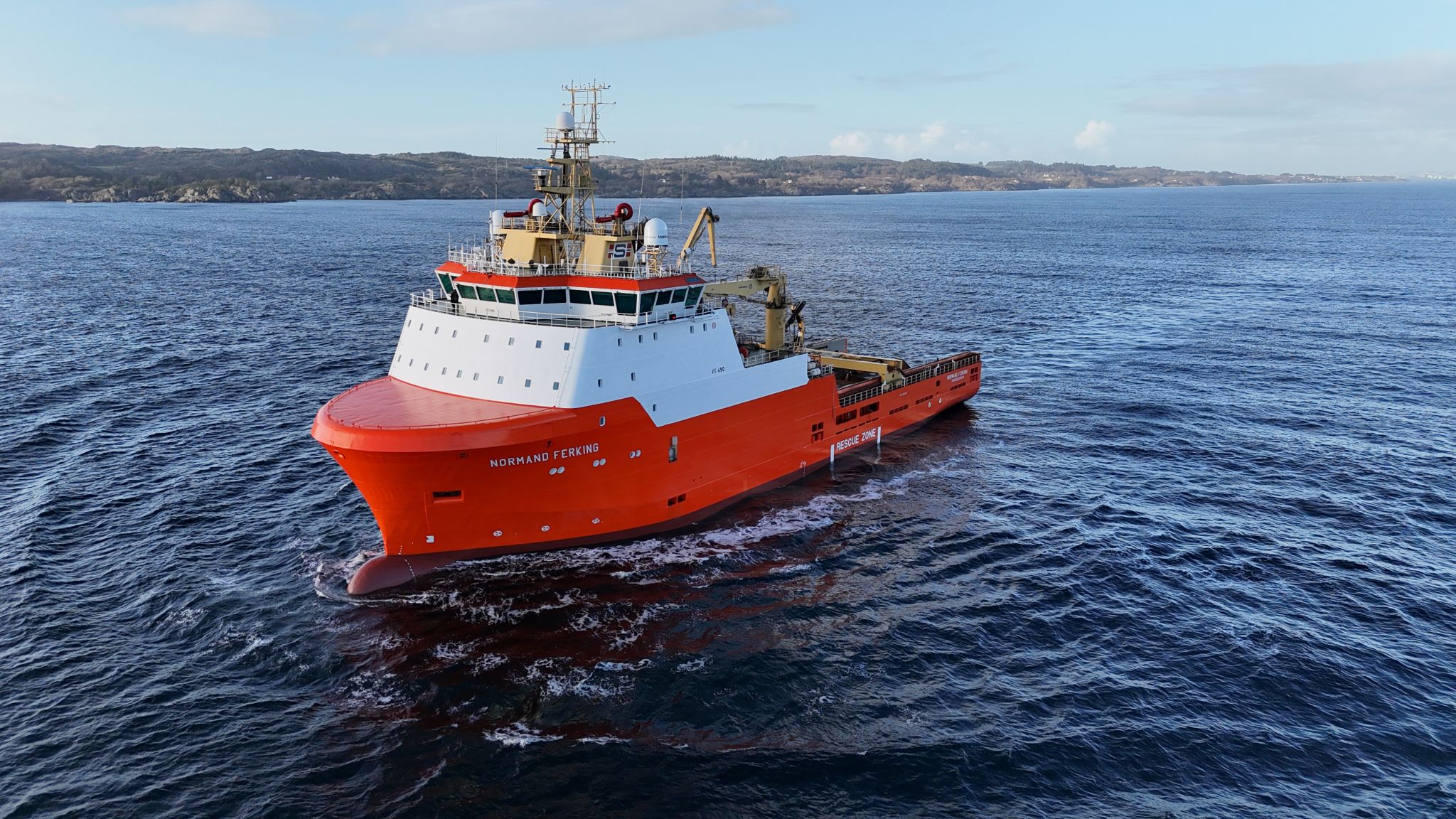
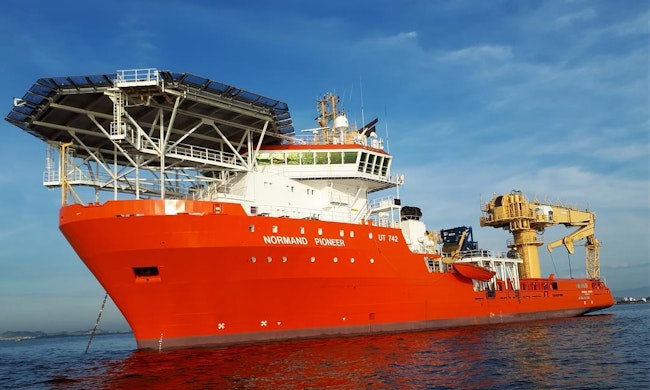
    Solstad has secured a four-year charter with Petrobras for the construction support vessel Normand Commander with Petrobras, with operations expected to begin in the first quarter of 2026. The deal is valued at approximately USD 108 million, excluding ROV services.

    Also on Monday, DOF announced two new four-year contracts, also with Petrobras, for the AHTS vessels Skandi Fluminense and Skandi Lifter. These awards stem from the same tender processes that recently secured long-term contracts for Skandi Logger, Skandi Iguaçu, Skandi Angra, Skandi Paraty and Skandi Urca.

    To stay updated on Brazil’s OSV market and access exclusive project data, reach out to: comercial@cms.oneenergynews.com. Stay informed on key offshore developments — visit www.wsb-one.com, our data platform trusted by leading offshore companies.
  • Petrobras 2x AHTS Newbuilds – Updated Clarification Schedule

    Petrobras 2x AHTS Newbuilds – Updated Clarification Schedule

    By Pedro Pellegrini

    After reviewing the tender documents and their respective attachments for the 2x AHTS newbuildings requirement, Petrobras had scheduled a clarification live session for this Friday (1st). However, due to technical issues, the session has been postponed to next Monday (4th) at 3:30 PM (Brazilian time).

    The requirement — which has sparked considerable discussion in the industry due to its unprecedented specifications and technical challenges — has caught the attention of several key players.

    Interested in understanding this unique AHTS project that’s shaking up the market?

    Click the link below to stay in the loop:

  • Open tenders & More

    Open tenders & More

    Dear All,

    WSB is pleased to provide an update on the current long-term tenders that are open to offer.

    Open tenders:

    What has changed?

    • Petrobras SEP Up to 1x PSV GC: Opportunity 7004436597 new deadline August 4th, 2025;
    • Petrobras SDSVs: Opportunity 7004370497 new deadline August 8th, 2025;
    • Petrobras At least 1x LH: Opportunity 7004484466 released on August 1st, 2025.

    What else is happening?

    • Petrobras redefines its ambitious AHTS technical specifications, reducing vessel size, deck area, crane strength and torpedo pile capacity. The redesign moves away from record-breaking specs toward a more feasible, globally aligned solution, shaped by industry feedback. The result is a technically capable vessel design that significantly reduces construction complexity and cost, without compromising its core function within Petrobras’ offshore operations.
    • PRIO receives IBAMA’s Preliminary License approval for Wahoo field, bringing PRIO closer to production through a lean subsea tieback strategy, reducing environmental impact.
  • Petrobras: new AHTS specs

    Petrobras: new AHTS specs

    By Alexandre Vilela and Pedro Pelllegrini

    Petrobras Scales Back Ambitious Design in Multi-Year AHTS Newbuilding Tender

    Petrobras has revised the technical specifications for its next-generation large Anchor Handling Tug Supply (AHTS) vessels under Brazil’s landmark AHTS Newbuilding tender, which is expected to result in multi-year awards. The original requirements were developed after extensive market sounding and aimed to stretch design boundaries by proposing a vessel of unprecedented scale and capacity, intended to redefine offshore support capabilities in deep and ultra-deepwater environments.

    The initial concept called for a vessel capable of carrying eight 160-ton torpedo piles on deck, effectively centralizing operations typically performed by up to four conventional AHTSs. This responded to Petrobras’ plan to increase torpedo pile weights from 120 to 160 tons, with the goal of reducing the number of mooring lines required per offshore unit. The concept also envisioned enhanced chain-handling capacity and significant onboard storage to support operations in remote, high-energy basins such as the Equatorial Margin.

    After significant industry feedback and feasibility analysis, Petrobras has now adopted a more pragmatic approach. The revised specifications bring the project closer to international standards while maintaining operational effectiveness.

    Key updates include a reduction in length overall from 130m to 97m, draft from 8.4m to 7m and deck area from 1,500m² to 840m². The original 250-ton subsea crane will be replaced with a 20-ton main crane and deck capacity has been lowered from 8+1 to 4+1 torpedo piles.

    The result is a technically capable vessel design that significantly reduces construction complexity and cost, without compromising its core function within Petrobras’ offshore operations.