Tag: PSV

  • Special WSB: Por onde anda? Bravante VI

    Special WSB: Por onde anda? Bravante VI

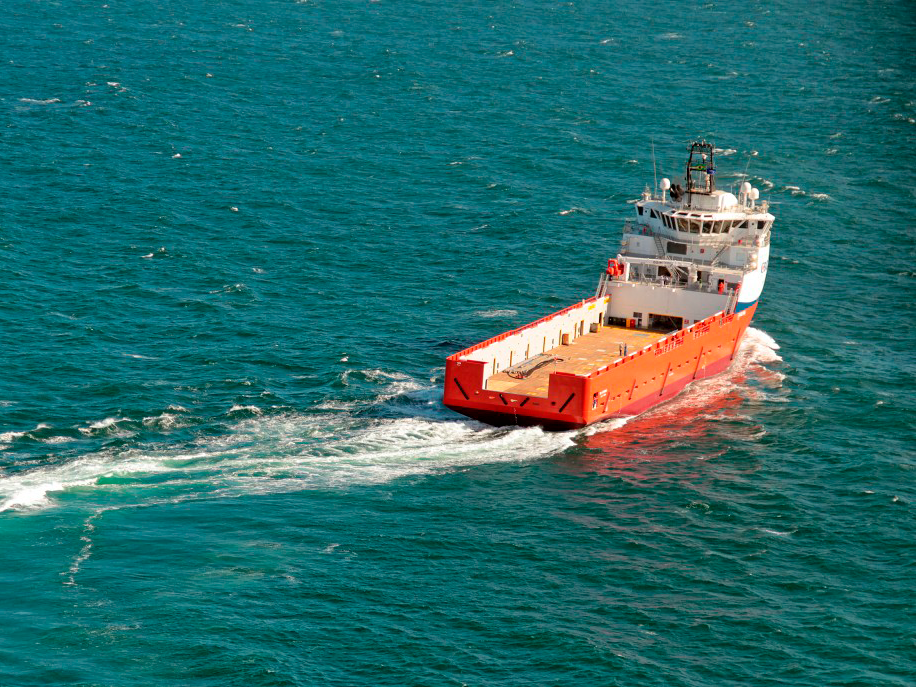
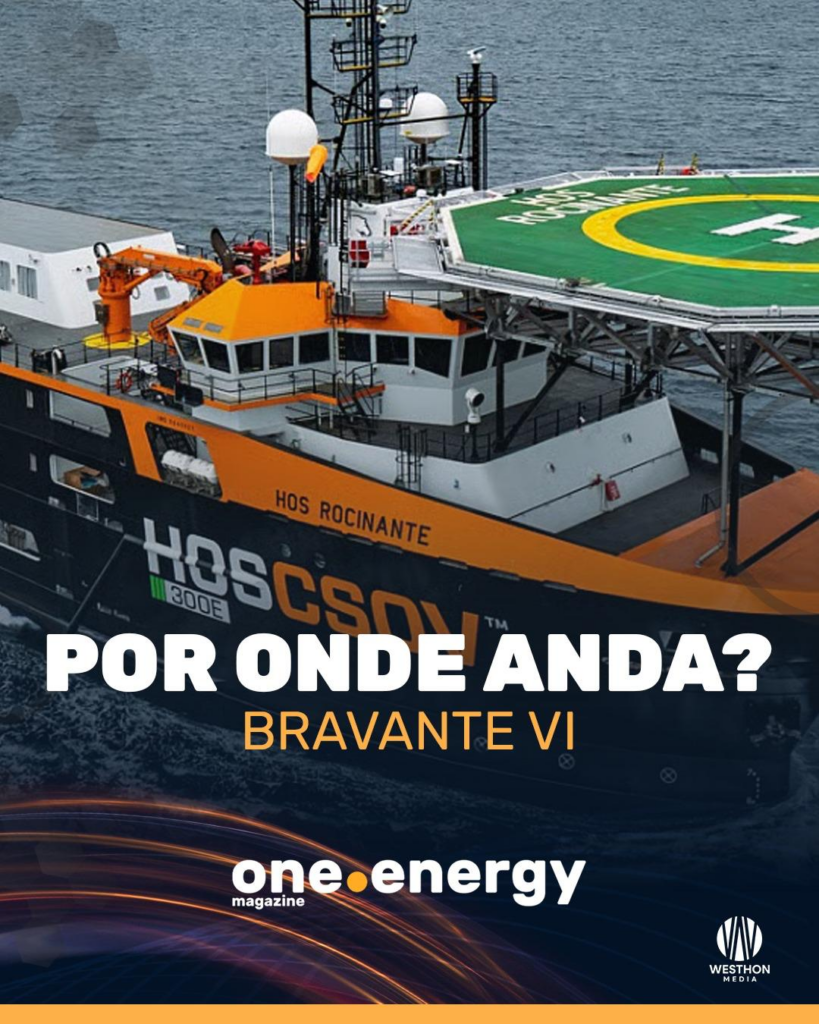
    The former Brazilian PSV now operating as a Service Operation Vessel in the United States.

    The Bravante VI (IMO 9645621) followed a path that differs from most of the vessels featured in this series.

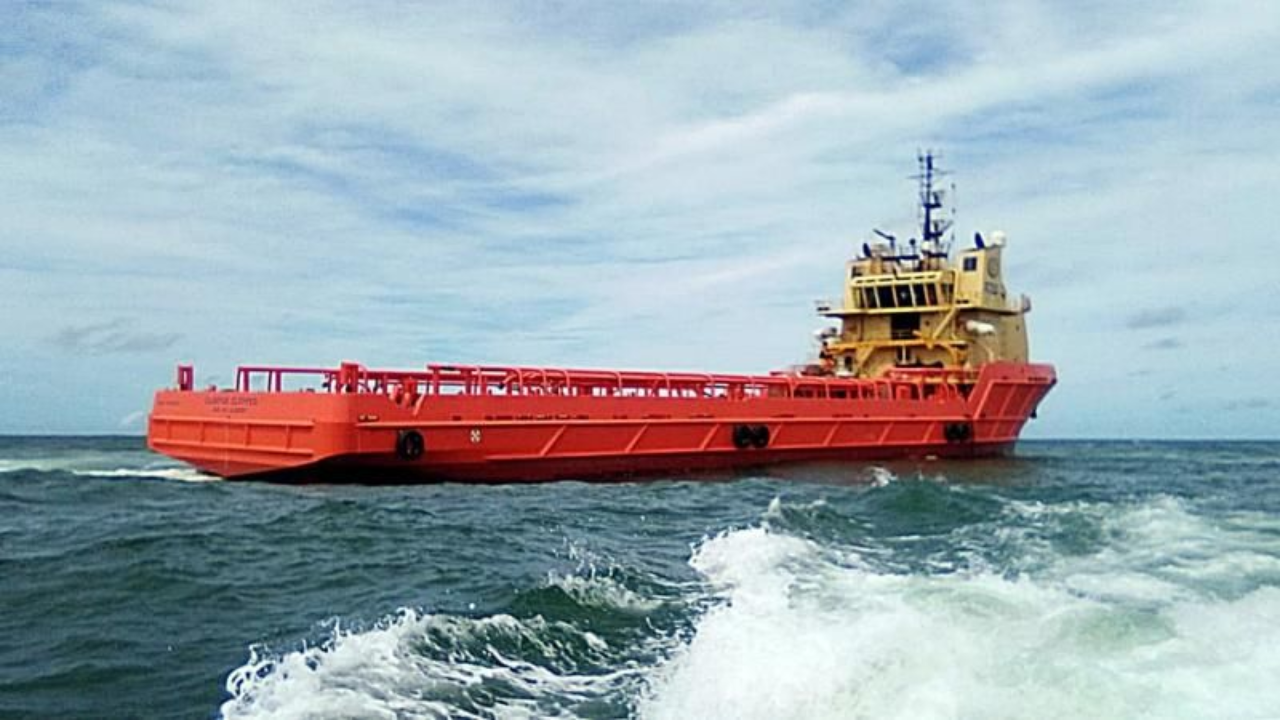
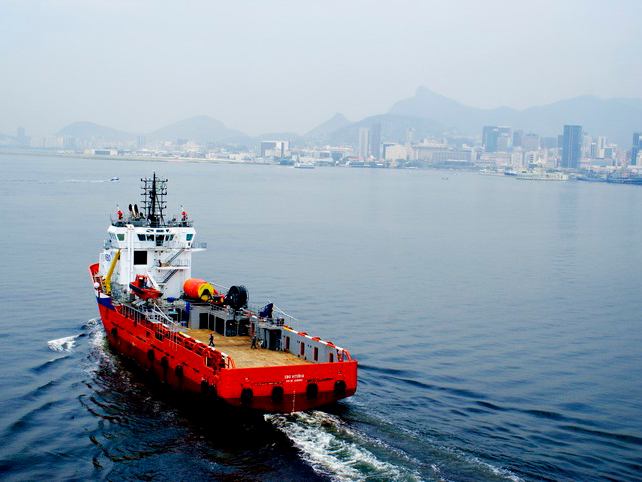
    Built in 2014 by Eastern Shipbuilding Group in Florida, the vessel was delivered to Boldini S.A., a company of Brazil’s Bravante Group, as a Platform Supply Vessel (PSV) designed to support the Brazilian offshore market.

    Measuring approximately 92 metres in length, with an 18-metre beam and DP-2 dynamic positioning, she was designed to transport cargo, equipment and supplies to offshore installations. At the time, Brazil was experiencing one of the strongest periods of demand for offshore support vessels, driven by Petrobras’ expanding offshore activities and the rapid development of the pre-salt fields.

    That scenario, however, changed quickly.

    From 2014 onwards, reduced Petrobras investment, the impacts of the Lava Jato investigations and an oversupplied OSV market triggered one of the most challenging periods ever faced by Brazil’s offshore support industry. Several shipowners underwent financial restructuring, contracts were terminated and part of the fleet was either sold or redeployed to other regions.

    Bravante VI became part of that movement.

    In 2022, the vessel was acquired by Hornbeck Offshore Services, one of the leading offshore vessel operators in the United States. Initially renamed HOS Rosehill, she returned to the same shipyard where she had been built for an extensive conversion project. Before re-entering service, she received her current name: HOS ROCINANTE.


    The conversion

    Rather than continuing to operate the vessel as a conventional PSV, Hornbeck chose to convert her into a Service Operation Vessel (SOV) — a category also commonly referred to as CSOV within the offshore wind sector.

    The project was carried out by Eastern Shipbuilding Group, the vessel’s original builder.
    While retaining the original hull, the conversion substantially changed her operational profile. The vessel received a motion-compensated walk-to-work gangway, a hybrid battery system, accommodation for up to 119 personnel, an S-92-certified helideck, a 3D motion-compensated offshore crane and infrastructure designed to support extended offshore campaigns.

    The former PSV was adapted to perform a completely different role, providing technical support, accommodation for specialised crews and safe personnel transfer during offshore operations.

    According to Eastern Shipbuilding Group and Hornbeck Offshore Services, HOS ROCINANTE is the first U.S.-flagged SOV converted from an existing offshore support vessel.

    Where is she now?

    Today, the former Bravante VI operates as HOS ROCINANTE, remaining in the Hornbeck Offshore Services fleet and operating along the U.S. East Coast.

    Recent public vessel tracking records indicate her involvement in activities supporting the Revolution Wind offshore wind project. Her trajectory also reflects significant changes in two different offshore markets.

    By the time she left Brazil, the country’s offshore support sector was still recovering from one of its deepest downturns, with limited demand for walk-to-work vessels. Investment remained largely focused on PSVs, AHTSs, RSVs and MPSVs supporting conventional oil and gas operations.

    In the United States, meanwhile, the expansion of offshore wind projects has created demand for vessels capable of accommodating specialised personnel, providing safe offshore personnel transfers and supporting extended offshore campaigns.

    Hornbeck’s decision also reflects a broader strategy that has become increasingly common across parts of the maritime industry. Rather than investing in a newbuild, the company selected a relatively modern hull, already built in the United States and compliant with the Jones Act, reducing delivery time, capital investment and project risk compared with commissioning a completely new vessel.

    The former Bravante VI therefore reflects three important developments over the past decade: the contraction of Brazil’s offshore support market, the international redeployment of offshore assets and the growing demand for specialised support vessels serving the U.S. offshore wind industry.

    It remains to be seen whether this project will remain an isolated case within the U.S. fleet or become a reference for future conversions of similar offshore vessels.

  • DOF and Petrobras

    DOF and Petrobras

    DOF has confirmed the award of two new long-term contracts by Petrobras, together valued at over USD 275 million, surpassing BRL 1 billion at current exchange rates.

    The AHTS Skandi Logger has secured a four-year charter, joining the ranks of other DOF vessels recently contracted by Petrobras, including the Skandi Iguaçu, Skandi Angra, Skandi Paraty, and Urca. Operations are expected to begin in February 2026.

    Meanwhile, the RSV Skandi Achiever was also awarded by Petrobras a four-year contract, with offshore activities scheduled to start in December 2025. The agreement includes the deployment of two WROVs and a subsea crane, reinforcing the vessel’s advanced subsea intervention capabilities.

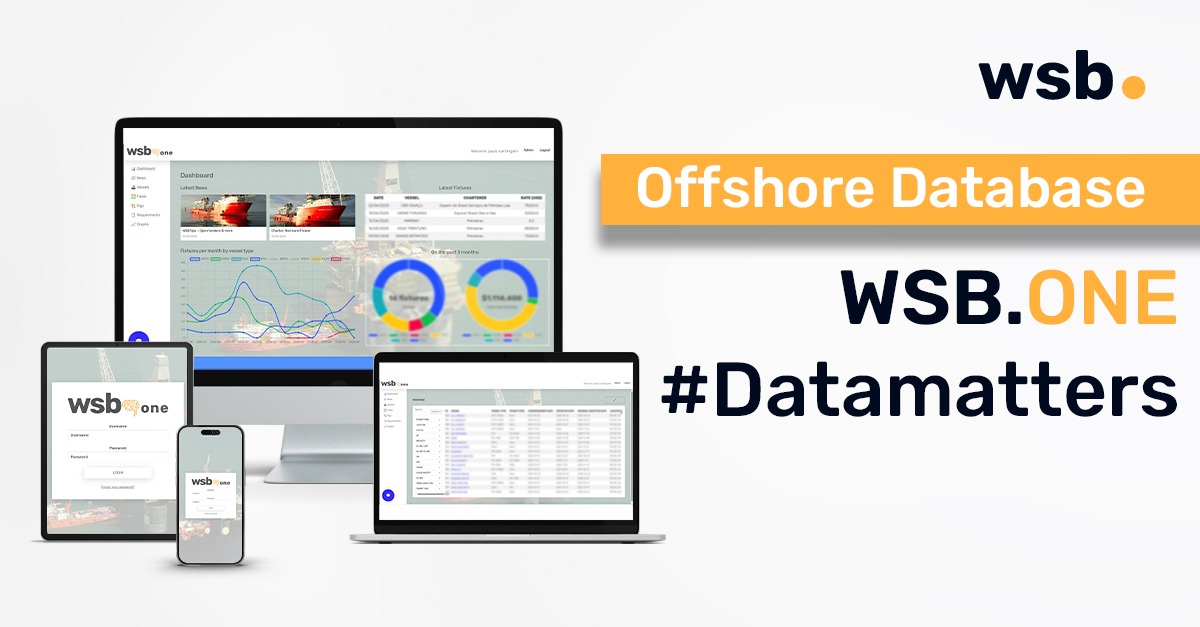
  • Offshore Database: WSB.One

    Offshore Database: WSB.One

    Datamatters –

    Paulo Cantergiani, Market Intelligence Intern at WSB Advisors, conducted a comparative study of Brazil’s offshore support vessels (OSV) fleet, analyzing May 2024 against the same period this year. Drawing from exclusive data within WSB. One, our database, the study reveals important trends shaping the sector’s evolving dynamics.

    AHTS vessels recorded the sharpest decline, dropping from 53 to 50 units, a 5.7% contraction. The reduction reflects a temporary gap in chartering activity, largely linked to the timing of Petrobras tenders currently being finalized.

    Meanwhile, the RSV segment remained stable, with 28 active units throughout the period, reinforcing the steady demand for subsea inspection and maintenance services critical to offshore infrastructure integrity.

    PSV numbers also saw a slight reduction, from 129 units in May 2024 to 122 in May 2025. a 5.4% contraction.

    The findings highlight the differentiated behavior of each OSV segment and reinforce the value of real-time and data-driven decision-making. In a volatile market, access to accurate and granular fleet information remains a key asset for anticipating shifts and aligning commercial strategies.

    More details in the infographic below or by subscribing to our WSB. One database.

    WSB – We Support Your Business

  • Sealink 178 in Rio de Janeiro

    Sealink 178 in Rio de Janeiro

    By Rafael Bortoloti

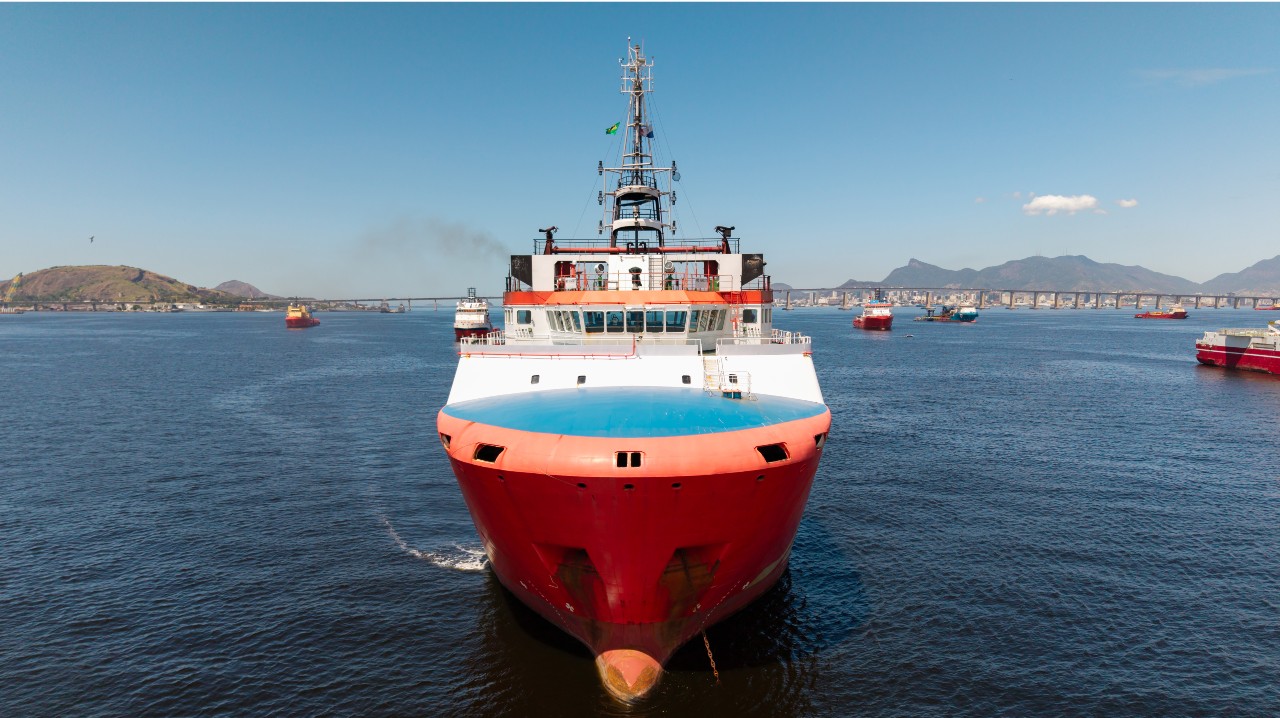
    Camorim has welcomed its newest MPSV, the SEALINK 178, to Rio de Janeiro, this month. The vessel left Malaysia in December and is set to begin a four-year contract with Petrobras, operating as a PSV 4500. Contract operations are expected to start in April 2025.

    Built in China, the SEALINK 178 features a DP-2 dynamic positioning system, measuring 84.4 meters in length with a 22-meter beam. The vessel’s arrival reinforces Camorim’s strong momentum. In recent months, the company has celebrated the delivery of the ASD tugs C-Fênix, C-Falcão, and C-Albatroz, with two more azimuthing units, C-Condor and C-Harpia, set to join the fleet soon.

    The SEALINK 178 is the third offshore vessel Camorim has secured for Petrobras in less than a year, following the Aegis and Sayan Polaris. Currently operating over 150 vessels in Brazil (including PSVs, AHTSs, barges, launches, floating docks, and LHs). Camorim continues to expand its presence in the market.

    What’s next?

  • WSB tips – Open Tenders & More

    WSB tips – Open Tenders & More

    By Pedro Pellegrini

    Dear All,

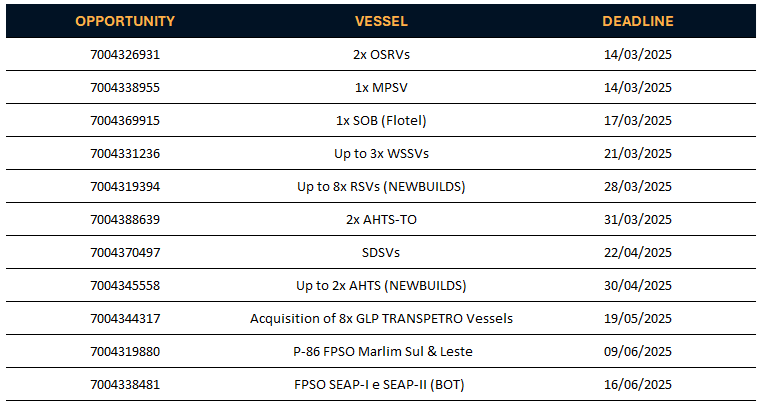
    WSB is pleased to provide an update on the current long-term tenders that are open to offer.

    Open tenders:

    What has changed?

    • Petrobras 2x AHTS-TO: Opportunity 7004388639 released Mar 10th, 2025;
    • Petrobras 2x OSRVs: Opportunity 7004326931 new deadline Apr 14th, 2025;
    • Petrobras 3x WSSVs: Opportunity 7004331236 new deadline Apr 21th, 2025.

    What else is happening?

    • Subsea7 progresses with AHTS for Búzios 8. Even though Carnival is over, market remains rattling and windows are challenging. Can SS7 keep up with the rythmn?
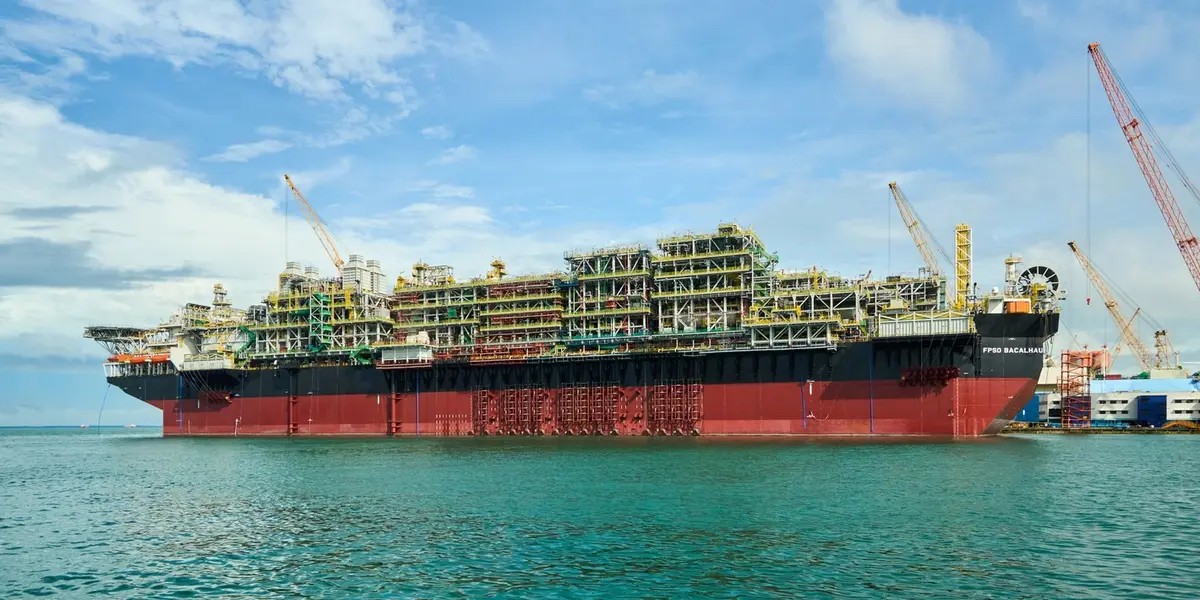
    • FPSO Bacalhau hooked up and anchored. Station keeping tugs all returned to Guanabara Bay, except some will not stay for long…
    • Want to know everything about new requirements, contract windows, time charter, bareboat and spot opportunities, daily rates for each vessel, fortnightly meetings and countless other pieces of information? Get in touch with us to learn more about our package featuring the most complete database in the market: WSB.One!
  • New Petrobras PSV tender

    New Petrobras PSV tender

    By Rafael Bortoloti

    Petrobras has released a new SEP tender (invitational) to charter up to 3 PSVs.

    The PSVs are divided into different specifications (Multipurpose, Fluid Carrier, Oil Carrier & General Cargo) and will be chartered according to a pre-defined priority order.

    Offers are for 4-year firm contracts with delivery in November 2025 or 180 days after contract signature.

    All the vessels must be DP-2 and age not above 20 years

    Current deadline to send proposals:

    November 15, 2024 at 17:00 LT

    To learn more details about the specifications of the vessels, please contact us at comercial@cms.oneenergynews.com

    Priority order:

    PSV 4500 DWT MULTIPURPOSE

    PSV 4500 DWT FLUID CARRIER

    PSV 4500 DWT GENERAL CARGO

    PSV 4000 DWT GENERAL CARGO

    PSV 3000 DWT GENERAL CARGO

    PSV 3000 DWT OIL CARRIER

  • PSVs in Brazil: an analysis

    PSVs in Brazil: an analysis

    – Over the next 10 years, 75% of the PSV vessel fleet in Brazil will lose its “validity,” considering the current standard 20-year operational lifespan limit set by the major charterers – reports Pedro Pellegrini, Shipbroker Intern at WSB Advisors and manager of WSB. One, the most comprehensive database in the market.

    Explore detailed data on contracts, daily rates (historical and current), contract durations, and charterers, empowering your decisions with unmatched precision and depth.

    WSB. One: all the information at your fingertips – Datamatters

    Contact us at comercial@cms.oneenergynews.com

  • Disqualification of OSRV Vessels: Petrobras Update

    Disqualification of OSRV Vessels: Petrobras Update

    By Omar Darian and Alexandre Vilela

    CBO Rio vessel (Source: CBO)

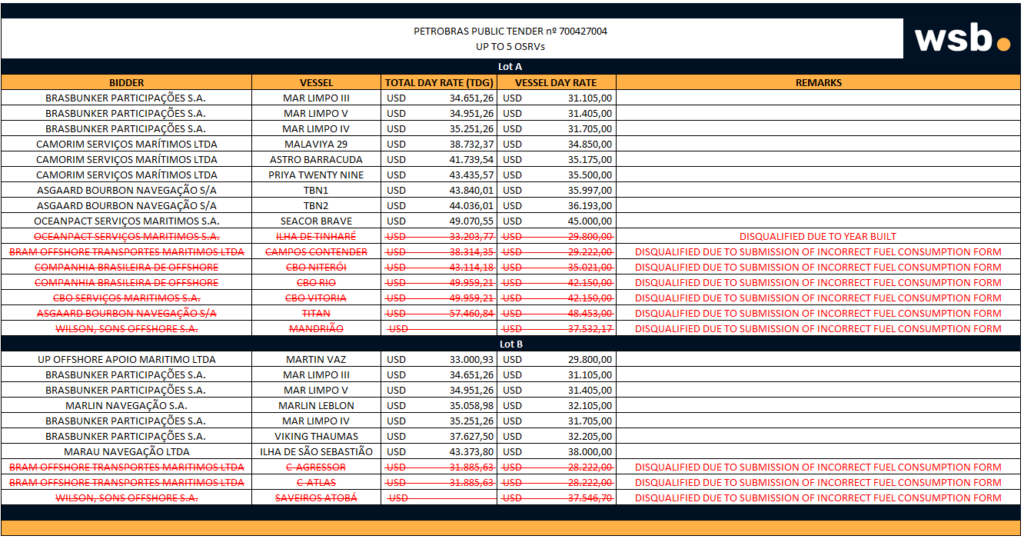
    Petrobras recently published the official ranking of proposals for the latest OSRV (Oil Spill Response Vessel) tender. 10 vessels were disqualified, 9 of which due to the mistaken submission of the fuel consumption spreadsheet, affecting 4 distinct owners. Currently, 13 vessels remain under consideration, divided into 2 lots.

    Root cause: An initial error in the documentation package provided by Petrobras, which included the wrong spreadsheet (PSV consumption scenarios instead of OSRV). In Q&A Circular 6 of 8, a corrected spreadsheet was made available, but many participants missed this update.

    What lesson can be learned from this tender process? Your insights and comments are welcome.

    For the complete list of disqualified vessels and owners, as well as those still under consideration, please check the image below

  • Normand Maximus coming to Rio de Janeiro

    Normand Maximus coming to Rio de Janeiro

    By Omar Darian

    The state-of-the-art CSV Normand Maximus has departed from Las Palmas and is en route to Rio de Janeiro. The Solstad Offshore ASA-owned vessel was chartered by Saipem and will be engaged on the Búzios 7 project, awarded to the Italian company at the end of 2021.

    The project includes the Engineering, Procurement, Construction and Installation (EPCI) of the Steel Lazy Wave Risers (SLWR) and associated flowlines interconnecting 15 subsea wells to the FPSO together with the related service lines and control umbilicals. Furthermore, Saipem will also be responsible for the provision and installation of the FPSO anchors and for the hook up of the FPSO at field.

    Normand Maximus is the result of innovative design philosophy aimed to combine SURF installation with field development activities in ultra-deep water. She is DP3, has a large working deck (2500m2), a main crane and an auxiliary crane with 900T and 150T capacity respectively.

  • 2 become 10

    2 become 10

    “Petrobras is facing ‘owner’s market’ conditions. The oil giant remains asking for too extended offer validity periods, and vessels are getting fixed elsewhere in a much more dynamic market. Notwithstanding, owners’ challenges with financing modifications and other particular requirements of the Brazilian market remain, Petrobras ain’t getting what they expect to hire.

    The inevitable consequence is to review ongoing tenders as the current PSV demand being revised from 2 PSV/OSRV type to 10 units, now including oil, general cargo, fluid carriers and multipurpose PSV specs.”

    This is the reflection of Alexandre Vilela, CEO of WSB, on the recent change promoted by Petrobras in opportunity 7004270127 via Petronect.

  • Petrobras: chartering news

    Petrobras: chartering news

    Newbuilding tender: Petrobras opens for all tenderers (no pre-qualification). Also, PEOTRAM only demanded upon contract commencement. Maximum of 4 vessels per bidder remains.

    AHTS: New tender coming still within May 2024.

    OSRV: New tender coming November 2024.

    PSV: Three of five tenders still coming out this year. More flexibility: Mob and demob to be allowed on foreign flag vessels offers + 60 days firm offer short from originally 120 days added of automatic 60 days validation only if offer qualify.

    PSV 2025: Two tenders already confirmed for 2025.

    These news from LOEP. US-SUB demands and tenders not included on this note.

  • PSV en route to Brazil

    PSV en route to Brazil

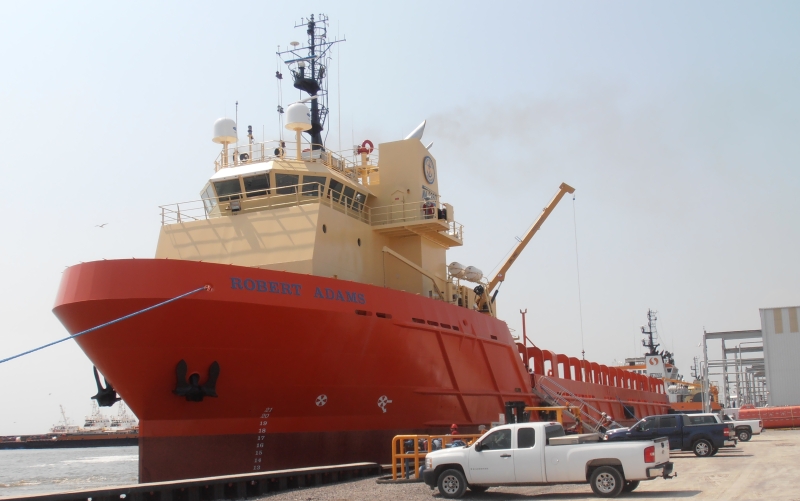
    Following the award as “PSV 4500 general cargo”, Bram’s Robert Adams is en route to Rio de Janeiro. She will commence a 1460-days firm charter with Petrobras alongside another PSV from Bram’s fleet; Juan C which has recently arrived in Brazil. After a long period prioritizing the hiring of national tonnage, Petrobras will be chartering both vessels under foreign flag.