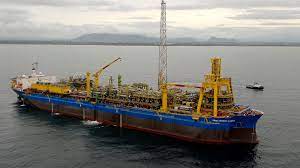
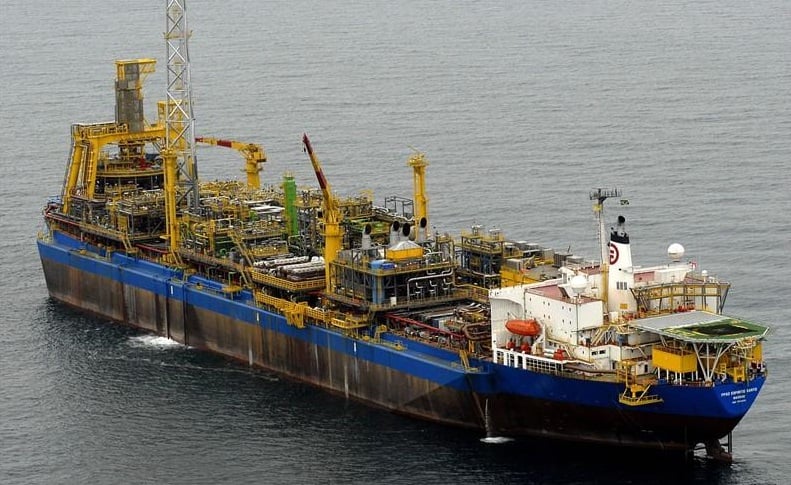
Shell have returned to their quest of finding an AHTS vessel to assist in the heading control of FPSO Espírito Santo and likely other internal demands from their producing fields as well. The Dutch company had already issued a spot requirement before the Carnival holidays but, due to an extremely high utilization of AHTS vessels in Brazil, there are no available candidates at the moment. The requirement is firm for 3 days with additional 15 days options and commencement window set for March 2nd or earlier, in case any options arise.
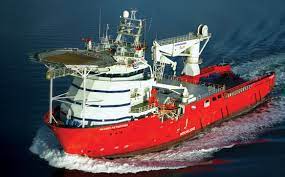
DOF Subsea Brasil has secured a contract for a SURF (Subsea Umbilical Riser and Flowline) project in Brazil. The Norwegian base offshore support company will mobilize RSV Geoholm for the contract. Mobilization is set to start in March 2023. The term contract is for 180 firm days with extension options to be agreed. The Charterer has not yet been disclosed, we shall report further when more info is made available.
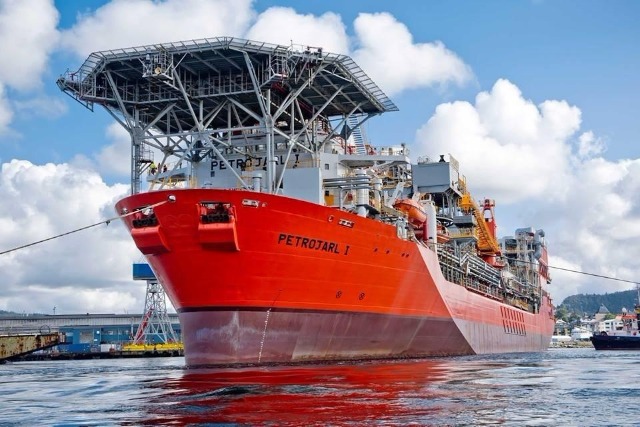
Enauta’s FPSO Petrojarl I has entered preventive maintenance which should be concluded by the beginning of next week. The company explained that this type of activity is part of the operational routine of floating production units that normally operate with an efficiency uptime close to 90%.
According to Enauta, Petrojarl I had an operation rate of 92% in 2022 and this maintenance is included in the FPSO operation plan hence shall not affect future oil production estimates.
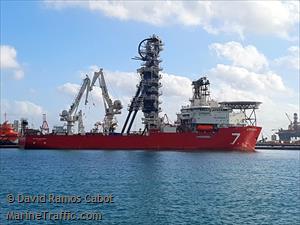
Subsea7´s PLSV Seven Cruzeiro has been awarded a contract extension by Petrobras. With the new agreement, she is firm with the Brazilian oil company until November 2023.
After receiving non-binding proposals from Karoon, Enauta and PRIO for the sale of Parque das Conchas field in Campos basin, Shell decided to withdraw the sale of the asset. The field currently produces through FPSO Espirito Santo. In parallel, the company is reviewing the proposals received for the decommissioning of Bijupira and Salema fields, also located in Campos basin.
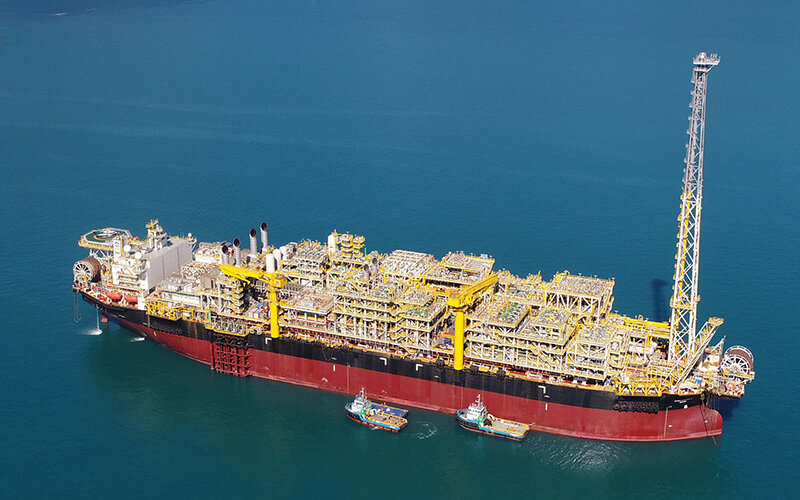
A Final Investment Decision for Lapa field was made by Total Energies earlier this week. The French oil major is the operator of the field with 45% interest. Shell and Repsol Sinopec are partners with 30% and 25% respectively. It has been decided that Lapa Southwest region will be developed by FPSO Lapa, currently located 12 Km away in the Northeast region of the field, with which three wells will be connected. Expectations are for an increased production of 25,000 bopd and first oil to be produced in 2025. Total investment for this project will be of $1 Billion.
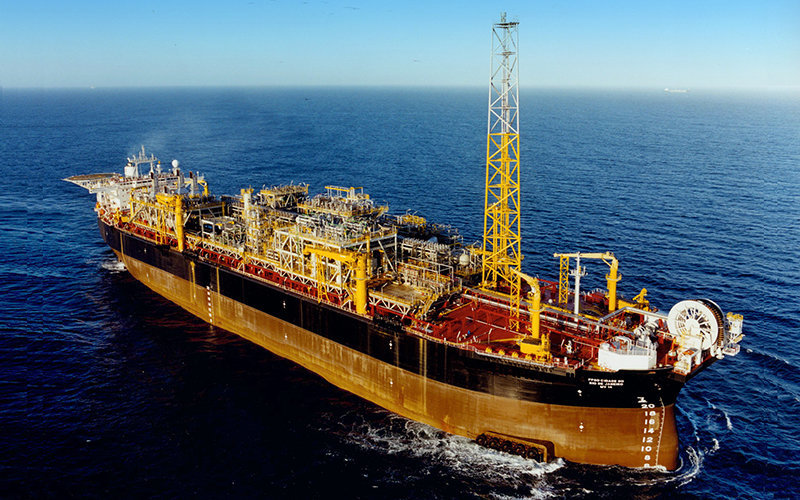
Petrobras has announced that FPSO Guanabara has recently reached its full production capacity. Installed in Mero field, pre-salt of Santos basin, the unit produced 180,000 barrels of oil in one day 8 months after its operation has started. Mero field also counts with FPSO Pioneiro de Libra producing 50,000 bopd. Petrobras is the operator of the consortium with 38,6% interests, balance split between Shell, Total, CNODC, CNOOC and PPSA.
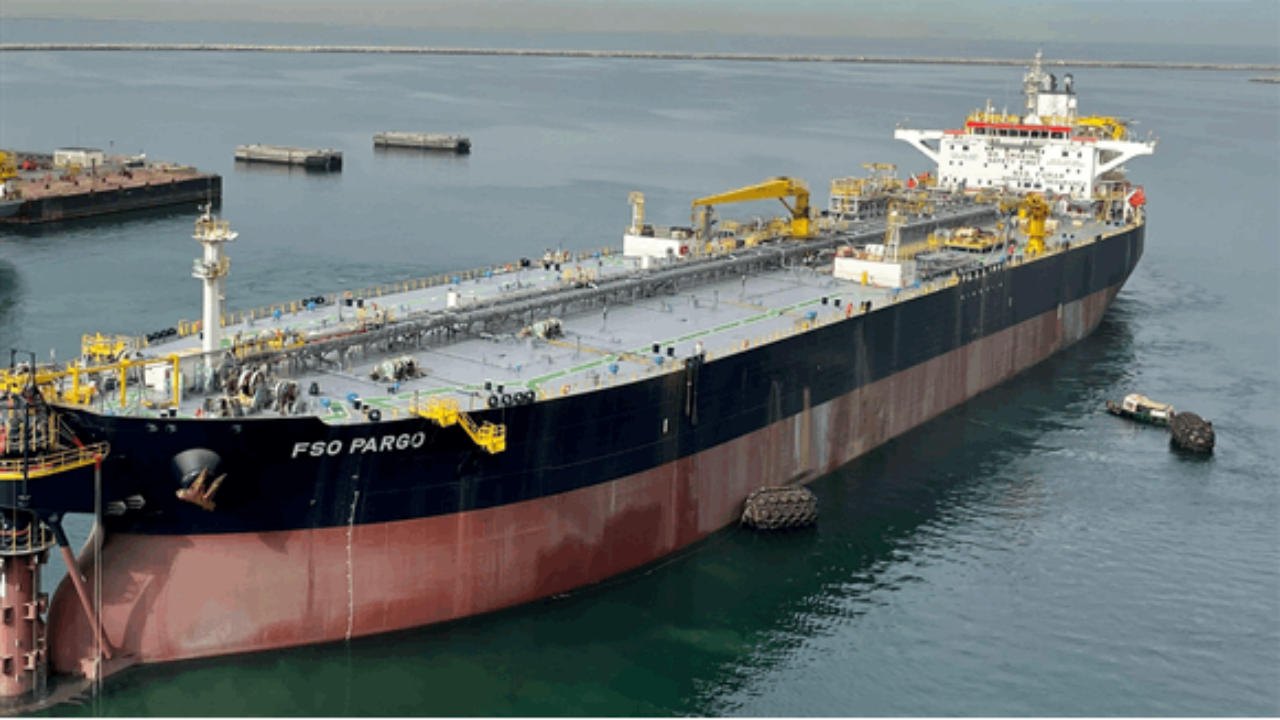
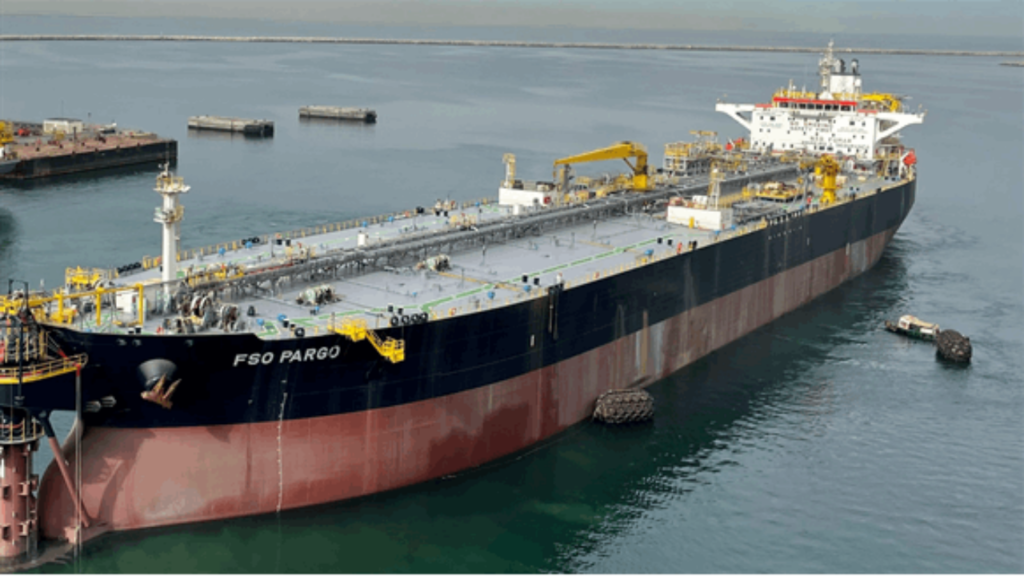
Perenco’s floating storage and offloading unit, FSO Pargo departed Dubai and is on its way to Brazil. The vessel spent almost one and a half years in a yard, working to extend its life spaN as well as necessary adaptations to comply with Brazilian regulations and project specifics. The FSO is expected to be moored at Pargo field in Campos Basin by April, aiming to start operations in August 2023. The installation of the unit is part of a USD 400 million investment plan, targeting the enhancement of the field’s production throughout the concession. Ever since taking the operatorship of the Pargo cluster, which comprises the fields Pargo, Carapeba and Vermelho, PERENCO’s asset’s production had already increased from 2.800 bpd to 12.000 bpd, with the expectation to increase it by a further 25% until the end of this year.
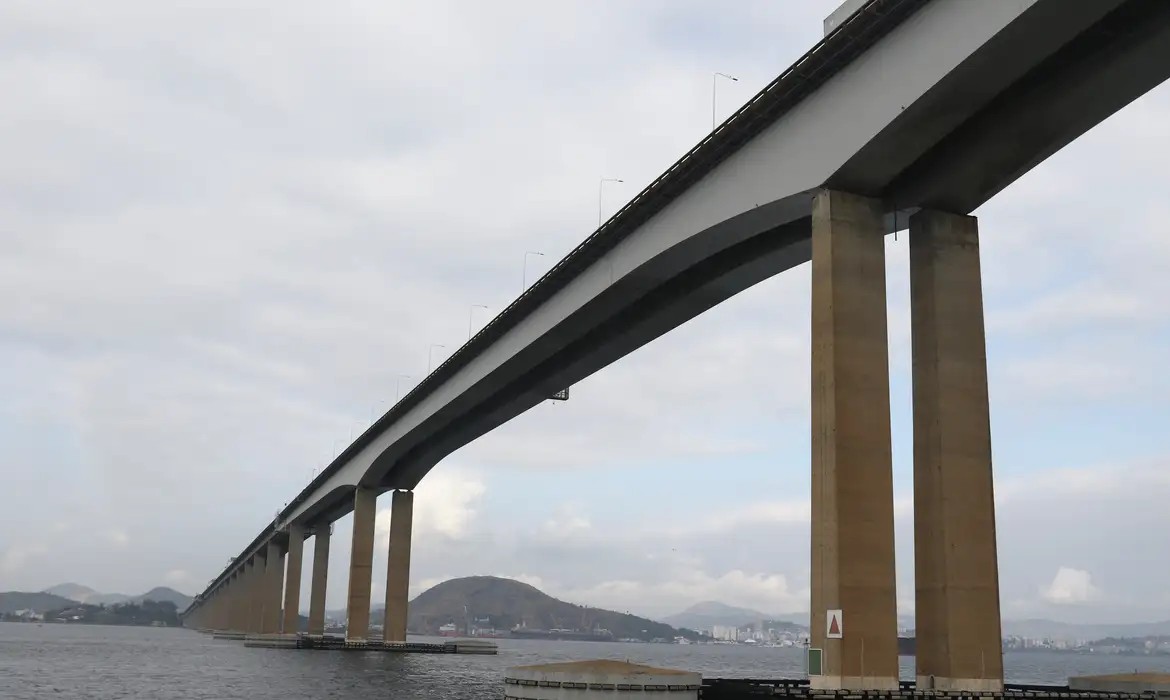
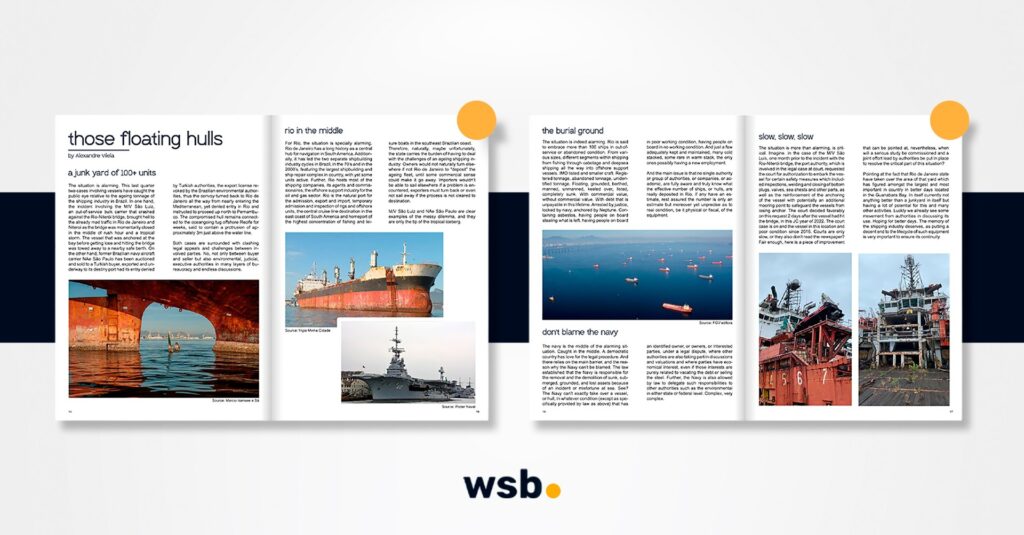
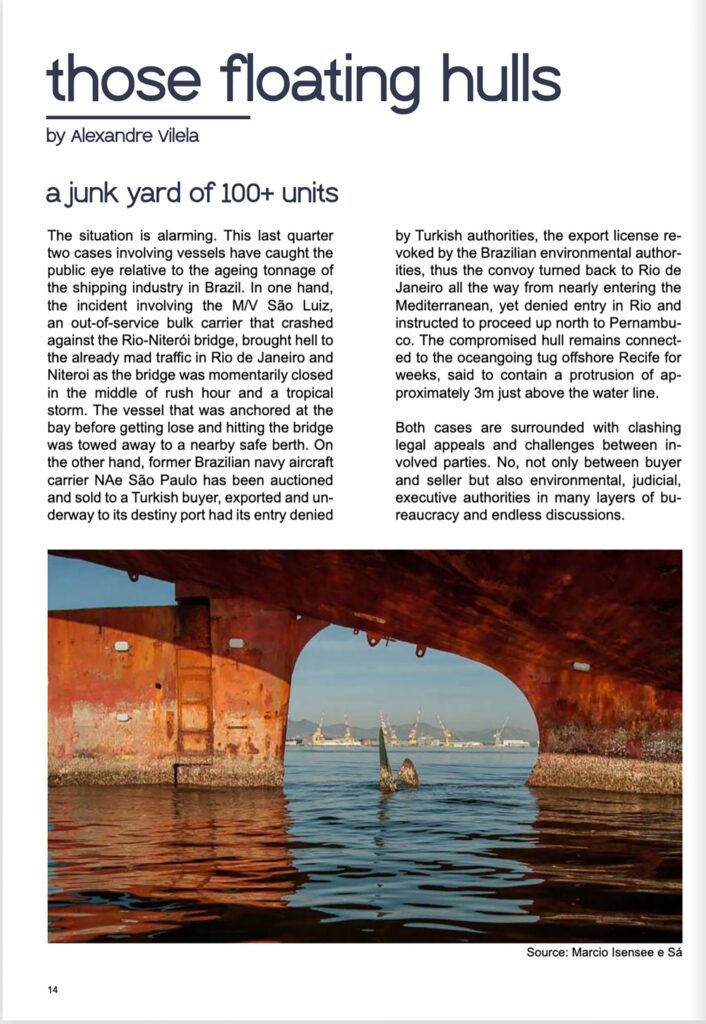
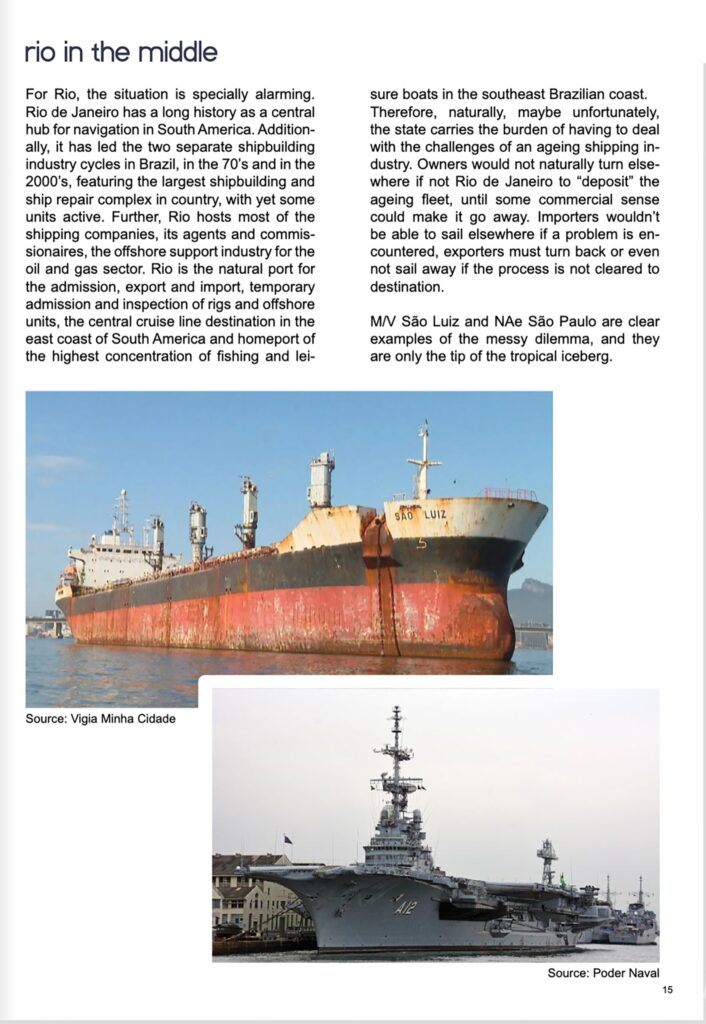
This last quarter two cases involving vessels have caught the public eye relative to the ageing tonnage ol the shipping industry in Brazil.In one hand the incident involving the M/V São Luiz, an out-of-service bulk carner that crasined against the Rio-Niterói bridge, brought hell to the already mad traffic in Rio de Janeiro and Niterói as the bridge was momentarily closed in the middle of rush hour and a tropical storm. The vessel that was anchored at the bay before getting lose and hitting the bndge was towed away to a nearby safe berth.
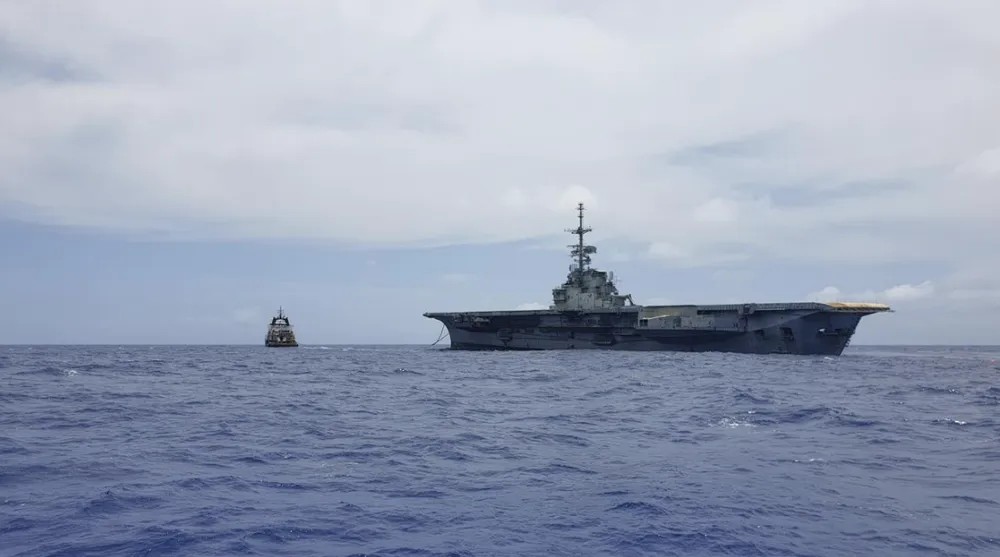
On the other hand, former Brazilian navy aireraft carrier NAe São Paulo has been auctioned and sold to a Turkish buyer, exported and underway to its destiny port had its entry denied by Turkish authorities, the export license re voked by the Brazilian environmental authorities, thus the convoy turned back to Rio de Janeiro al the way from nearly entering the Mediterranean, yet denied entry in Rio and instructed to proceed up north to Pernambuco. The compromised hull remains connected to the doeangoing tug ofishore Recife for weeks, said to contain a protrusion of approximately 3m just above the water line.
Both cases are surrounded with clashing legal appeas and challenges betwean involved parties. No, not only between buyer and seller but aiso environmental, judicial executive authorties in many layers of bureaucracy and endless discussions.
Rio de Janeiro has a long history as a central hub for navigation in South America. Additionally, it has led the two separate shipbuilding industry cycles in Brazil, in the 70’s and in the 2000 s, featuring the largest shipbuilding and ship repair complex in country. with yet some units active.
Further, Rio hosts most of the shipping companies, its agents and commis-sionaires, the offshore support industry for the oil and gas sector. Rio is the natural port for the admission, export and import, temporary admission and inspection of rigs and olishore units, the central cruise line destination in the east coast of South America and homeport of the highest concentration of fishing and lei-sure boats in the southeast Brazilian coast.
Therefore, naturally, maybe unfortunately, the state carries the burden of having to deal with the challenges of an ageing shipping industry. Owners would not naturally turn else-where if not Rio de Janeiro to “deposit” the ageing fleet, until some commercial sense could make it go away. Importers wouldn’t be able to sail elsewhere if a problem is en-countered, exporters must turn back or even not sail away if the process is not cleared to destination.
MN São Luiz and NAe São Paulo are clear examples of the messy dilemma, and they are only the tip of the tropical iceberg.
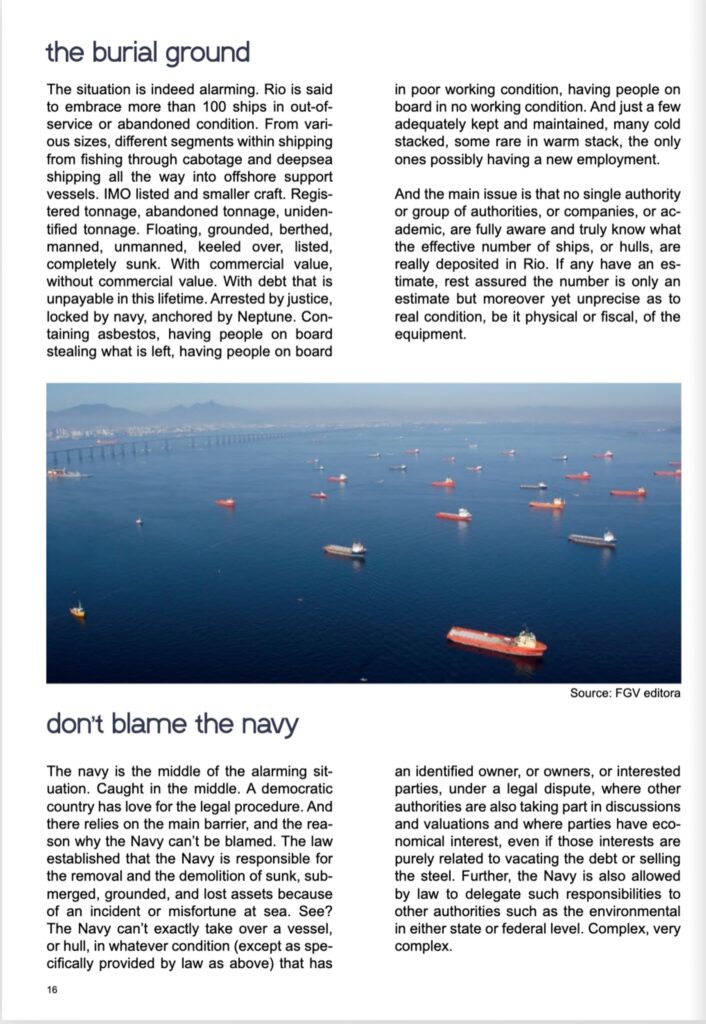
Rio is said to embrace more than 100 ships in out-of-service or abandoned condition. From various sizes, different segments within shipping from fishing through cabotage and deepsea shipping all the way into offshore support vessels. IMO listed and smaller craft. Registered tonnage, abandoned tonnage, unidentified tonnage. Floating, grounded, berthed, manned, unmanned, keeled over, listed completely sunk. With commercial value, without commercial value. With debt that is unpayable in this lifetime. Arrested by justice, locked by navy, anchored by Neptune containing asbestos, having people on board stealing what is left, having people on board in poor working condition, having people on board in no working condition. And just a few adequately kept and maintained, many cold stacked, some rare in warm stack, the only ones possibly having a new employment.
And the main issue is that no single authority or group of authorities, or companies, or academic, are fully aware and truly know what the effective number of ships, or hulls, are really deposited in Rio. If any have an es-timate, rest assured the number is only an estimate but moreover yet unprecise as to real condition, be it physical or fiscal, of the equipment.
The navy is the middle of the alarming situation. Caught in the middle. A democratic country has love for the legal procedure. And there relies on the main barrier, and the reason why the Navy can’t be blamed. The law established that the Navy is responsible for the removal and the demolition of sunk, sub-merged, grounded, and lost assets because of an incident or misfortune at sea. See?
The Navy can’t exactly take over a vessel. or hull, in whatever condition (except as specifically provided by law as above) that nas 16 an idenufied owner, or owners, or interested parties, under a legal dispute, where other authorities are also taking part in discussions and valuations and where parties have economical interest, even if those interests are purely related to vacating the debt or selling the steel. Further, the Navy is also allowed by law to delegate such responsibilities to other authorities such as the environmental in either state or federal level.
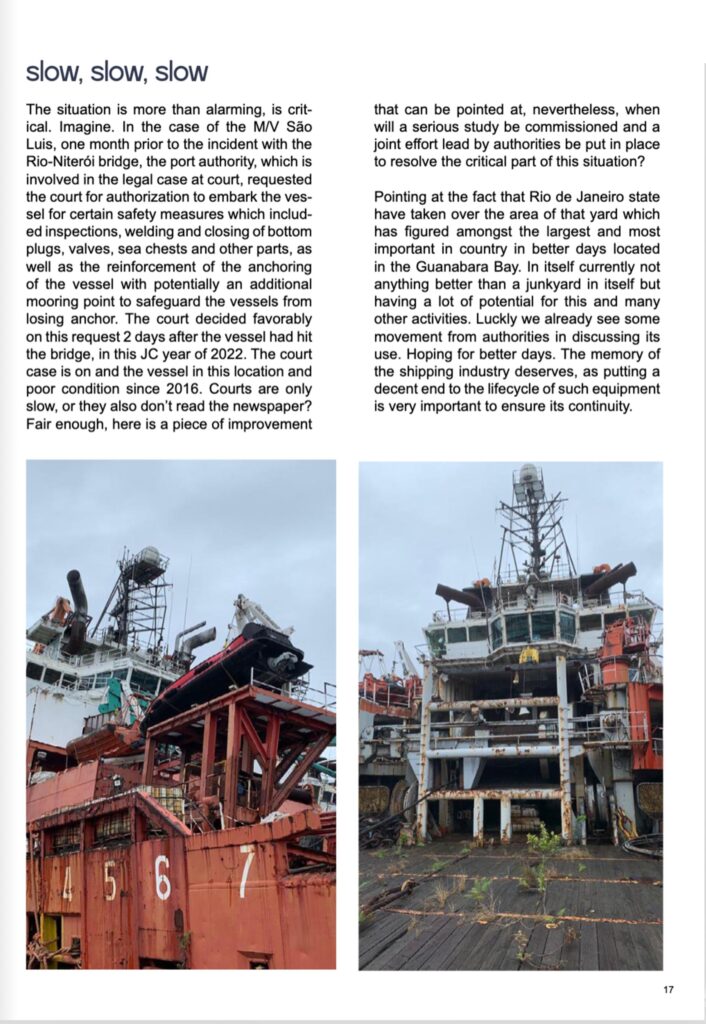
The situation is more than alarming. is crit-ical. Imagine. In the case of the MY São Luis, one month prior to the incident with the Rio-Niterói bridge, the port authority, which is involved in the legal case at court, requested the court for authorization to embark the ves. sel for certain safety measures which included inspections, welding and closing of bottom plugs, valves, sea chests and other parts, as well as the reinforcement of the anchorng of the vessel with potentially an additional mooring point to safeguard the vessels trom losing anchor.
The court decided favorably on this request 2 days alter the vessel nagu the bridge, in this JC year of 2022. The court case is on and the vessel in this location and poor condition since 2016 Courts are only slow, or they also don’t read the newspaper? Fair enough, here is a piece of improvement that can be pointed at, nevertheless, when will a serious study be commissioned and a joint effort lead by authorities be put in place to resolve the critical part of this situation?
Pointing at the fact that Rio de Janeiro state have taken over the area of that yard which has figured amongst the largest and most important in country in better days located in the Guanabara Bay. In itself currently not anything better than a junkyard in itself but naving a lot of potential for this and many oiner activities. Luckly we already see some movement from authorties in discussing its use Hoping for better days. The memory of the shipping industry deserves, as putting a decent end to the lifecycle of such equipment is very important to ensure its continuity.
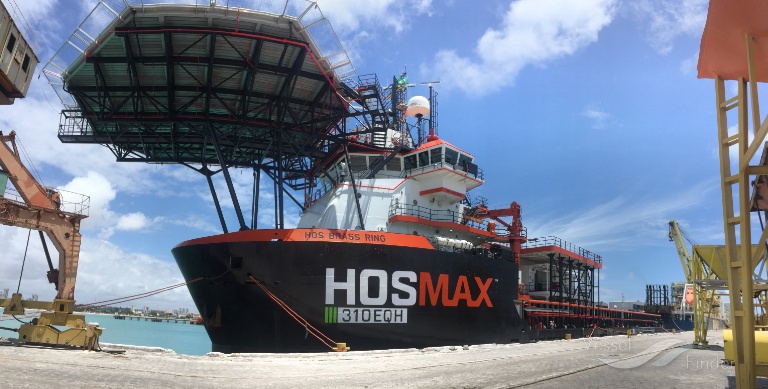
After departing to Guyana in October last year to perform core sampling activities as noticed by WSB, the HOS Brass Ring has made it safely back to Guanabara Bay anchorage. The vessel is being refitted and will soon be trading in Brazilian waters.
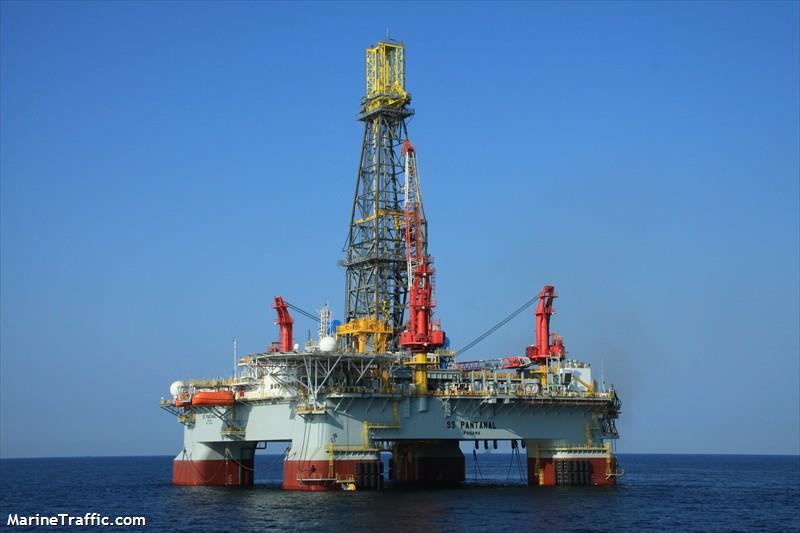
ICBC Leasing, the Chinese financial institution, has announced the sale of the deepwater semi-submersible drilling rig SS Pantanal. The unit was built by Yantai CIMC Raffles Shipyard, delivered in November 2010 and, upon completing final preparations and mobilisation, operated in Brazil from 2012 to 2014. The rig was laid up in Porto do Açu since 2015 and in early 2021 was transported by a Cosco heavy lift to Indonesia where she had remained in lay up since her arrival. According to the auction manager, Zhejiang Shipping Exchange, all the machinery and equipment are shut down and some areas and tanks cannot be presently accessed and inspected. Further, it has not been dry-docked since delivery. The starting price is USD 8 million with bid increments at multiples of USD 0.02 million. Interested parties have until February 9th to register as participants.
Last Friday, Petrobras received offers for the AHTS tender with hybrid propulsion (battery packs). The opportunity aims the hire of up to 2 vessels for a 4-year firm contract period with mobilization expected between July and September this year or 120 days after contract signature, whichever occurs latest. There was some concern over the battery packs requirement however, even with many requests not accepted by Petrobras during the tender process and several postponements of the submission deadline, the opportunity displayed a decent number of competitors, granted this was the first ever public tender to demand a hybrid propulsion solution. Amongst a total of 9 vessels presented to Petrobras, CBO snatched the first two places at USD 39.650,00/day with their AHTSs acquired from Finarge – AH Liguria and AH Valletta. Although bidders had to comply with the battery requirement, the winning rates did not wander too far from the USD 35.000 winning day rate in the previous AHTS tender which did not require any kind of hybrid propulsion. Despite not waiving the hybrid propulsion while understanding the technical and logistics challenges involved in such adaptation, Petrobras granted the awarded vessels a 12 month-window from the start of the contract to be fully compliant with this requirement.