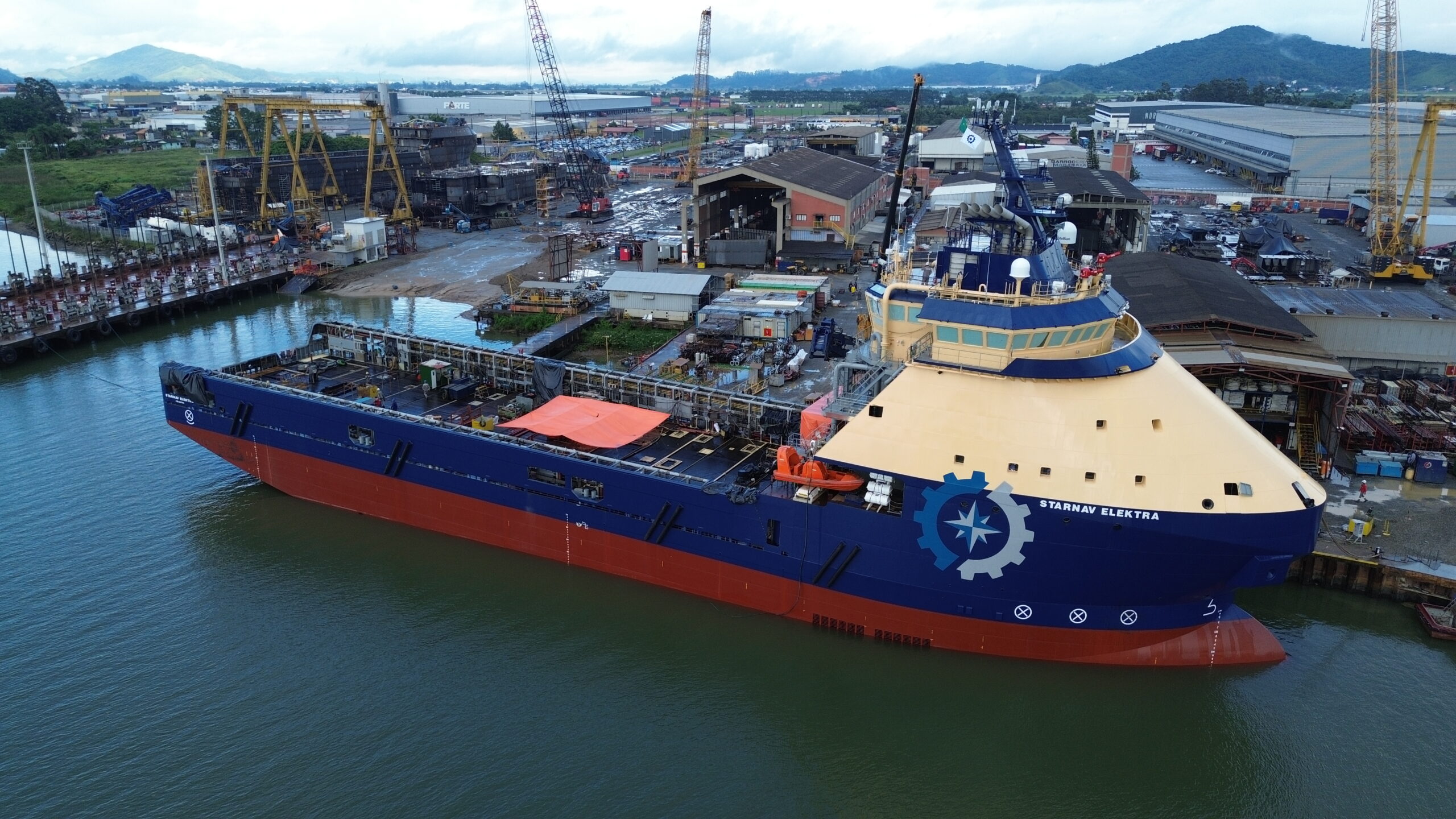
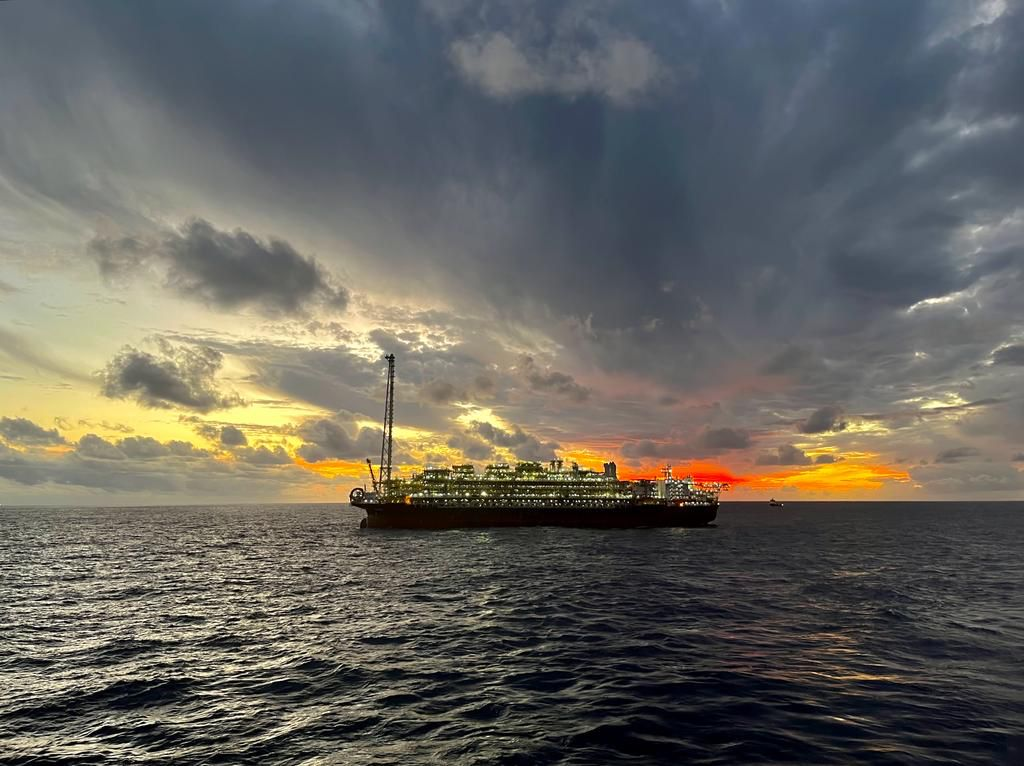
Detroit Brasil shipyard launched, in late March, the Starnav Elektra, a new PSV for Starnav Serviços Marítimos, with delivery scheduled for July 2026. The vessel stands out for its larger dimensions within the fleet, with 5,500 tons of deadweight and 1,000 m² of deck space.
Measuring 92.1 meters in length and 20 meters in beam, it expands the company’s operational capacity. It is equipped with DP2, accommodation for 42 people, and Schottel azimuth propulsion. Its main differentiator is the hybrid system with batteries supplied by WEG. The engines comply with the IMO Tier III standard, featuring an SCR system for emissions reduction.
It also incorporates advanced solutions for energy efficiency and maneuverability. It will be the first hybrid vessel built in Brazil with the Hybrid notation from the American Bureau of Shipping (ABS).
Want to learn more about this vessel? Stay tuned for our next magazine issue.
1. Mota-Engil secures R$728 million decommissioning contract with Petrobras
Mota-Engil has signed a new contract with Petrobras worth R$728 million to execute subsea decommissioning services in Campos Basin. The five-year agreement includes engineering, preparation, removal and final disposal of offshore structures, reinforcing ongoing efforts to advance Brazil’s decommissioning agenda.
2. Camorim advances into heavy-lift segment with new Super Derrick Barge
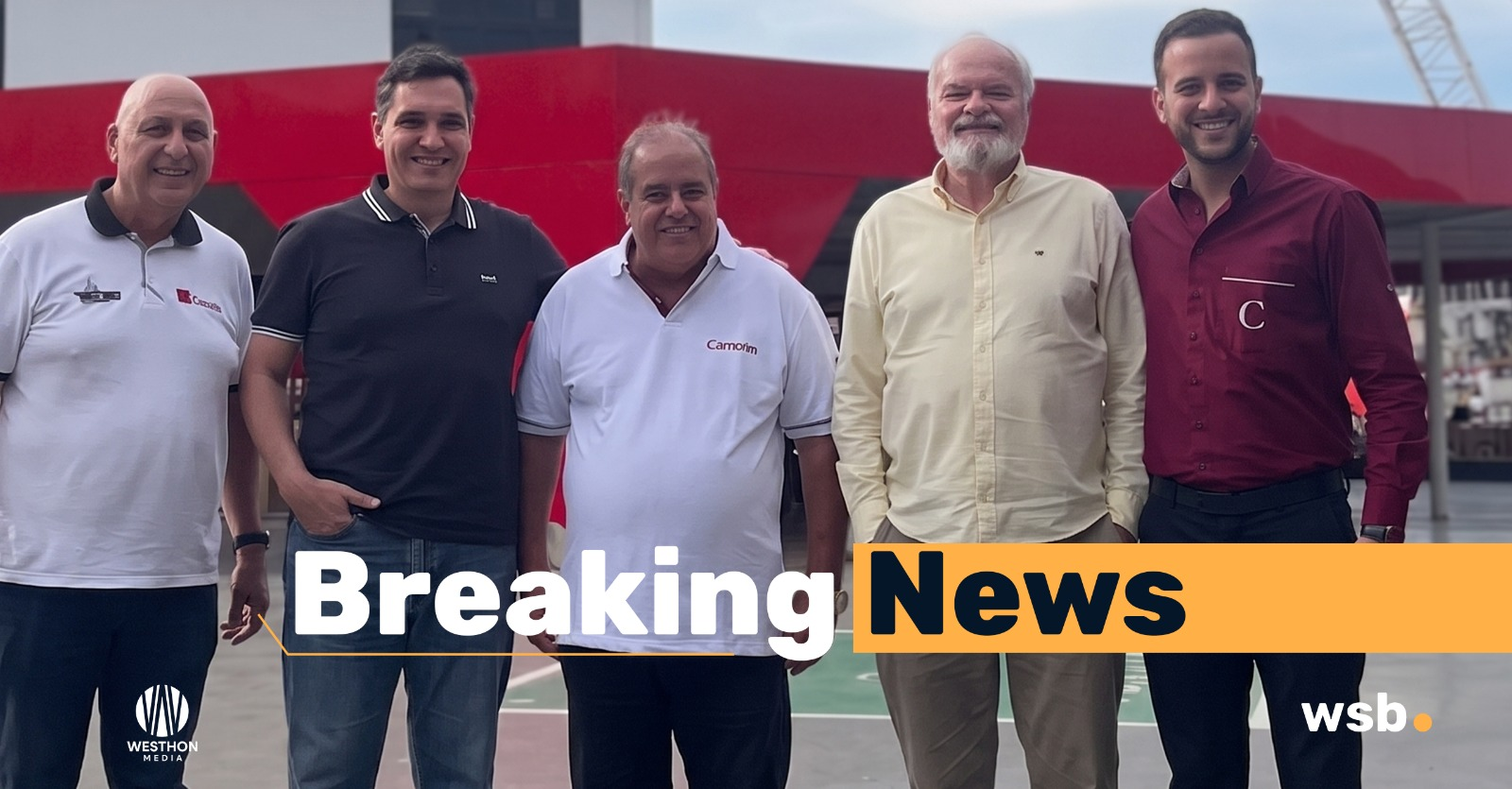
Camorim confirmed the construction of a Super Derrick Barge (Super Cábrea) in partnership with Grupo Tomé, marking a strategic move into larger-scale lifting operations within Brazil’s maritime and offshore support segment. The project involves an investment of R$52 million and will be built at Estaleiro Juruá, in Manaus. The unit is scheduled to enter operation in March 2027.
Technical specifications indicate a lifting capacity of 750 tons, supported by an eight-point anchoring system, positioning the asset to support complex offshore installation, decommissioning and logistics operations.
Although Camorim already operates barges and derrick units, this project represents its first asset at this scale, signaling a step-change in operational capability and market positioning. According to company leadership, the investment is aligned with fleet expansion strategy and aims to increase participation in higher-complexity offshore projects in Brazil.
3. Halliburton signs multibillion unconventional contract with YPF
Halliburton has signed a long-term, exclusive contract with YPF to provide integrated unconventional completion services in Vaca Muerta. Although financial details were not disclosed, the agreement was described as a multibillion-dollar deal, further strengthening Halliburton’s position in Argentina’s shale development.
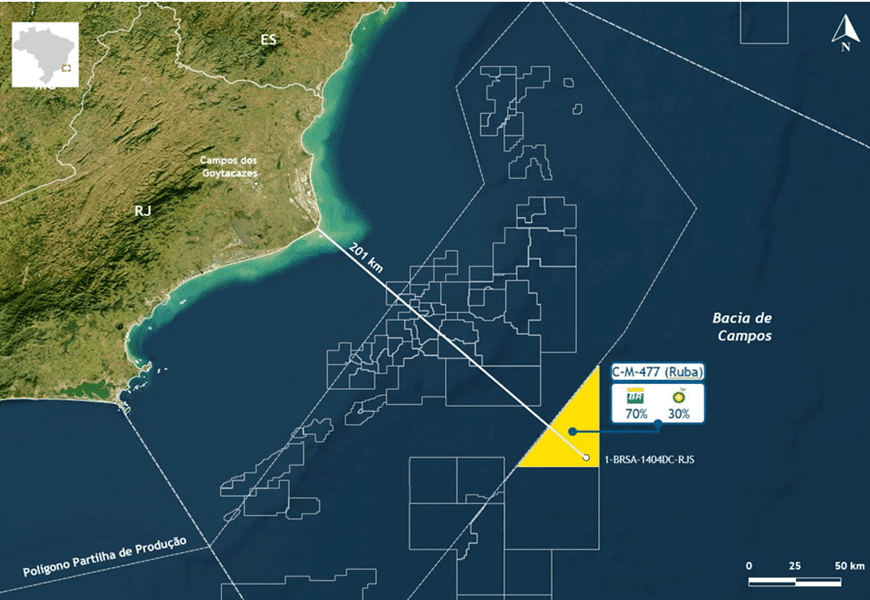
Petrobras has announced this Monday (April 13) a new hydrocarbon discovery in the pre-salt section of the Campos Basin, confirming the presence of hydrocarbons in an exploratory well drilled in the SC-AP4 sector, block C-M-477, located 201 kilometers offshore the state of Rio de Janeiro at a water depth of 2,984 meters.
According to the company, the hydrocarbon-bearing interval was identified through electric logs, gas indications and fluid sampling. The collected samples will now undergo laboratory analysis to characterize the reservoir and fluid conditions, a step that will support the ongoing assessment of the area’s exploratory potential.
The announcement adds to Petrobras’ efforts to replenish reserves in mature offshore areas, with the company maintaining 70% interest in the block alongside BP, which holds the remaining 30%.
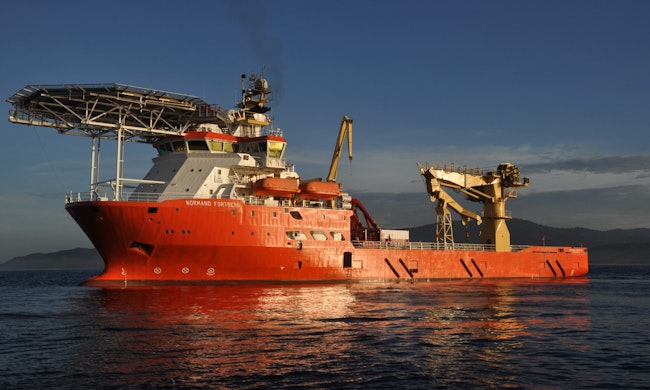
Solstad Offshore announced on April 13 a two-year contract extension with Petrobras for the construction support vessel (CSV) Normand Fortress, starting in July 2026. The gross contract value is estimated at approximately USD 56 million, under a bareboat arrangement. Built in 2006, the vessel will reach 20 years of service in 2026. It has a deadweight of 4,170 tonnes, a beam of 19.7 meters, and operates under the Norwegian flag.
Want more details about this vessel and/or this contract? Subscribe to WSB One.
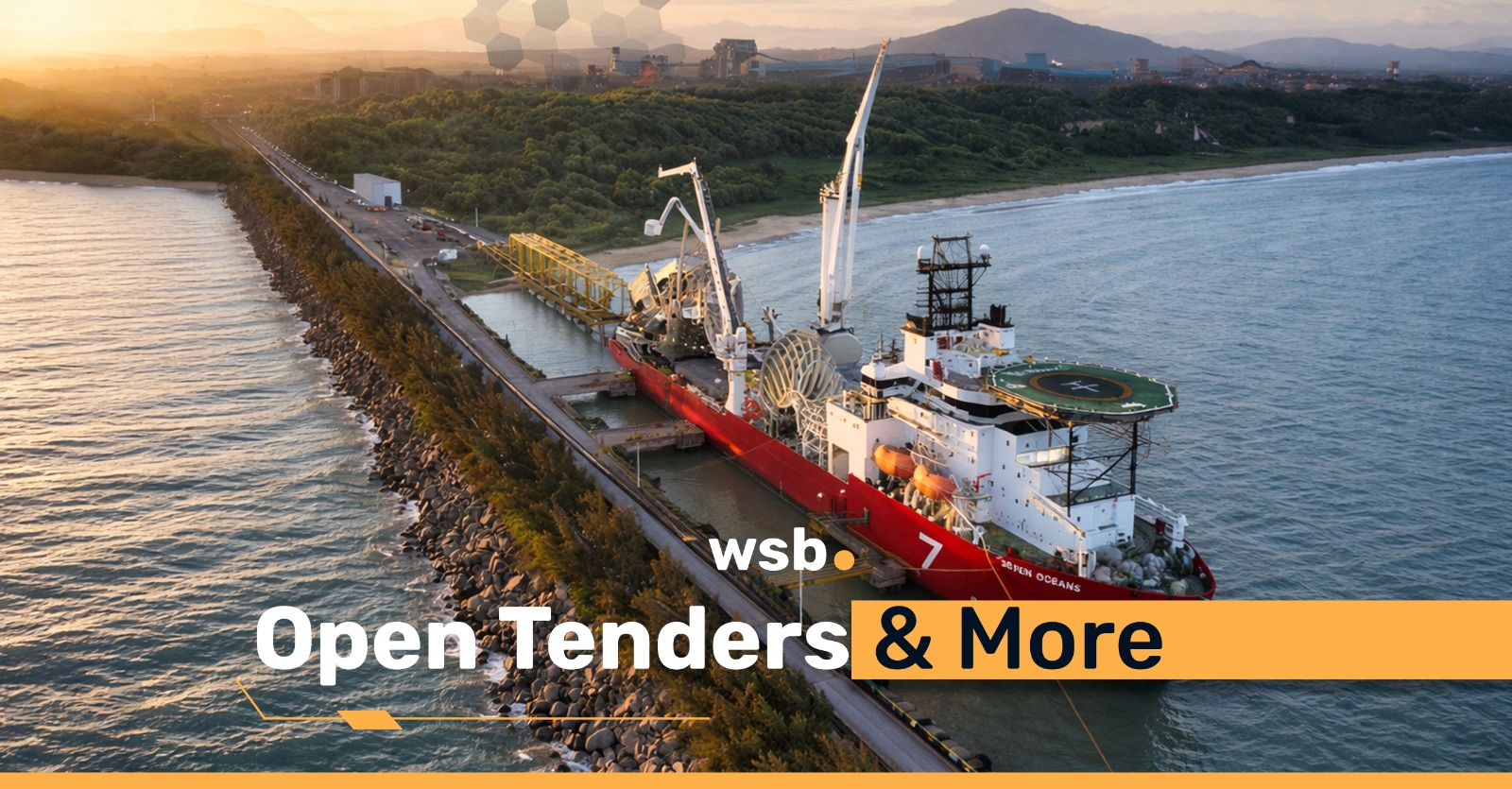
WSB is pleased to provide an update on the current long-term tenders that are open to offer.
Open tenders:
New deadlines were released across ongoing Petrobras opportunities. Below are the latest changes monitored by WSB Advisors.
What has changed?
Petrobras — Up to 4x SOVs: Opportunity 7004563745, new deadline April 10th, 2026 • Petrobras — FPSO for Albacora Revitalization: Opportunity 7004415516, new deadline July 6th, 2026
What else is happening?
Subsea7 signed a supermajor contract, exceeding USD 1.25 billion, with Petrobras for the development of the Sépia 2 field in the Santos Basin pre-salt, located approximately 280 km offshore Rio de Janeiro. The scope includes engineering, procurement, fabrication, installation and pre-commissioning of subsea systems for 17 wells, as well as a gas export line. Project management and engineering activities are set to start immediately, with offshore operations scheduled from 2029.
Stay informed on key offshore developments — visit wsb-one.com, our data platform trusted by leading offshore companies.
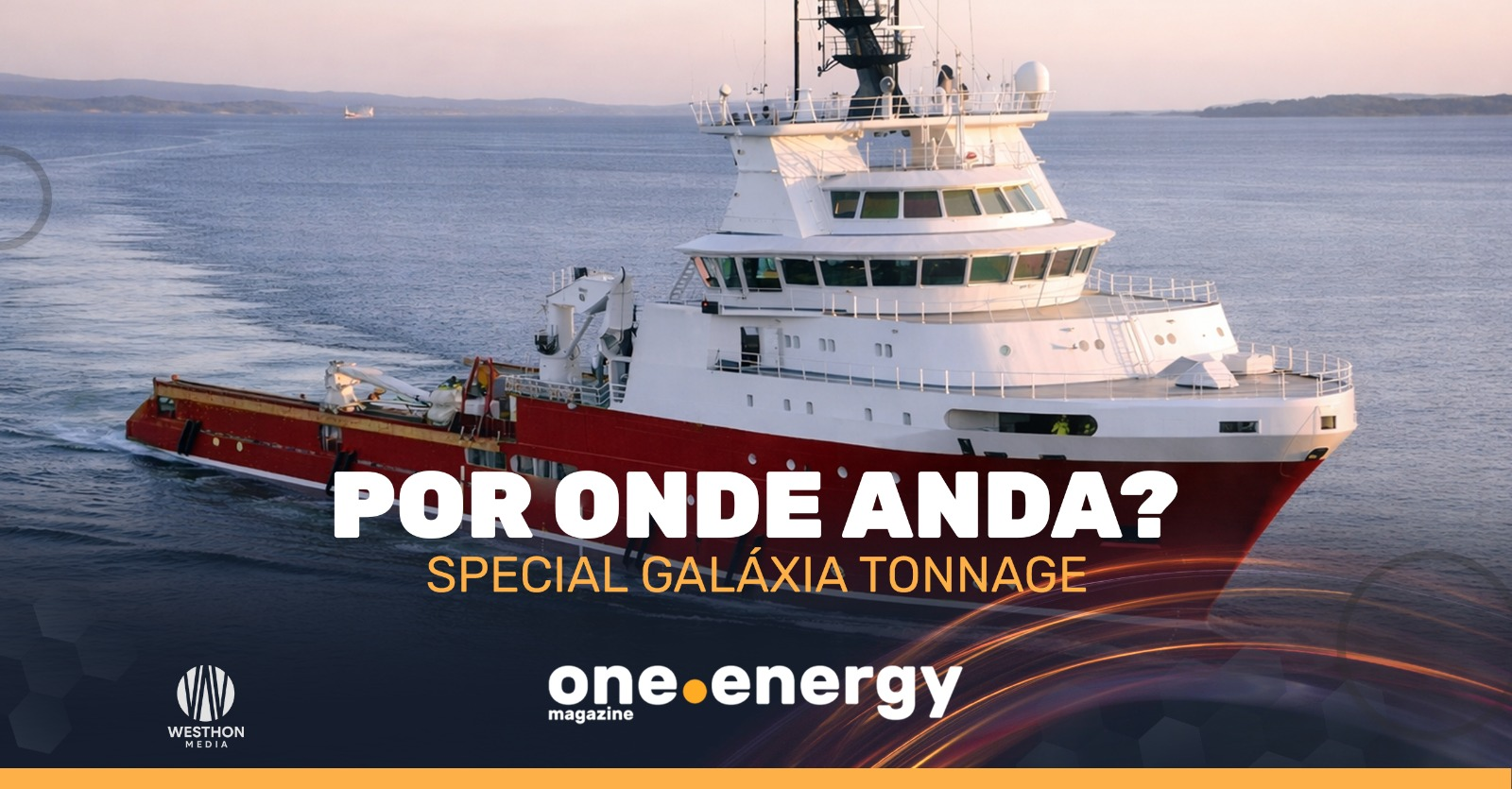
As the market’s primary reference for fleet data—also reflected in our WSB One Database—we are frequently challenged by clients to explain not only where vessels are, but under what structures they remain where they are.
That is precisely what happened following our recent article on Atlas Z. As readers and users looked more closely into the Galáxia fleet, a broader question began to emerge: where is the Brazilian tonnage sustaining the REB eligibility of some of the group’s foreign-built vessels now operating under Brazilian flag?
The issue is not marginal.
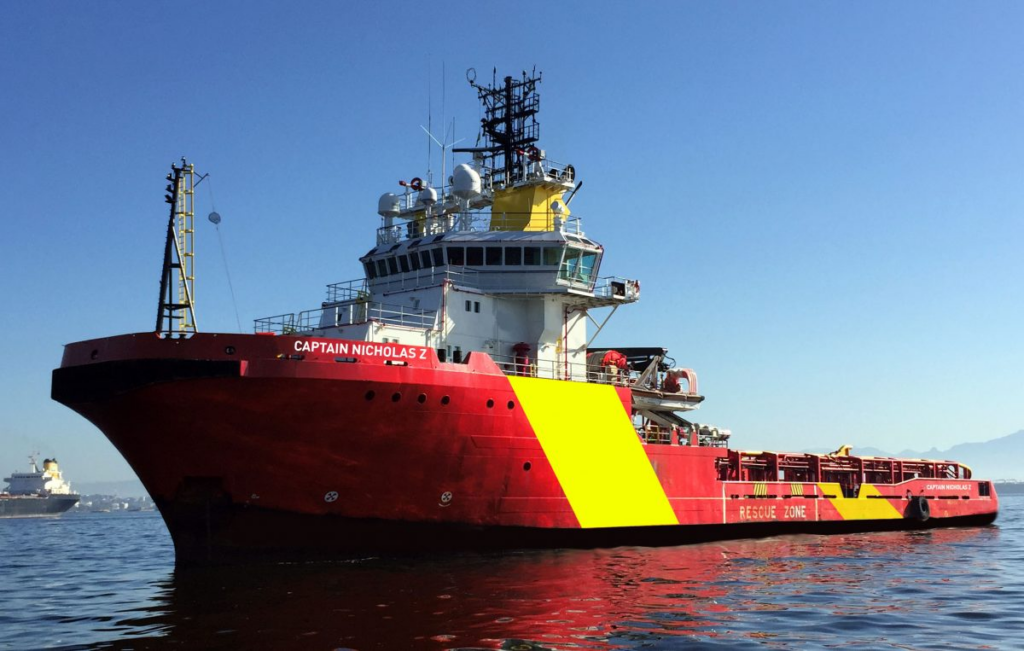
Three vessels originally introduced from abroad and now operating under REB through the Galáxia structure—Captain Nicholas Z, Apollo Z and Theseus Z—appear, at least from publicly available information, to rely on a tonnage base that is difficult to identify with clarity.
The numbers are what make the question unavoidable.
Captain Nicholas Z, with 3,211 tonnes, appears on Galáxia’s own website and in class records, yet is not clearly listed within the publicly visible fleet of either Galáxia Navegação or Galáxia Marítima. Apollo Z and Theseus Z, together representing approximately 4,800 tonnes, do appear linked to Galáxia Marítima. The problem is that Galáxia Marítima, according to official public records, appears to have no local tonnage currently capable of supporting that REB structure.
On the Galáxia Navegação side, the only visible local tonnage appears to be GNL 1015, with approximately 1,800 tonnes. That vessel, although not genuinely Brazilian in origin, became legally valid local tonnage after Galáxia took it over through judicial auction in the aftermath of the Varada case.
Even taking GNL 1015 into account, the structural question remains.
How can Apollo Z and Theseus Z remain under REB if Galáxia Marítima has, for a considerable period, lacked the local tonnage apparently required to sustain that flag structure? And how can Captain Nicholas Z remain under REB through Galáxia Navegação if GNL 1015, as the only visible local-tonnage vessel in that company, does not appear to provide the equivalent tonnage required to support it?
These are not merely theoretical questions.
We have been in contact with the Maritime Court, which confirmed that the condition precedent of equivalent tonnage must be maintained for the vessel to remain eligible under REB. The Court also clarified that any practical action depends on ANTAQ, as regulatory authority, formally informing the Maritime Court that the underlying conditions have been lost.
ANTAQ, for its part, has not yet returned our questions, although it is understood that a process is in its final stages for a definitive decision on the matter.
This is where the issue becomes more significant than a fleet-list discrepancy.
If vessels are able to remain under REB indefinitely until a grace period expires, even after the supporting tonnage has already been lost, then the structure opens room for a potentially unlimited migration of foreign-built tonnage into REB without effective ongoing equivalence. That would not be a minor administrative tolerance, but a material reinterpretation of the rule itself—one that would deserve much clearer visibility from both regulator and Court.
If, on the other hand, due process ultimately confirms that the supporting structure was not validly maintained, the consequences are potentially severe. ANTAQ’s own framework provides for sanctions where regulatory conditions are not preserved.
There is another element worth noting.
Our sources have identified what appears to be a late registration, in ANTAQ, of the charter contract for GNL 1015 by Galáxia Navegação. According to documentation presented by Galáxia itself, that contract was not timely executed to support the initial admission of Captain Nicholas Z into the Galáxia Navegação fleet. ANTAQ itself, in formal correspondence, is understood to have noted that the contract submitted did not cover the vessel’s initial admission period.
That point, if confirmed, would only reinforce the broader concern: not simply whether local tonnage exists today, but whether it existed at the moment it was legally required.
Galáxia could not be reached for comment.
For now, the vessels remain under REB, active and visible in the market.
What remains less visible is the tonnage behind them.
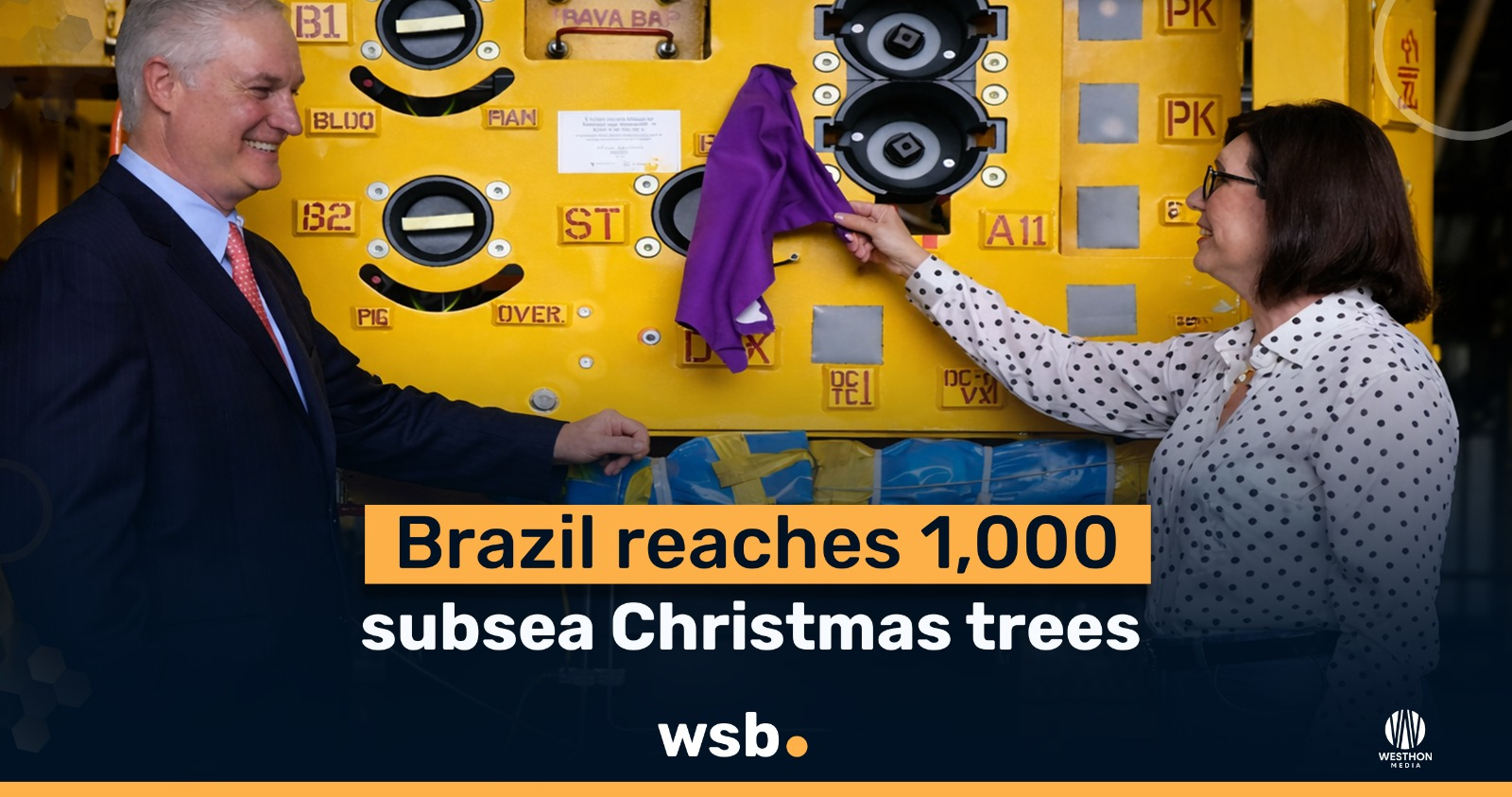
Brazil’s offshore industry reached a new milestone in April 2026 with the manufacturing of its 1,000th subsea Christmas tree, set to be installed in the Búzios Field, operated by Petrobras.The milestone was highlighted during an event attended by Magda Chambriard, reinforcing the strategic role of subsea systems in sustaining Brazil’s offshore production growth.
Subsea Christmas trees are critical components installed on the seabed to control oil and gas flow. In Brazil’s pre-salt, they operate in water depths exceeding 2,000 meters and under high-pressure, high-temperature (HPHT) conditions, requiring high-spec engineering and long-term reliability.
Source: Courtesy/Technip FMC
More than half of the 1,000 units produced to date have been deployed in Petrobras-operated fields, with the majority linked to developments in the Santos Basin — particularly Búzios, currently producing over 1 million barrels of oil per day and ranking among the most productive deepwater assets globally.
The equipment has largely been supplied through long-term partnerships with companies such as TechnipFMC, reflecting decades of technological development and consolidation of Brazil’s subsea supply chain.
Strong visibility for subsea contractors in Brazil Búzios consolidates its position as the main offshore demand hub Continued reinforcement of local content and subsea manufacturing capacity
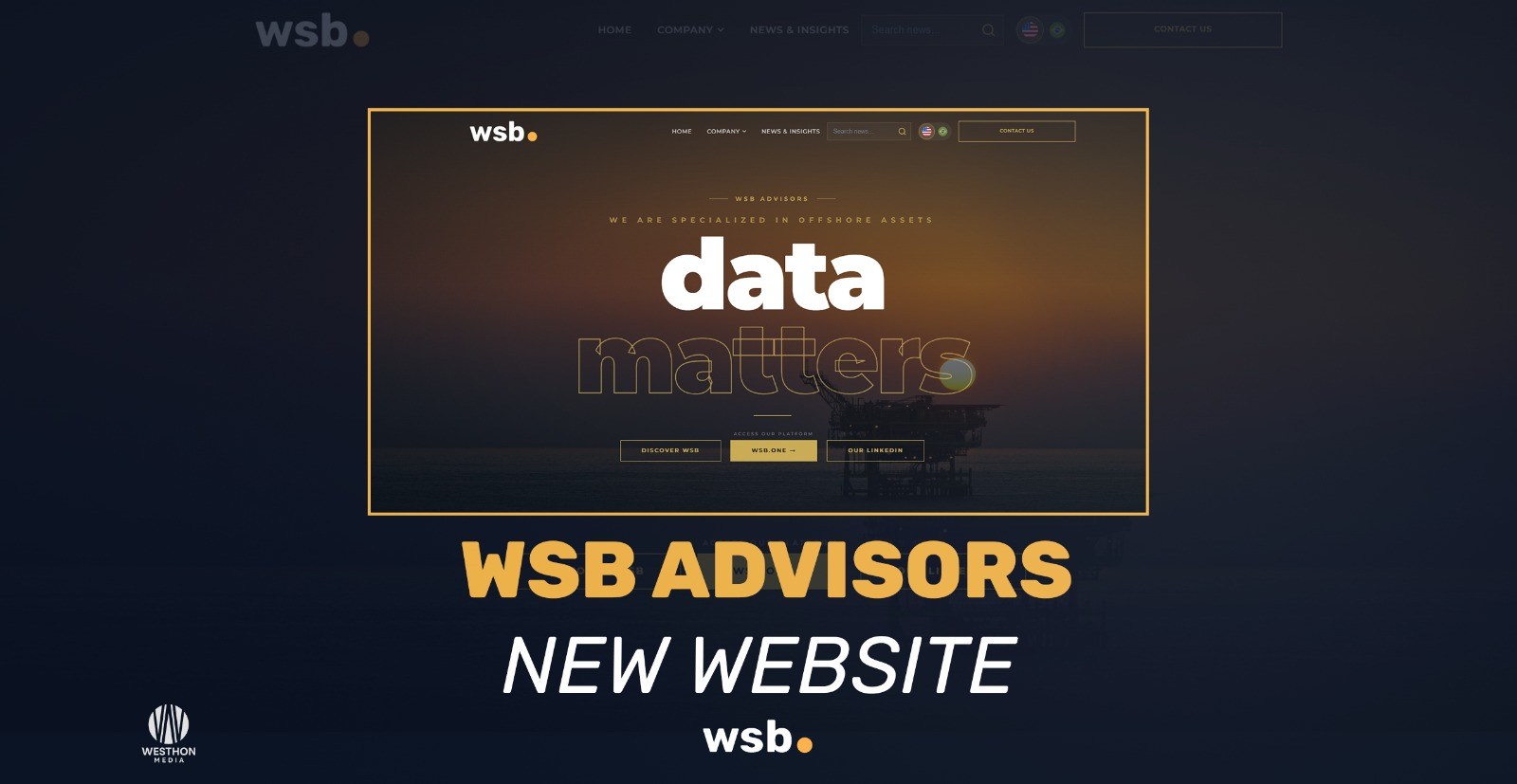
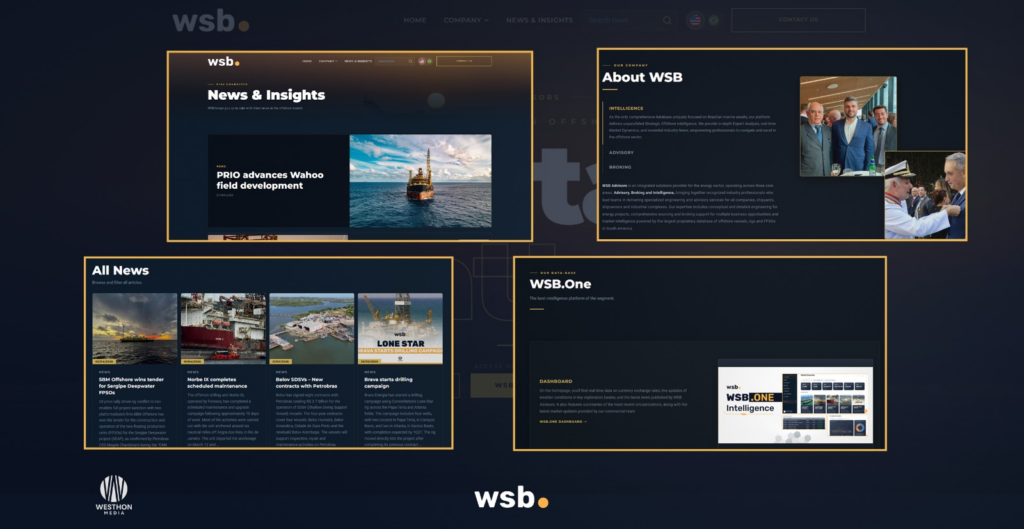
Have you checked out the new WSB Advisors website?
Our Intelligence, Advisory, and Brokerage platform is now live with a fresh new look, featuring greater interactivity, intuitive navigation, and a much smoother user experience. All of this in a faster, more responsive environment designed to enhance user comfort.
In addition to the well-established English version, the website now also offers a fully localized Portuguese version, further expanding our reach.
Same address. Same team. A brand-new experience.
– cms.oneenergynews.com – goes beyond delivering up-to-date market insights, always backed by the sharp perspective of our broker team. The platform also provides direct access to key WSB assets, including One Energy magazine and the WSB One database.
In just a few clicks, you can learn more about our journey, explore our team, and understand why choosing WSB Advisors is always a strategic decision.
We Smart Your Business
Want to be featured on our new platform? Get in touch.
PRIO announced the start-up of the third producing well at the Wahoo Field, in the Campos Basin, with production stabilized at approximately 10,000 barrels of oil per day.
With three wells online, field output has been adjusted to around 32,000 barrels per day as part of the ramp-up process. The company expects to bring a fourth well online by the end of April, which should increase production to approximately 40,000 barrels per day.
As the first field fully developed by PRIO, Wahoo is connected to the Frade Field through a subsea tieback of approximately 30 km, with processing carried out by the FPSO Valente, which has a capacity of up to 100,000 barrels per day.
In March, PRIO reported total production of approximately 161,000 barrels of oil equivalent per day, representing an increase of around 8% compared to February.
Pre-salt gains momentum as ANP expands offering and prepares new auction with 23 blocks
ANP published on April 6 a new version of the Production Sharing Permanent Offer (OPP) notice, following board approval on March 27 and validation by the Ministry of Mines and Energy (MME).
The update expands the number of areas available in Brazil’s pre-salt, with 15 new exploratory blocks added to the eight previously offered, bringing the total to 23 blocks available for future OPP cycles.
All areas are located within the pre-salt polygon, with eight blocks in the Campos Basin and 13 in the Santos Basin — both considered strategic regions for national production.
The blocks have received joint environmental feasibility assessments from the MME and the Ministry of Environment and Climate Change, allowing them to be included in the offering. Despite updates to technical and economic parameters, bidding rules and contract structures remain unchanged, reinforcing regulatory stability.
With the publication, the areas are now open to expressions of interest from companies — a prerequisite for launching the 4th OPP cycle. Under this model, bidding rounds are only triggered once companies formally declare interest in specific blocks.
As one of Brazil’s main licensing mechanisms, the Permanent Offer provides continuous availability of acreage and greater flexibility for companies to assess opportunities. To date, Brazil has held three production-sharing cycles under the OPP framework, consolidating the model as a key tool for attracting investment in the upstream sector.
Constellation Oil Services announced on April 1, 2026, that it has secured contract extensions with Petrobras for three offshore drilling rigs, adding approximately $1.1 billion to its backlog and reinforcing long-term revenue visibility.
The agreements cover the Brava Star, Gold Star and Alpha Star units and represent a multi-year extension of contracted operations. As a result, Constellation’s total backlog increases to around $2.8 billion, with coverage extending through 2030.
The most significant extension was awarded to the drillship Brava Star, which secured a four-year extension through December 2030, valued at approximately $569 million. The unit will continue operating in the Búzios field, in the Santos Basin, and will undergo technological upgrades, including the implementation of managed pressure drilling (MPD) systems starting in 2027.
Meanwhile, the semi-submersible rigs Gold Star and Alpha Star, both built in 2009, were awarded extensions of approximately two years and ten months, keeping them contracted through 2028. The extensions add roughly $266 million and $300 million to the backlog, respectively, and include expanded scopes such as integrated riser services and support for well intervention and decommissioning activities.
All contracts will commence immediately after the expiration of the current terms, ensuring operational continuity for the units. The agreements also include the implementation of new safety-focused technologies on the drill floor, particularly for the Brava Star and Alpha Star units.
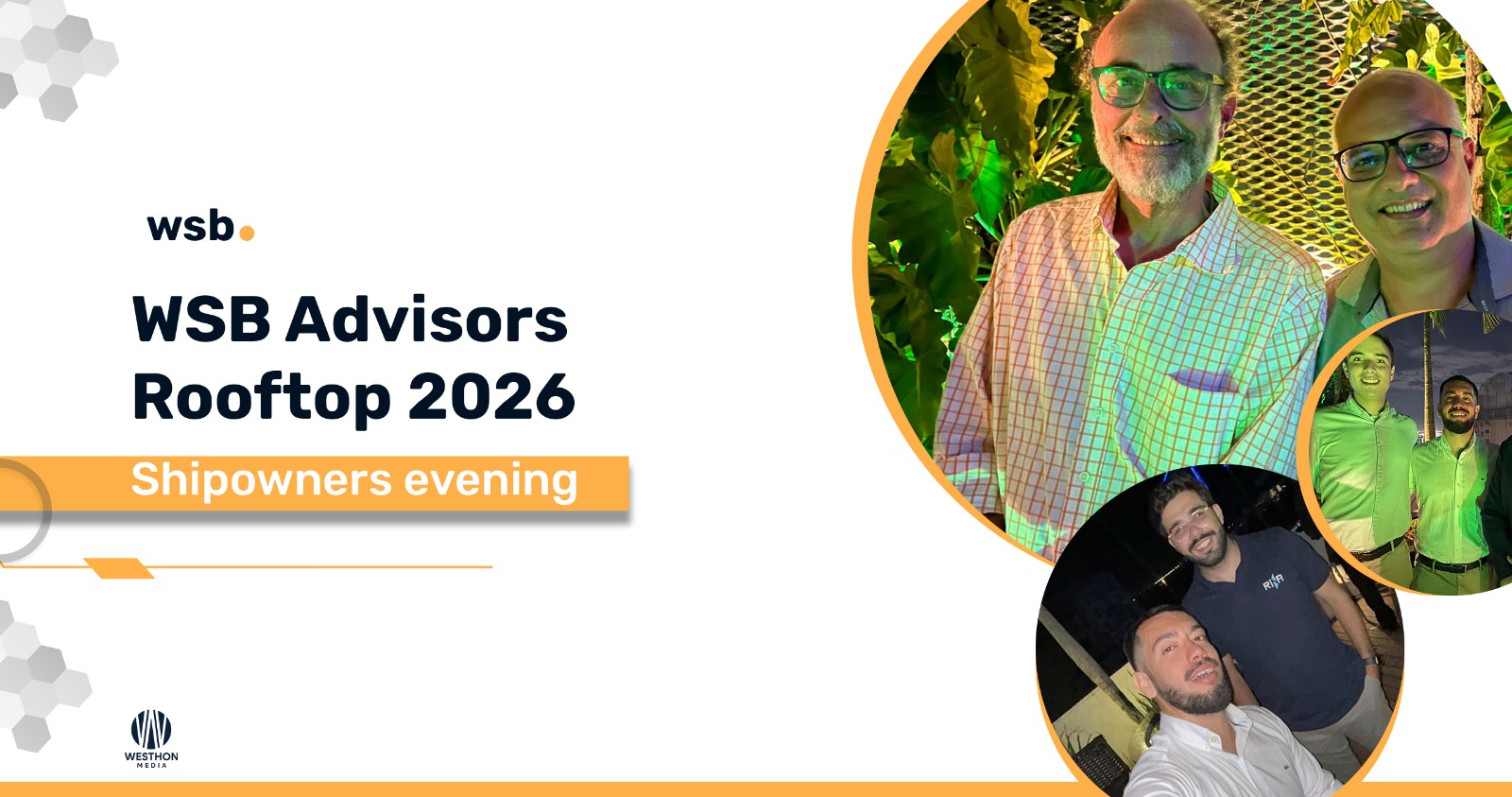
On March 26, WSB Advisors hosted its first happy hour of 2026 at the company’s rooftop in downtown Rio de Janeiro, gathering around 40 executives and professionals from the offshore sector.
The event brought together clients, partners and industry peers, with strong participation from shipowners, providing an opportunity to exchange views on current market dynamics in an informal setting. Since 2022, the WSB rooftop has served as a recurring meeting point for the offshore community.
“It was a memorable night. We dedicated this event to the shipowners, who turned out in force and filled our rooftop. As it was the first of the year, there was strong engagement, with participants actively exchanging valuable information and experiences,” said Pedro Pellegrini, Shipbroker and Naval Engineer at WSB Advisors.
WSB Advisors thanks all attendees for their presence and looks forward to the next gathering.
“Congratulations to the entire team for organizing the event. Everything was wonderful, with incredible energy, in a fantastic location, and excellent food and drinks. Every detail was thought out to make the guests feel comfortable.”, told Roberto D’Amato Leão, commercial manager at CLIAPORTO.
“It was a great moment. I think we can now say that 2026 has truly begun,” said Romulo Bacchiega, Head of Content & Sales at WSB Advisors, during his first participation in the company’s events.