Tag: FPSO

  • Weekly News

    Weekly News

    Open Tenders

    Dear All,

    WSB is pleased to provide an update on the current long-term tenders that are open to offer.
    What has changed?

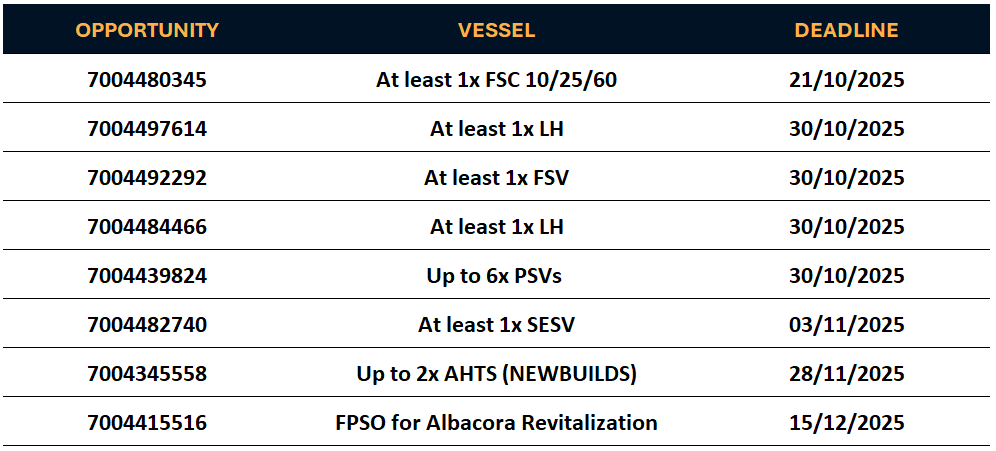
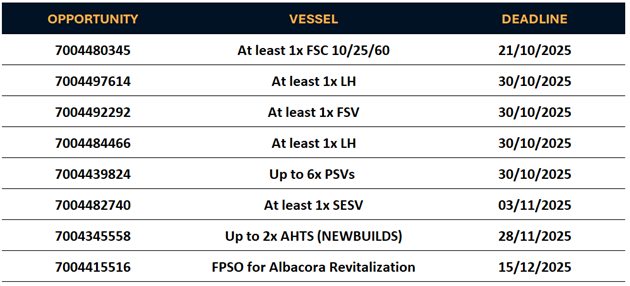
    • Petrobras At least 1x LH: Opportunity 7004497614 new deadline October 30th, 2025;
    • Petrobras At least 1x FSV: Opportunity 7004492292 new deadline October 30th, 2025;
    • Petrobras At least 1x LH: Opportunity 7004484466 new deadline October 30th, 2025;

    What else is happening?

    • Skandi Chieftain and Skandi Olympia have been awarded 4-year RSV contracts with Petrobras, valued at approximately USD 200 million, with delivery expected in October 2026.

    FPSO Peregrino

    The FPSO Peregrino, operating in the Campos Basin, officially resumed production on October 17, 2025, following authorization from ANP. The platform, operated by Equinor, will now begin ramping up output after being offline since August 2025, when production was halted due to operational safety procedures.

    The restart marks an important step for PRIO, which holds a 40% interest in the field. The remaining 60% stake in the Peregrino field is currently being acquired from Equinor, in a transaction expected to significantly expand PRIO’s operated portfolio in the Campos Basin.

    The Peregrino FPSO produces heavy oil from shallow waters and has been a key contributor to Brazil’s offshore production since it first came online in 2011.

    FPSO Peregrino
    FPSO Peregrino (Source: Equinor)

    Key Offshore Updates

    • Halliburton has signed new contracts to support operations in deepwater fields in the Santos Basin, with activities set to begin in 2026. In the Búzios field, the company will deploy SmartWell technology to optimize production, while in the Sépia and Atapu fields, it will supply EcoStar electric safety valves. The Stim Star Brasil vessel will also perform stimulation services to enhance the productivity and efficiency of Petrobras’ reservoirs.
    • SBM submitted the best proposals in Petrobras’ tender for the SEAP I and II FPSOs, valued at approximately US$ 4 bi. Petrobras now review compliance with technical and contractual requirements before awarding the contracts. Both units will follow the Build, Operate, and Transfer (BOT) model, under which the contractor is responsible for construction, operation, and later transfer of the assets. SEAP 2 is expected to begin operations in 2030.
    • The SEAP project forms part of Petrobras’ broader strategy to accelerate production growth and improve access to financing.
    • Petrobras has announced plans to restart operations of the FPSO Cidade de Angra dos Reis in the Tupi field, following compliance with safety requirements established by Brazil’s regulatory agency, ANP . The unit has been offline since February but is expected to return to service.
    • The FPSO Cidade de Angra dos Reis has a production capacity of up to 50,000 barrels of oil per day and has been operating in the Tupi field since October 2010. It was the first large-capacity FPSO to begin production in the Santos Basin pre-salt area, marking a key step in Brazil’s offshore development

    FPSO Cidade Angra dos Reis
    FPSO Cidade Angra dos Reis (Source; Petrobras)

    FPSO Bacalhau

    The FPSO Bacalhau has officially begun production in the Santos Basin pre-salt, marking a major step in Brazil’s offshore development. Operated by Equinor in partnership with ExxonMobil and Petrogal, the unit is among the most advanced ever deployed in the country, a 370-meter-long and 64-meter-wide floating production system with capacity to process 220,000 barrels of oil per day and store up to 2 million barrels.

    Production started on October 15, 2025, at the Bacalhau field, located about 185 km off the coast of Ilhabela (São Paulo), in water depths exceeding 2,000 meters. The first phase includes 19 wells that will be gradually brought online during the ramp-up period.

    The field’s recoverable reserves exceed 1 billion barrels of oil equivalent (boe), making it one of the largest deepwater projects under development outside Petrobras’ direct operation. The FPSO, supplied and operated initially by MODEC, integrates combined-cycle gas turbines (CCGT) and advanced CO₂-abatement systems designed to keep carbon intensity around 9 kg per boe.

    Ownership is distributed among Equinor (40%, operator), ExxonMobil Brasil (40%), and Petrogal Brasil (20%), with PPSA overseeing production sharing over its expected 30-year lifetime.

    Special Westhon Media

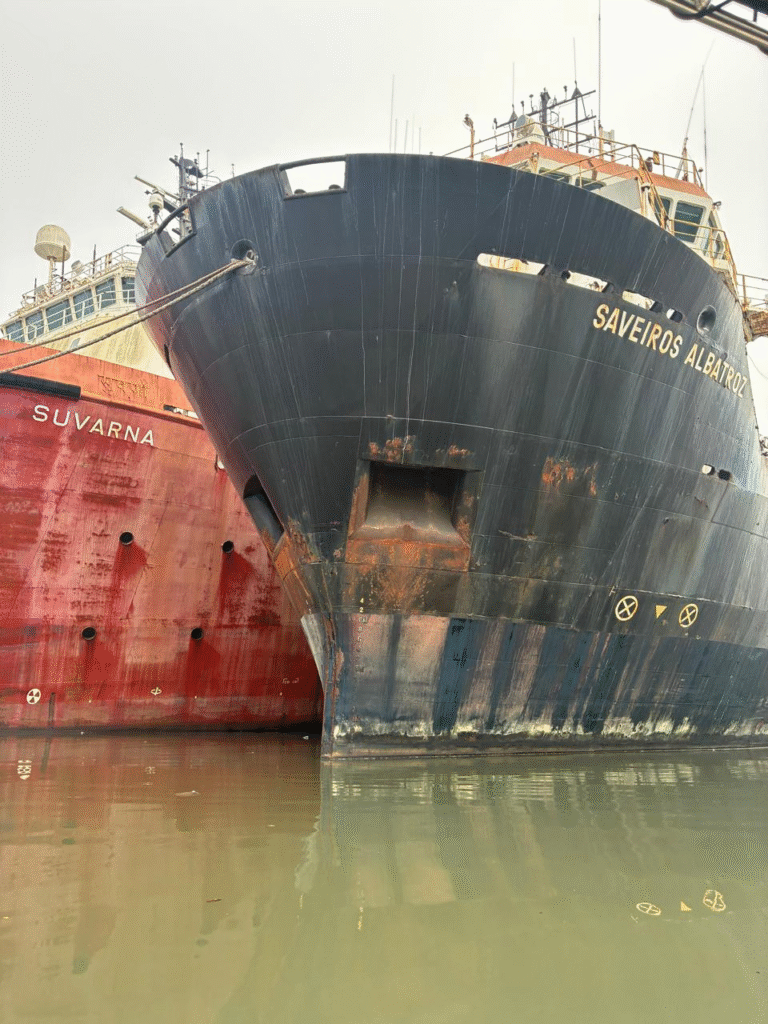
    Media reports say the AHTS Suvarna has been abandoned in Rio’s Canal do Cunha — leaking oil, listing, and the subject of investigations and actions against current responsible Superpesa.

    The once-formidable AHTS trio – Suvarna, Sudaksha and Subhiksha – were originally part of Varun Shipping’s fleet, left adrift during the oil downturn and later registered under Wilson Sons, left over with the local shipping company.

    Today?

    The Brazilian Navy, Tribunal Marítimo, and ANTAQ have no record whatsoever of these vessels. They’ve been sold, scrapped, or simply vanished.

    FACT CHECK:

    Only Suvarna still “exists” – barely floating, rusting and spilling in the shadows of Guanabara Bay.

    Sudaksha and Subhiksha? Dismantled. One of their keels now lies underwater, literally.

    Yet, some “global databases” still list all three as tonnage.

    Not on WSB-One.

    At WSB-One.com, ships don’t vanish – they’re verified.

    Next Thursday: “Por onde anda VARADA MARESIAS?”

    Stay tuned.
    Source: Internet

    WSB at UFRJ

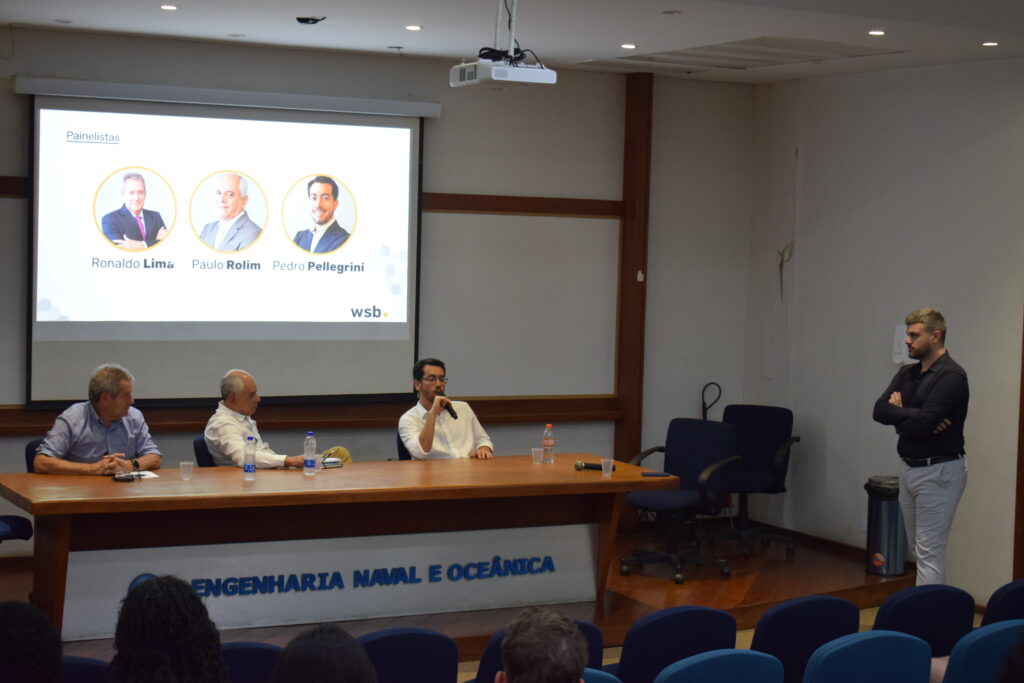
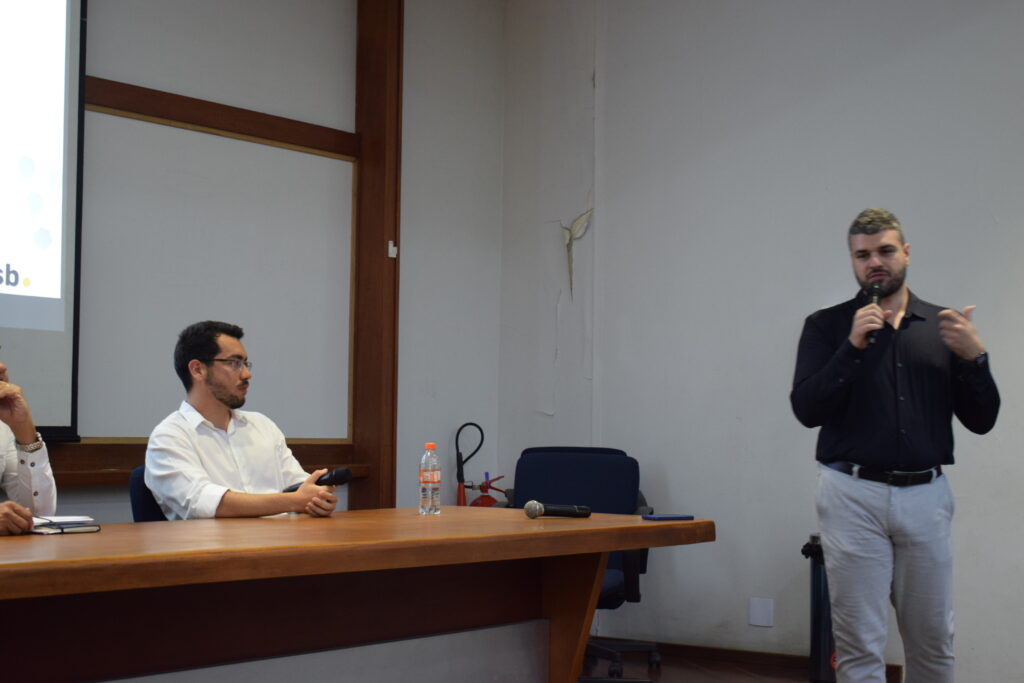
    At the invitation of the Naval League, WSB Advisors held a special talk yesterday (October 14th) for students of Naval and Ocean Engineering at UFRJ. Four WSB professionals shared their experiences and insights on the current landscape and future opportunities in the naval and offshore industries — both essential pillars for Brazil’s energy and economic development.
    Source: Plínio Ruan dos Santos Lima/Liga Naval

    The two-hour roundtable was moderated by Raphael Montes (Proposals Manager) and featured Paulo Rolim (Advisory Lead), Ronaldo Lima (Senior Advisor), and Pedro Pellegrini (Intern and Naval Engineering student at UFRJ). Together, the group fostered an enriching and intergenerational dialogue, combining different but complementary perspectives on professional growth in the industry.
    Source: Plínio Ruan dos Santos Lima/Liga Naval

    During the discussion, WSB Advisors explained how the commercial segment operates within the naval industry, emphasizing that there is much more beyond structural calculations, EPCI projects, and classification societies. The speakers highlighted that shipbroking does not necessarily require an engineering background — although a solid understanding of vessel design and operations is a valuable advantage.

    Ronaldo Lima, a civil engineer by training, shared his experience transitioning from a technical foundation into the commercial and financial sides of the offshore sector, detailing the challenges and opportunities that come with this shift.

    Paulo Rolim emphasized that even in uncertain market cycles, there will always be space for skilled professionals. With five decades of experience as a naval engineer, he underlined the importance of internships, continuous learning, and the university experience as key elements in developing maturity and professional confidence.

    Closing the session, Pedro Pellegrini spoke about the importance of building a strong and authentic professional network — even for those pursuing purely technical paths. He highlighted how his time at WSB Advisors has broadened his perspective, giving him a comprehensive understanding of the sector and its main players — from shipowners and charterers to drillers and service companies.

    The event concluded with remarks from Plínio Ruan dos Santos Lima, Vice President and Marketing Coordinator of the Naval League, who expressed his gratitude:

    “The Naval League is deeply thankful for WSB Advisors’ participation. Events like this show students the real-world side of naval engineering and its many opportunities while inspiring us with the speakers’ experiences. Every word was received with enthusiasm and will serve as valuable guidance for our professional journeys. One question that remains is: what’s more challenging — moving from the technical side to the commercial area, or the other way around?”

    Staff Announcement

    WSB Advisors is pleased to welcome Romulo Bacchiega, who joins the company as Head of Content & Sales.

    Born in Niterói (RJ), Romulo joined the team in late October with the mission of strengthening WSB Advisors’ communication and marketing departments while fostering strategic partnerships with leading offshore market players.

    With a solid career since 2004 in the Oil & Gas and Naval sectors, he brings extensive experience in technical procurement, negotiation and EPC contract management. Over the years, he has worked with major shipyards and international companies, leading acquisitions of equipment, materials and services for large-scale projects — including the construction of ships and offshore platforms.

    Fluent in English and skilled in the use of Generative AI tools, Romulo holds a degree in Business Administration from ESPM, a postgraduate degree in Project Management from COPPEAD/UFRJ, and is currently pursuing postgraduate studies in Digital Journalism and Communication at FAAP. He is recognized for his strong negotiation skills, strategic vision in procurement and proven ability to optimize processes and manage relationships with global suppliers.

    We are excited to have Romulo on board and look forward to his contributions and growth within the group.

    “It is a great pleasure and honor to join such a highly qualified and dedicated team as the one I’ve found at WSB. I am confident that we will achieve excellent results together, delivering information with accuracy and credibility while contributing to the development of the naval, offshore and energy sectors through WSB’s valuable market intelligence,” said Bacchiega.


  • Open Tenders & More

    Open Tenders & More

    By Maria Eduarda Camba

    Dear All,

    WSB is pleased to provide an update on the current long-term tenders that are open to offer.

    Open tenders:

    What has changed?

    • Petrobras At least 1x LH: Opportunity 7004497614 new deadline October 30th, 2025;
    • Petrobras At least 1x FSV: Opportunity 7004492292 new deadline October 30th, 2025;
    • Petrobras At least 1x LH: Opportunity 7004484466 new deadline October 30th, 2025;

    What else is happening?

    • Skandi Chieftain and Skandi Olympia have been awarded 4-year RSV contracts with Petrobras, valued at approximately USD 200 million, with delivery expected in October 2026.
    • Bacalhau field in the Santos Basin has officially started production, marking a key milestone for Equinor and its partners, with the field set to produce safely, efficiently and with production emissions half the industry average.
    • The FPSO Peregrino, operating in the Campos Basin , officially resumed production on October 17, 2025, following authorization from (ANP). The restart marks an important step for PRIO, which holds a 40% interest in the field. The remaining 60% stake in the Peregrino field is currently being acquired from Equinor, in a transaction expected to significantly expand PRIO’s operated portfolio in the Campos Basin.
  • FPSO Peregrino resumes production after ANP authorization

    FPSO Peregrino resumes production after ANP authorization

    The FPSO Peregrino, operating in the Campos Basin, officially resumed production on October 17, 2025, following authorization from (ANP). The platform, operated by Equinor do Brasil, will now begin ramping up output after being offline since August 2025, when production was halted due to operational safety procedures.

    The restart marks an important step for PRIO, which holds a 40% interest in the field. The remaining 60% stake in the Peregrino field is currently being acquired from Equinor, in a transaction expected to significantly expand PRIO’s operated portfolio in the Campos Basin.

    The Peregrino FPSO produces heavy oil from shallow waters and has been a key contributor to Brazil’s offshore production since it first came online in 2011.

    Stay informed on key offshore developments — visit wsb-one.com, our data platform trusted by leading offshore companies.

  • FPSO Cidade Angra dos Reis: Petrobras set to restart production

    FPSO Cidade Angra dos Reis: Petrobras set to restart production

    Petrobras has announced plans to restart operations of the FPSO Cidade de Angra dos Reis in the Tupi field, following compliance with safety requirements established by Brazil’s regulatory agency, ANP – Agência Nacional do Petróleo, Gás Natural e Biocombustíveis. The unit has been offline since February but is expected to return to service.

    The Cidade de Angra dos Reis has a production capacity of up to 50,000 barrels of oil per day and has been operating in the Tupi field since October 2010. It was the first large-capacity FPSO to begin production in the Santos Basin pre-salt area, marking a key step in Brazil’s offshore development.

    Petrobras has extended the charter of the unit through 2030, when its decommissioning is planned. The Tupi consortium is operated by Petrobras (67.216%), alongside Shell (23.024%), Petrogal Brasil S.A. (9.209%), and PPSA (Pré-Sal Petróleo S/A) (0.551%). Tupi remains Brazil’s second-largest producing field, behind only Búzios.

    Stay informed on key offshore developments — visit wsb-one.com, our data platform trusted by leading offshore companies.

  • Petrobras sets production record

    Petrobras sets production record

    Petrobras’ Almirante Tamandaré unit, part of the Búzios 7 Project, reached a record output of 225,000 barrels of oil per day — the highest production ever achieved by a single unit in the company’s history and three months before of the expected. Located in the massive Búzios field in the Santos Basin pre-salt, the FPSO began operations in February and hit full capacity with just five wells.

    The milestone confirms Búzios’ potential to become Petrobras’ top-producing field, with projections of reaching 1.5 million bpd by 2030. The company highlighted sustainable technologies onboard, such as a closed flare system and heat recovery solutions, which earned the unit ABS’s Sustainability Seal.

    Stay informed on key offshore developments — visit wsb-one.com, our data platform trusted by leading offshore companies.

  • Energy Solutions are ON!

    Energy Solutions are ON!


    Petrobras announces the contracting of its first fully electric FPSOs. The P-84 and P-85 units, developed in partnership with ABB and Seatrium, will be deployed in the Atapu and Sépia pre-salt fields. Each platform will have the capacity to produce up to 225,000 barrels per day, but the main highlight is the full electrification of operations, expected to reduce greenhouse gas emission intensity by 30% per barrel produced.

    The package includes advanced automation and control systems, with part of the equipment to be manufactured in Brazil, strengthening the local supply chain. Seatrium will lead the engineering and construction of both units.

    This week, Petrobras also confirmed the restart of construction on Train 2 at the Abreu e Lima refinery (RNEST). The expansion aims to double the refinery’s capacity to 260,000 barrels per day by 2029, increasing the output of higher-value products with lower sulfur content.

    More Plans


    Beyond the new FPSOs, Petrobras is advancing on several other energy transition fronts:

    • Commercialization of VLS B24 bunker fuel, with 24% second-generation biodiesel made from agro-industrial waste.
    • First direct sale of coprocessed diesel with renewable content to an end customer.
    • Partnership with Embrapa to develop low-carbon biofuels and sustainable fertilizers using feedstocks such as soy, macaúba, and eucalyptus.
    • Successful test of 5% eucalyptus biomass oil blended with fossil feedstock—broadening the portfolio of low-carbon solutions.

  • WSB tips – Open Tenders & More

    WSB tips – Open Tenders & More

    By Pedro Pellegrini

    Dear All,

    WSB is pleased to provide an update on the current long-term tenders that are open to offer.

    Open tenders:

    What has changed?

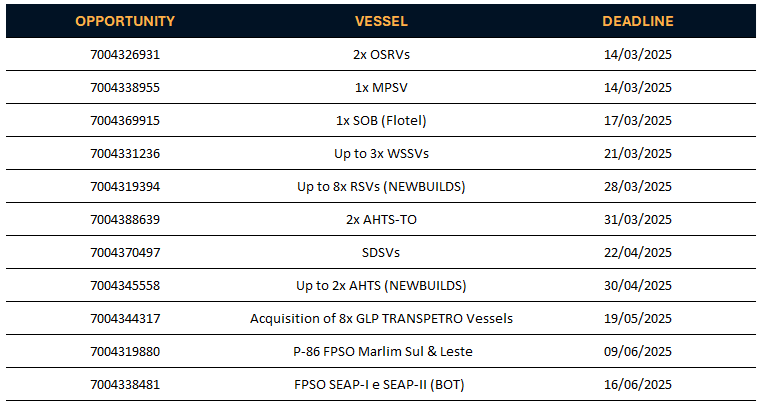
    • Petrobras 2x AHTS-TO: Opportunity 7004388639 released Mar 10th, 2025;
    • Petrobras 2x OSRVs: Opportunity 7004326931 new deadline Apr 14th, 2025;
    • Petrobras 3x WSSVs: Opportunity 7004331236 new deadline Apr 21th, 2025.

    What else is happening?

    • Subsea7 progresses with AHTS for Búzios 8. Even though Carnival is over, market remains rattling and windows are challenging. Can SS7 keep up with the rythmn?
    • FPSO Bacalhau hooked up and anchored. Station keeping tugs all returned to Guanabara Bay, except some will not stay for long…
    • Want to know everything about new requirements, contract windows, time charter, bareboat and spot opportunities, daily rates for each vessel, fortnightly meetings and countless other pieces of information? Get in touch with us to learn more about our package featuring the most complete database in the market: WSB.One!
  • Karoon acquires FPSO

    Karoon acquires FPSO

    Karoon Energy has acquired 100% of the FPSO Cidade de Itajaí from Altera Infrastructure & Ocyan for $115 million. The deal also includes approximately $8 million in transaction costs, with the bureaucratic procedures expected to be completed by April.

    The vessel has been operating in the Baúna Field, Santos Basin, since 2013 and has a production capacity of up to 80,000 barrels of oil per day (boed) and gas compression capacity of 2 million cubic meters per day.

    Karoon has owned the Baúna Field since 2020. Now, as both the field and FPSO owner, the Australian company will seek a new operator for the unit. Until then, Altera & Ocyan will continue managing operations.

  • FPSO Petrojarl I: new owner – lifespan extension

    FPSO Petrojarl I: new owner – lifespan extension

    By Rafael Bortoloti

    Amplus Energy Acquires FPSO Petrojarl I

    Amplus Energy has announced the acquisition of the FPSO Petrojarl I from Altera Infrastructure, marking a new phase of investment for the company. Financial details were not disclosed.

    The FPSO has a long history in the O&G sector, reinforcing the engineering quality behind its longevity. Since first oil in 1986, it has operated in over ten fields and had been in Brazil since 2017. After completing its mission at Atlanta field (Brava-operated), the unit Starts decommissioning at the end of 2024.

    Technical specs:
    • Production capacity: 30,000 bopd
    • Storage: 180,000 bbls
    (Ramp-up may be required before reactivation, potentially affecting these numbers.)

    “The Petrojarl 1 is field-ready for quick turnaround solutions, from early production to tail-end developments.” Amplus, a Scotland-based oil field development company official noted.

    What’s next for the Petrojarl I?

  • Petrobras Outlines Ambitious Investment Plan

    Petrobras Outlines Ambitious Investment Plan

    During Transpetro’s event launching the bid for eight gas carriers, Petrobras’ President Magda Chambriard detailed key projects and reinforced ongoing commitments:


    • “Hit the gas”: Increasing local content requirements from 40% to 65% for goods and services.
    • R$78 billion investment in Brazilian shipyards by 2026:
    • R$58B for 10 new FPSO processing plants.
    • R$20B for Offshore support vessels.
    • 10 new FPSOs coming online by 2029 (seven contracted, three still to be tendered).
    • 44 new vessels (OSVs & gas carriers) by 2026, backed by the Merchant Marine Fund and accelerated depreciation incentives.
    • Commitment to repurposing vessels in decommissioning at local shipyards.
    • Concern over pre-salt reserve depletion, stressing the need to develop the Equatorial Margin safely and efficiently.
    • R$40 billion investment in refinery expansion and fertilizer plants across Brazil by 2026.

    With this roadmap, Petrobras signals a strong push for national industry and energy security.

    What’s your take, can these initiatives reshape Brazil’s shipbuilding and offshore sectors?

  • BRAVA Energia Achieves First Oil from FPSO Atlanta

    BRAVA Energia Achieves First Oil from FPSO Atlanta

    BRAVA Energia announced that the FPSO Atlanta has produced its first oil this week at the Atlanta Field in the Santos Basin. The vessel boasts a production capacity of up to 50,000 boe/d, can treat 140,000 barrels of water per day, and store up to 1.6 million barrels of oil.

    Formed last year through the merger of 3R Petroleum and Enauta, BRAVA becomes the first independent O&G company in Brazil to develop a deepwater production system from the ground up.

    The FPSO Atlanta is one of BRAVA’s flagship assets, underscoring its commitment to innovation and growth in the offshore sector.

  • Brazilian production

    Brazilian production

    On the first working day of 2025, the ANP (National Oil Agency) released its Monthly Report on Oil and Natural Gas Production for November 2025. During this period, total production (oil + gas) reached 4.301 million barrels of oil equivalent per day (boed).

    Highlights

    Of this total, 3.310 million barrels of oil per day were produced.

    Natural gas production in November was 157.64 million cubic meters per day (m³/d).

    Total production (oil + natural gas) in the pre-salt fields in November was 3.385 million boe/d, being 2,631 milion of bbl/d of oil and 119,87 milion m³/d of gas.