
Tag: Shipbroking

  • Special WSB: Que fim levou? WSUT

    Special WSB: Que fim levou? WSUT

    By Alexandre Vilela

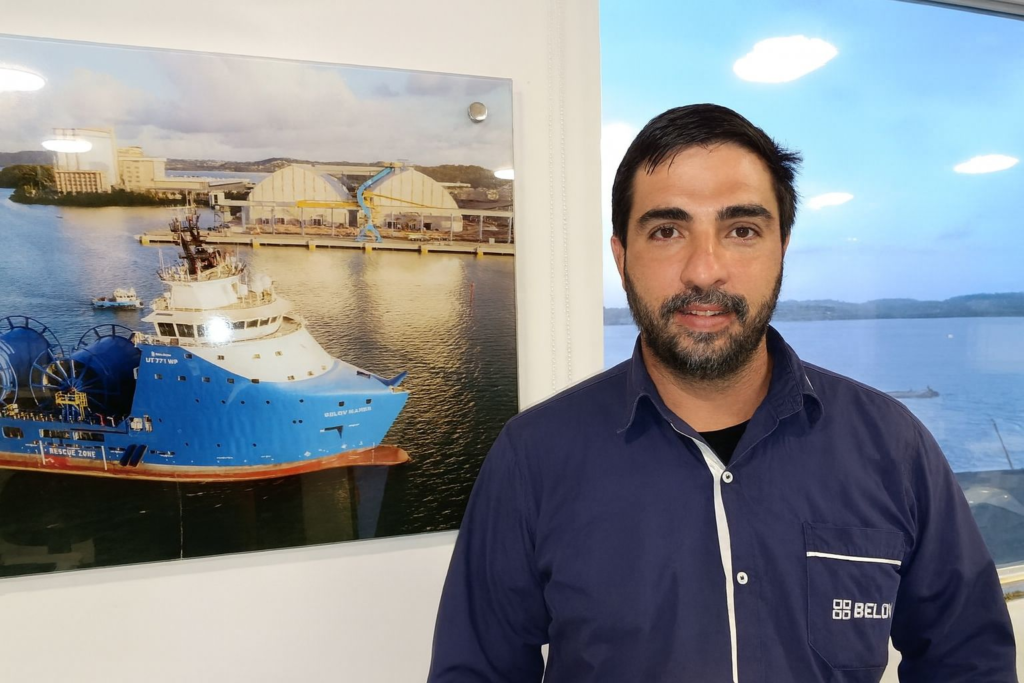
    Alexandre Vilela
    Alexandre Vilela (Source: WSB Team)

    Discipline Meets Opportunity
    Tidewater’s move in Brazil and what it reveals about the offshore cycle

    Brazil’s offshore sector has entered a new phase of consolidation. Within days of OceanPact and CBO announcing their combination, Tidewater moved to acquire Wilson Sons Ultratug Offshore (WSUT), a transaction valued at approximately $500 million including debt. The proximity of these announcements is unlikely to be coincidental. Rather, it signals that Brazil has once again become a focal point for offshore capital allocation.

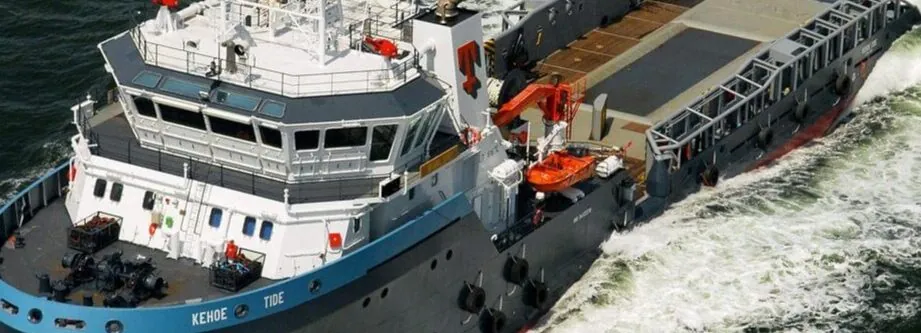
    At first glance, the transaction is straightforward. Tidewater is acquiring a fleet of 22 platform supply vessels, the vast majority already operating in Brazilian waters, and in doing so expands its local footprint from a marginal position to a meaningful presence. Yet, as is often the case in offshore shipping, the strategic importance of the deal lies less in the number of vessels than in the economic philosophy behind it.

    Tidewater has spent the past several years rebuilding its position through a disciplined and consistent approach to capital allocation. The acquisition of WSUT follows the same pattern established in earlier transactions, including the purchase of PSVs from Solstad, where the company expanded its fleet selectively while preserving balance sheet strength. Even after the WSUT transaction, Tidewater expects to maintain net leverage below 1x, a level that stands out in a sector historically prone to overextension.

    The economics of the acquisition appear aligned with that discipline. The WSUT fleet is already integrated into the Petrobras offshore logistics system, providing immediate utilization and revenue visibility. Tidewater has indicated that the business could generate approximately $220 million in annual revenue with margins approaching the high-50% range, figures that fit comfortably within its operating model. Unlike more complex offshore service platforms, Tidewater’s value proposition remains rooted in a relatively simple equation: vessel availability, utilization and day rates.
    Source: Tidewater

    The equity market’s reaction reflects this familiarity. Rather than a sharp repricing, Tidewater’s shares have responded with measured confidence, consistent with investor expectations that the company will continue to expand without abandoning its core principles. In a sector where capital discipline has often been elusive, predictability itself has become a source of value.

    The contrast with recent developments in Brazil is notable. While local consolidation has produced larger and more diversified platforms, Tidewater’s entry reinforces a different interpretation of the market. The company is not pursuing integration into subsea or environmental services, nor is it attempting to build a broader offshore services ecosystem. Instead, it is doubling down on what the Brazilian market continues to demand most consistently: reliable offshore tonnage.

    Read also: Special WSB: Que fim levou? Consolidation without repricing

    That demand profile remains strikingly traditional. Despite years of discussion around integrated service models, Petrobras’ contracting strategy has in several areas moved back toward more conventional structures. Activities once envisioned as bundled service packages have increasingly returned to EPCI contractors or internal capabilities, while day-to-day offshore logistics continues to rely on familiar vessel classes — PSVs, AHTS units and other support vessels that form the backbone of offshore operations.

    Tidewater’s strategy aligns closely with that reality. Its fleet, further strengthened by the earlier acquisition of Solstad vessels, is now increasingly positioned toward contracts with international oil companies, providing geographic diversification beyond Brazil. The addition of WSUT enhances its presence in Petrobras’ ecosystem without creating dependence on it, allowing Tidewater to balance exposure between national and international operators.

    One of the more telling aspects of Tidewater’s model lies in what happens after acquisition. The company has consistently demonstrated a willingness to dispose of or retire vessels once their economic usefulness declines. This discipline suggests that not all of the vessels acquired through WSUT are intended to remain in the fleet indefinitely. As Petrobras contracts expire, Tidewater will likely evaluate each unit based on expected cash generation relative to maintenance and upgrade costs. Where that equation no longer holds, vessels may simply exit the fleet.

    Such an approach reflects a broader principle that has guided Tidewater’s resurgence. Growth is not pursued for its own sake; it is pursued where it can be supported by cash flow. In an industry where aging fleets and deferred maintenance have historically eroded value, this willingness to rationalize assets can be as important as the acquisitions themselves.
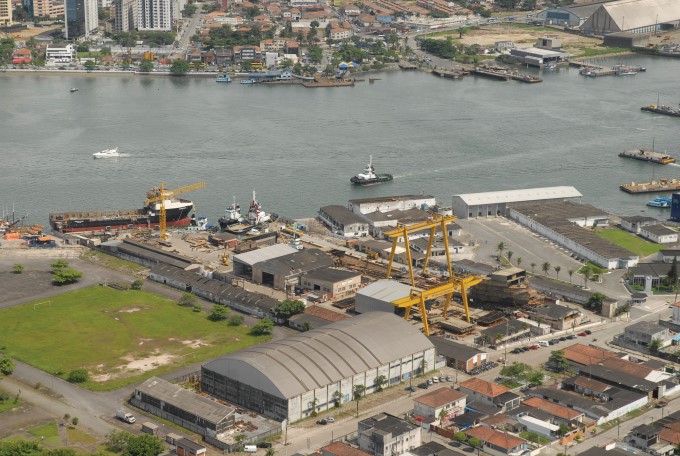
    Wilson Sons shipyard
    Wilson Sons shipyard (Source: Courtesy)

    The timing of the WSUT transaction also offers a broader signal. Coming immediately after a major local consolidation, it demonstrates that Brazil is once again attracting both domestic and international capital. Yet it also highlights that not all capital is being deployed in the same way. Where some players are building integrated platforms, others are reinforcing core fleet positions.

    The offshore sector has long oscillated between these two models. Periods of expansion often encourage diversification and operational complexity, while subsequent cycles tend to reward simplicity and financial discipline. Tidewater’s latest move suggests that, at least for now, the latter approach retains strong appeal.

    In that sense, the acquisition of WSUT is less about entering Brazil and more about reaffirming a strategy. It reflects a view that, even as the offshore market evolves, its economic fundamentals remain unchanged. Vessels still require capital. Contracts still determine value. And in the end, the companies that succeed are those that manage to convert operational scale into cash without allowing capital intensity to outrun returns.

    WSB Offshore Intelligence

    A detailed fleet, valuation and contract exposure analysis of the WSUT acquisition — including age profile, Petrobras vs IOC exposure and replacement CAPEX implications — is available to WSB subscribers.

  • Tartaruga Verde: Petrobras, Brava and Petronas

    Tartaruga Verde: Petrobras, Brava and Petronas

    Petrobras announced the acquisition of the 50% stake held by Petronas in the Tartaruga Verde and Espadarte fields, located in the Campos Basin, for US$450 million. As a result, the company will hold 100% ownership of the assets and remain the operator.

    The deal effectively represents a buyback. In 2019, Petrobras sold the same stake to Petronas for approximately US$1.29 billion. By reacquiring it at a lower price, the company secures a more capital-efficient position while regaining full control of the fields.

    The move also affects Brava Energia, which had been in negotiations to acquire the assets. Following the announcement, the company confirmed it has terminated talks with Petronas and stated it will be reimbursed for any amounts previously paid, with no financial loss.

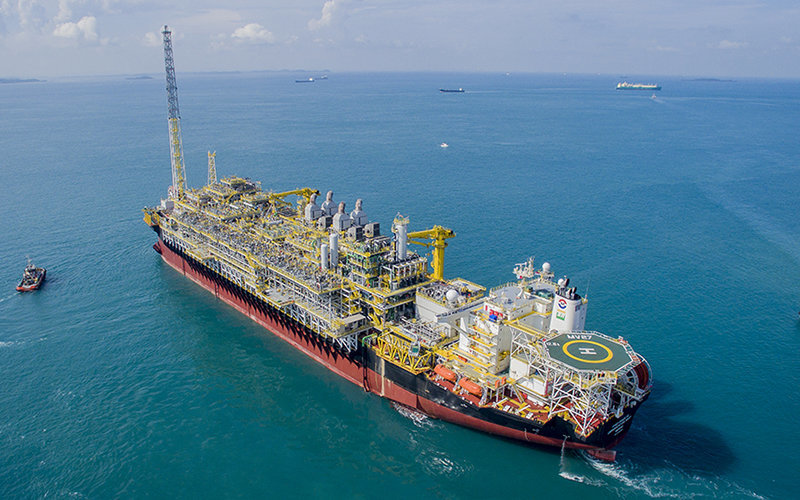
    The fields currently produce around 55,000 barrels of oil per day and are tied back to an FPSO. With full ownership, Petrobras will be able to optimize existing infrastructure, connect additional wells, and potentially increase production.

    According to the company, the acquisition aligns with its strategy of focusing investments on higher-return assets and strengthening its position in the oil and gas sector.

  • Oceânica secures US$736 million Petrobras contracts

    Oceânica secures US$736 million Petrobras contracts

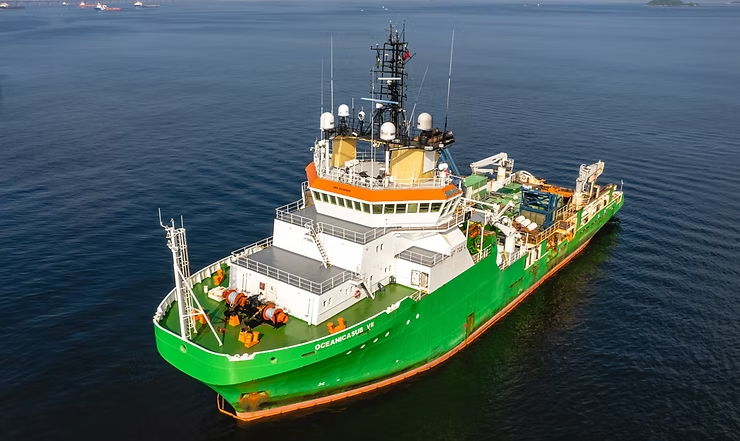
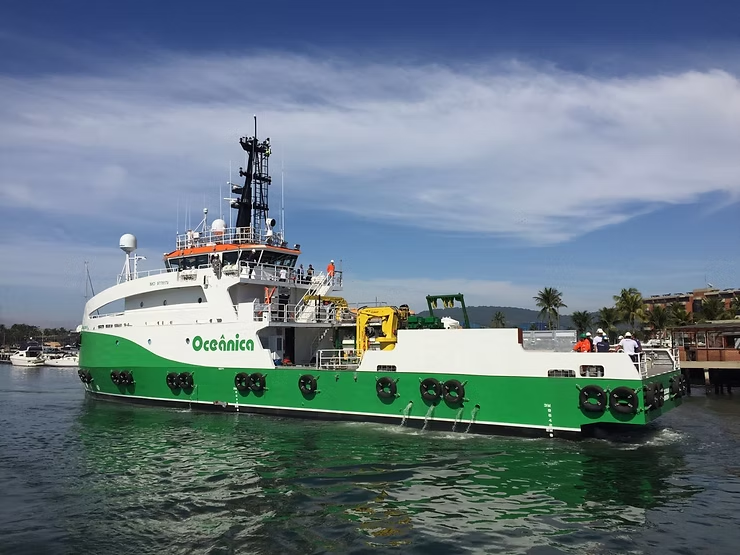
    Oceânica Engenharia has signed a series of subsea service contracts with Petrobras totaling approximately US$736 million, according to company disclosures. Agreements have a four-year duration, with offshore operations expected to begin in the first half of 2027 and extend through 2031.

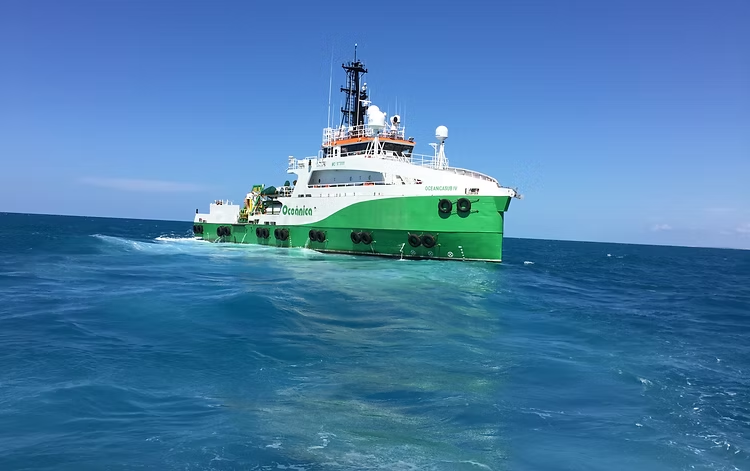
    Contracts include renewal of charter agreements for several vessels in Oceânica’s diving support fleet, which will continue providing inspection, maintenance and subsea intervention services across Petrobras’ offshore production systems.

    Oceanicasub VII (Source: Ocêanica)

    Fleet scope

    • SDSV vessels (Shallow Diving Support Vessels): Oceanicasub IV, V, VII and IX
    • Services: inspection, maintenance and subsea intervention
    • Assets deployed: workclass ROVs, electric ROVs and diving systems
    • RSV segment: contract renewal for Oceanicasub VIII

    Company also announced addition of Oceanicasub VI to its subsea fleet, expanding operational capacity.

    According to Oceânica, agreements increase backlog to around R$12 billion. Earlier in January 2026, company had already secured contract for Oceanicasub XV, valued at approximately R$500 million.

    Our view: What’s behind these developments

    A new contracting cycle is underway

    Brazil is entering a new subsea contracting cycle. A significant share of vessel contracts signed between 2018 and 2021 is reaching expiration between 2025 and 2027, triggering a wave of renewals and new tenders.

    Market is now seeing:

    • renewal of existing vessel contracts
    • extension of ongoing offshore campaigns
    • gradual addition of new vessels

    This cycle is expected to sustain demand for subsea support services through the end of the decade.

    Pre-salt growth continues to drive demand

    Expansion of infrastructure in Santos Basin remains the primary demand driver.

    Each new development adds complex subsea systems, including:

    • subsea trees
    • manifolds
    • flowlines
    • injection and control systems

    As this network grows, operators require continuous vessel support for inspection, maintenance and intervention.

    Demand becomes structural — not tied only to new field start-ups.

    Positioning of SDSVs

    Recent tenders highlight consistent utilization of SDSVs (Shallow Diving Support Vessels) in shallow and mid-depth intervention scopes.

    These vessels combine:

    • ROV capability
    • diving systems
    • direct subsea intervention capability

    This configuration allows operators to execute maintenance campaigns with lower mobilization costs and faster response times, particularly for less complex intervention scopes.

    Petrobras shifting back to longer contracts

    Another clear trend is return to longer contract durations.

    After a period of shorter agreements (2–3 years), recent tenders from Petrobras are increasingly structured around four-year terms or longer.

    Longer contracts:

    • secure vessel availability
    • provide revenue visibility for contractors
    • support fleet upgrades and operational planning

    Fleet expansion in a concentrated market

    Brazil is consolidating one of the largest subsea support vessel clusters globally, concentrated in Santos Basin.

    Key hubs include:

    • Búzios Field
    • Mero Field
    • Sépia Field
    • Atapu Field

    Each new FPSO increases subsea complexity and reinforces long-term demand for vessel support.

    Backlog reflects scale of the cycle

    Oceânica’s R$12 billion backlog highlights scale and visibility of current cycle.

    Multi-year contracts are providing:

    • predictable cash flow for contractors
    • sustained fleet utilization
    • support for continued offshore expansion

    Brazil is consolidating its position as one of the largest global markets for subsea support vessels, supported by scale of its pre-salt infrastructure.

    Oceanicasub IV
    Oceanicasub IV – Source: Oceânica
  • Open tenders & More

    Open tenders & More

    WSB Advisors OPEN TENDERS — Updates

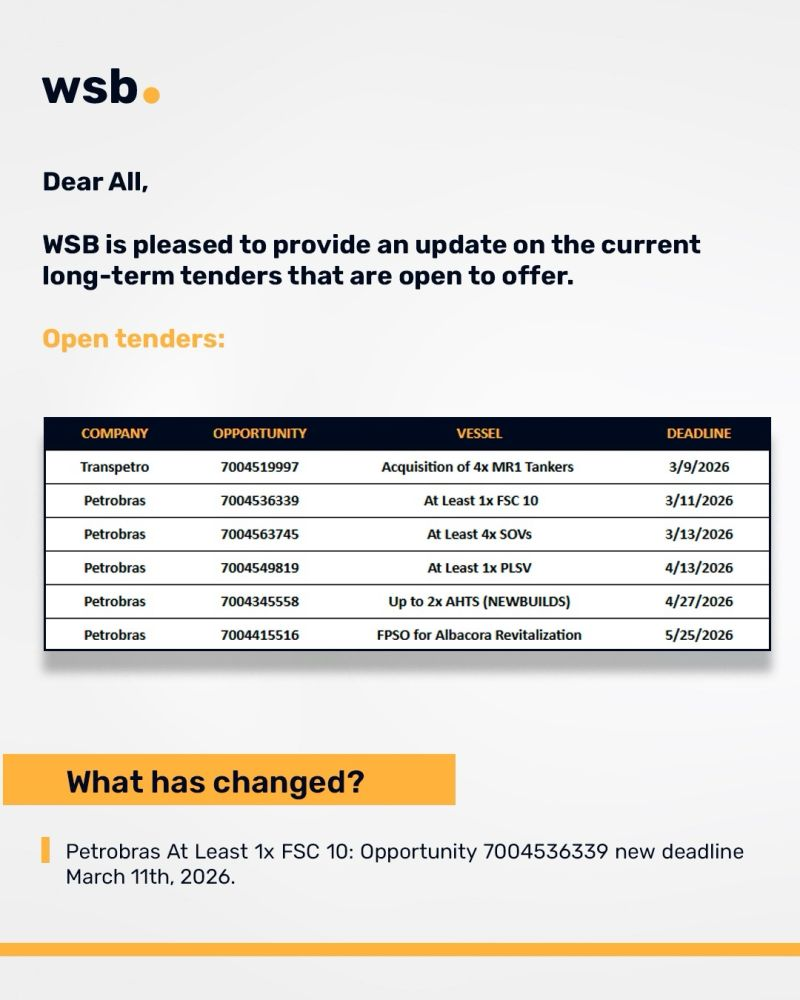
    WSB is pleased to provide an update on the current long-term tenders that are open to offer.

    What has changed?

    Petrobras At least 1x FSC 10: Opportunity 7004536339, new deadline March 17th, 2026
    Petrobras Up to 4x SOVs: Opportunity 7004563745, new deadline March 25th, 2026

    What else is happening?

    – Norbe IX has departed its anchorage near Angra dos Reis following a 58-day scheduled maintenance and upgrade period and is now mobilizing to begin drilling operations in the Santos Basin.

    – Constellation Oil Services drillship Amaralina Star, a 6th-generation unit equipped with MPD (Managed Pressure Drilling), has commenced a new contract with Petrobras, supporting exploratory drilling campaigns offshore Brazil.

  • Camorim behind the world’s largest New Year’s eve

    Camorim behind the world’s largest New Year’s eve

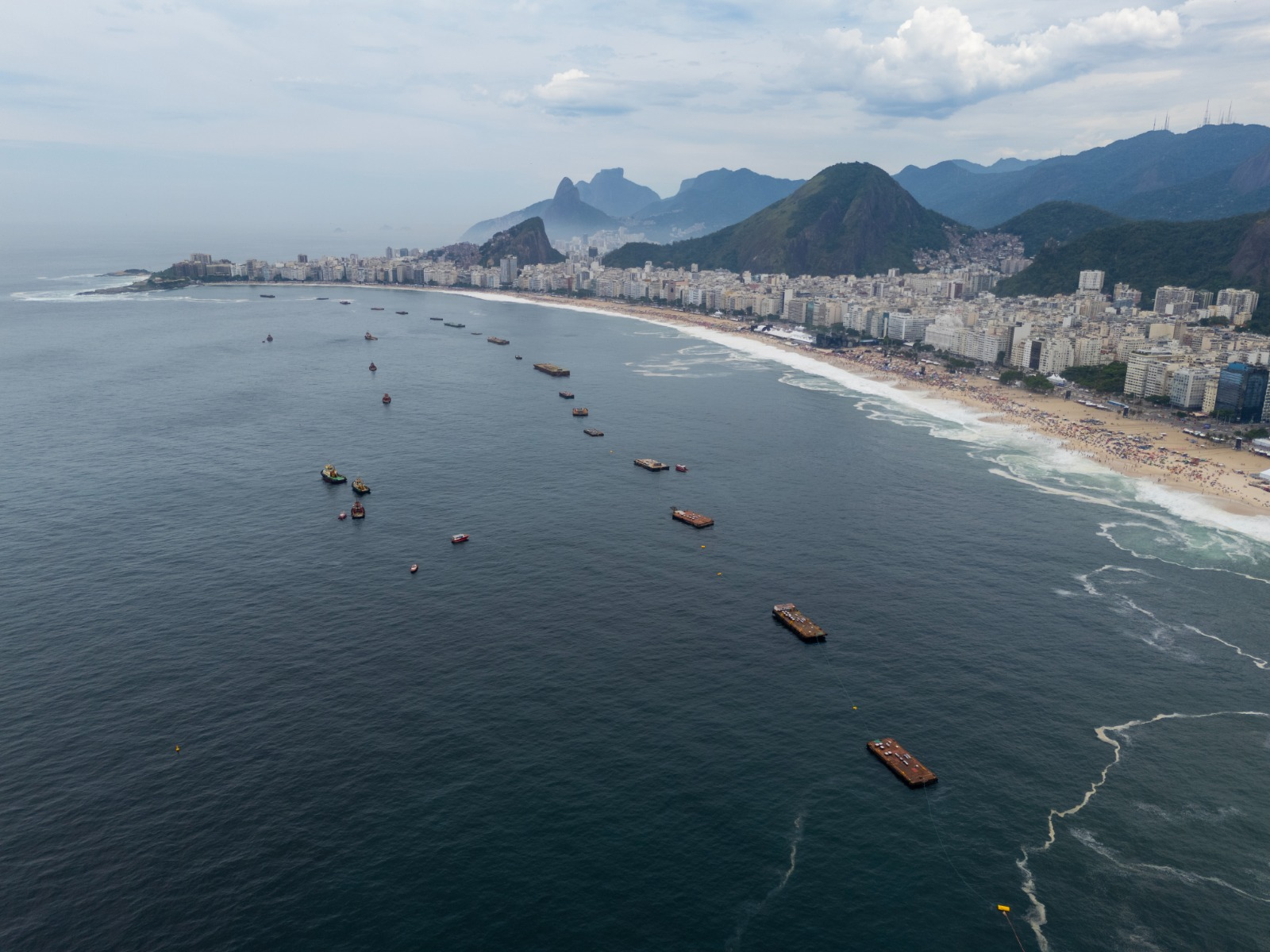
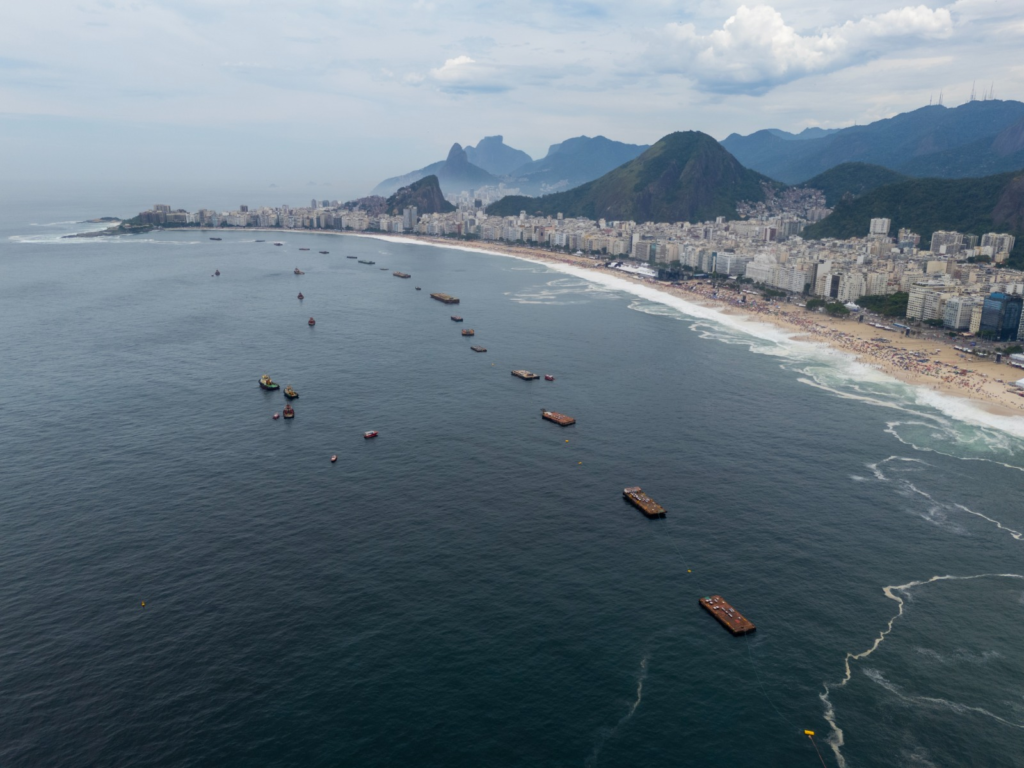
    In the last day of 2025, Copacabana’s New Year’s Eve celebration in Rio de Janeiro entered the Guinness Book of Records as the largest in the world. The spectacle held along Brazil’s most iconic beachfront brought together around 2.6 million people and featured Camorim as a key player in the complex fireworks operation.

    Responsible for supporting the scale of the event, Camorim led the maritime operation with excellence, mobilizing 150 professionals and 46 vessels — including 19 barges, 14 tugboats, 12 speedboats, and one shear crane. It was the work of hundreds of hands that, year after year, ensures the safety and visual impact that have made Copacabana a global New Year’s Eve reference.

    Although Camorim’s operations also extend to other major New Year’s Eve celebrations, it is in Copacabana that the company carries out its most emblematic operation. The transition from 2025 to 2026 featured 12 minutes of fireworks, performances by samba schools, and artists from different musical genres, further elevating the spectacle.

    The operation begins long before the countdown

    The New Year’s Eve machinery starts turning weeks in advance. On December 20, the barge preparation process was completed at Camorim’s bases. Between December 21 and 25, the fireworks were assembled and organized. On December 28 and 29, the pre-anchoring operation was carried out — an essential stage to ensure the vessels remain securely positioned during the fireworks display.

    The official countdown to the New Year began on December 30. From 7:00 p.m. onward, the barges were towed to Copacabana and strategically positioned along the shoreline, in a process that lasted until the morning of December 31. Still on the last daay of the year, Camorim teams monitored the transverse alignment of the barges in relation to the beach, while the Harbor Master’s Office inspected each stage of the operation.

    Final authorization for the fireworks display, granted by the Navy at 11:30 p.m. on December 31, depends on weather conditions — a factor that requires heightened attention and immediate response capability. In some years, this clearance is given only in the final minutes, underscoring the importance of experience and trust in the team.

    While the public celebrates, the operation continues. A group of ten professionals monitors the entire process on land, and about one hour after the fireworks end, the dismantling process and return of the barges to the company’s bases begins — an operation completed only on the morning of January 1.

    More than a spectacle, Copacabana’s New Year’s Eve celebration is the result of planning, technical expertise, and dedication — pillars that Camorim has been upholding for decades on the world’s largest New Year’s stage.

    “Many teams have been working in Copacabana for years. Families understand the magnitude of the responsibility. While millions celebrate on the beach, our professionals remain alert, ensuring everything happens with maximum safety.” , says João Guerra, Camorim’s commercial manager.

    “We recognize the efforts of our employees. They are true heroes. They work with commitment, responsibility, and care so that this great celebration can take place”, Guerra adds.

    About Camorim

    Camorim is a 100% Brazilian company with 30 years of experience in the national maritime sector. Considered a 360° hub in the provision of comprehensive logistics and navigation solutions, the corporation employs more than 1,300 people, creating opportunities along the entire Brazilian coast. Among the services offered by the company are port towing, port logistics, and offshore support.

    With more than 150 vessels, Camorim operates the most diversified fleet in Brazil, comprising tugboats, LHs, PSVs, AHTSs, OSRVs, cargo barges, water barges, sheerleg cranes, and speedboats (both cargo and passenger).

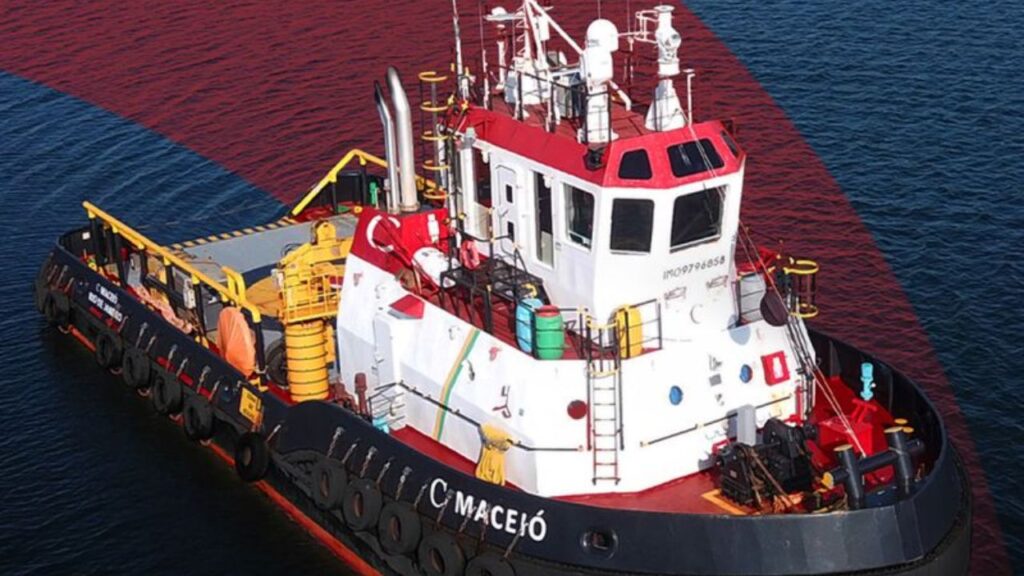
    C Maceio (Source: Camorim)
    C Maceio (Source: Camorim)

    Camorim owns a modern shipyard located on Ilha da Conceição in Niterói, where it operates a Private Use Terminal. In addition, the company has three strategically located operational bases (two in Niterói and one in Vitória, in the state of Espírito Santo), expanding support for maritime operations.

    The company also operates in ports located in the states of Rio de Janeiro, São Paulo, Espírito Santo, Paraná, Rio Grande do Sul, Pará, and Maranhão.

  • Special WSB: Por onde anda? Metaltanque II

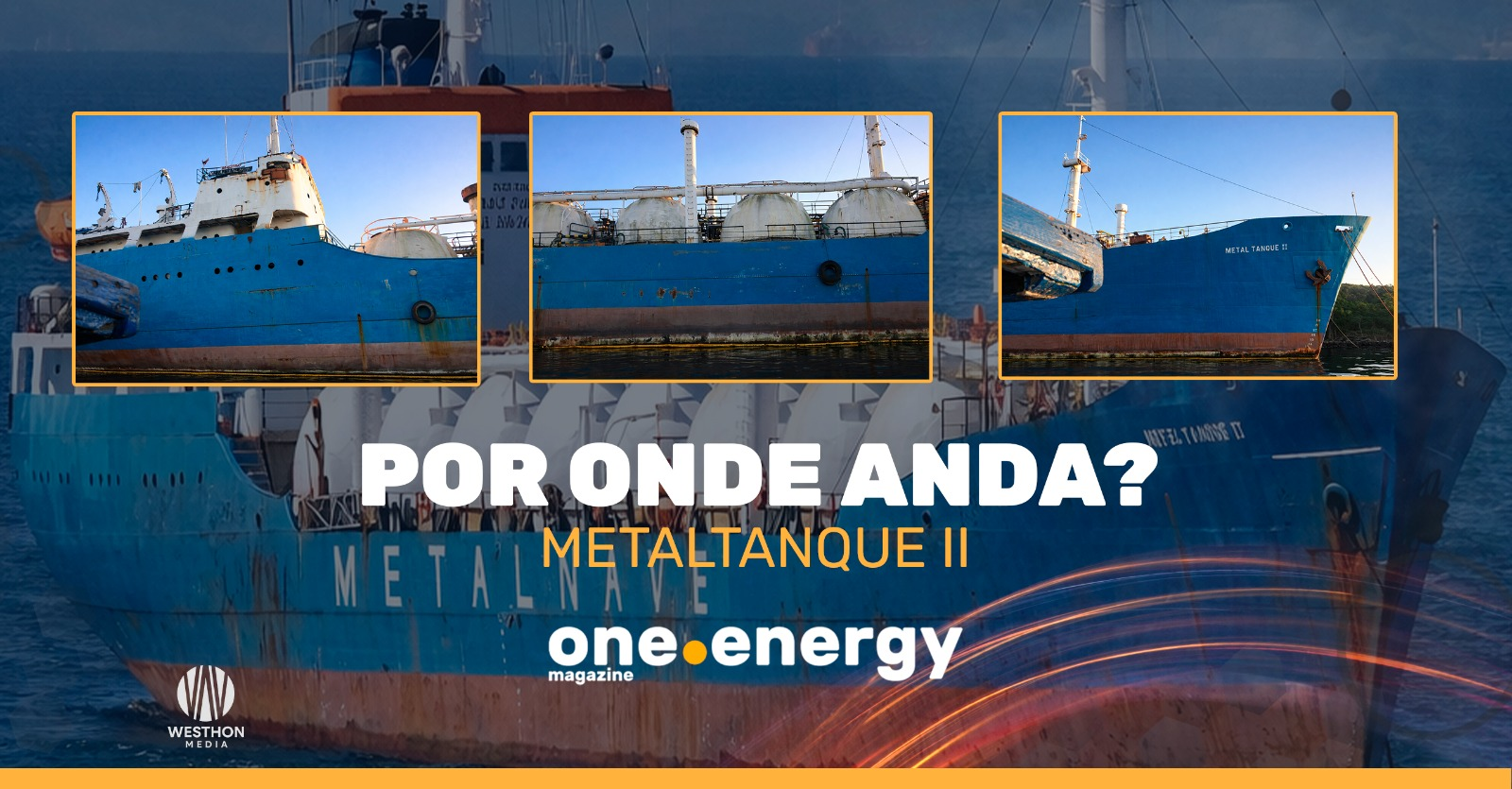
    Special WSB: Por onde anda? Metaltanque II

    Built in February 1963 by Fujinagata Shipyard in Japan, the vessel originally named Petrobras Oeste was designed with a clear mission: transport LPG along Brazilian waters. Powered by a B&W engine, with approximately 4,323 DWT and IMO 5407784, it was part of Petrobras’ fleet at a time when Brazil was beginning to build its own energy infrastructure.

    But the sea has a long memory. And ships often carry stories that do not end where many expect.

    In the mid-1980s, Petrobras Oeste and its sister vessel Petrobras Nordeste (IMO 5412997) were decommissioned and sold at auction as scrap. Petrobras Oeste was acquired by Brasilmar, while Petrobras Nordeste went to Metalnave.

    At first, the cycle seemed complete. The vessels had fulfilled their mission and would likely end their lives as scrap metal.

    That was not what happened.

    Metalnave S.A., a company that at the time operated tugboats and bunker barges in Guanabara Bay, Rio de Janeiro, controlled by entrepreneur Frank Wlasek, acquired Petrobras Nordeste.

    The auction contract required the vessels to be scrapped, prohibiting conversion or repair for use as merchant ships. After a lengthy legal dispute, Metalnave proved its right to convert and repair the vessel as its new owner. The company rebuilt and adapted Petrobras Nordeste to transport butadiene, renaming it Metaltanque I.

    Brasilmar, after acquiring Petrobras Oeste, made no changes to the vessel. Metalnave later purchased it and took an even more ambitious step: converting it into a semi-refrigerated vessel.

    The refit was carried out by Metalnave’s technical team, led by its technical director, engineer José Ruiz, a professional with a long career in the Brazilian shipbuilding sector. The challenge was significant: transform an old pressurized gas system from a vessel purchased as scrap into a modern semi-refrigerated plant capable of transporting gaseous chemical products. At the time, much of the domestic market considered the project virtually impossible.

    Yet it was done.

    The result was Metaltanque II. Before its final conversion and renaming, the vessel operated for a few years under the name Triunfogas. After the transformation, it entered service transporting chemical cargoes in Brazilian cabotage, serving demanding clients such as Braskem and Dow Química. With the incorporation of the two vessels, Metalnave S.A. also became a cabotage shipping company.

    More than a commercial twist, the episode demonstrated that Brazilian naval engineering was capable of revitalizing complex assets and returning them to the market in full operational condition — challenging the skepticism that long limited the sector’s ambitions.

    Today, Metaltanque II is inactive at Renave, in Niterói, Rio de Janeiro, at Ilha do Vianna. Those who visit the site find a vessel at rest, but not destroyed. It is not in a deplorable state. It stands like a ship that has simply paused after a long journey — somewhat worn, yet still present.

    After all, the sea has a long memory.

  • TotalEnergies starts up Lapa South-West project in Brazil

    TotalEnergies starts up Lapa South-West project in Brazil

    TotalEnergies announced start-up of the Lapa South-West project, located in Santos Basin about 300 kilometers offshore Brazil. Development includes three subsea wells tied back to FPSO Cidade de Caraguatatuba, production unit currently operating in Lapa Field.

    With an estimated investment of around US$1 billion, project is expected to increase field output by 25,000 barrels of oil per day, bringing total production from Lapa to approximately 60,000 barrels per day, as quoted by Repsol.

    Discovered in 2007, Lapa is located in water depths of roughly 2,140 meters in central portion of Santos Basin. First production started in 2016 through the FPSO Cidade de Caraguatatuba. Field is operated by TotalEnergies with 48% stake, in consortium with Shell (27%) and Repsol Sinopec Brasil (25%).

    According to Nicolas Terraz, President of Exploration & Production at TotalEnergies, the start-up represents another milestone for the company’s portfolio in Brazil, considered a key growth country for its upstream operations.

  • Petrobras–Shell consortium formalizes acquisition of Union stakes in Mero and Atapu

    Petrobras–Shell consortium formalizes acquisition of Union stakes in Mero and Atapu

    Brazil’s Ministry of Mines and Energy and Pré-Sal Petróleo S.A. signed on March 10 contracts transferring Union rights in non-contracted portions of shared reservoirs in Mero Field and Atapu Field, located in pre-salt of Santos Basin.

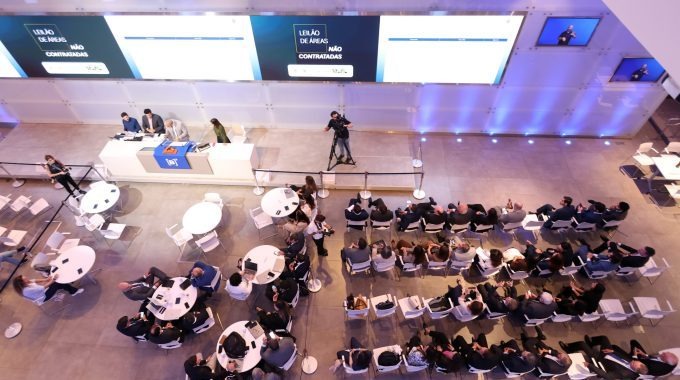
    Areas were acquired by a consortium formed by Petrobras and Shell in December 2025 auction of non-contracted areas, held at B3.

    Key transaction terms:

    • Total consideration: ~R$ 8.8 billion
    • Premium over minimum price: R$ 337 million
    • Union stake transferred: 3.5% in Mero / 0.95% in Atapu
    • Effective transfer date: March 1, 2027

    Until transfer becomes effective, oil and gas production from these areas remains property of Brazilian Union and will continue to be marketed by Pré-Sal Petróleo S.A..

    Auction marked first implementation of monetization mechanism based on Production Individualization Agreements (AIPs), allowing government to commercialize participation in non-contracted portions of producing reservoirs.

    Mero Field and Atapu Field remain among most productive assets in Brazilian pre-salt, reinforcing strategic importance of Santos Basin in long-term offshore supply outlook.

  • Constitutional Insights #1

    Constitutional Insights #1

    Congress must provide constitutional regulation for the gas sector

    By Luis Fernando Priolli

    Luis Fernando Priolli (Source: Private Collection)

    Brazil is at a crucial turning point in defining the rules for the natural gas sector. The National Agency of Petroleum, Natural Gas, and Biofuels (ANP) is currently debating a resolution to establish technical criteria differentiating transmission pipelines from distribution pipelines. While seemingly technical, this discussion directly impacts sector organization, legal certainty for investments, and the future of the national energy matrix.

    Natural gas is a strategic transition fuel. It emits fewer pollutants than coal and oil derivatives and offers the flexibility to meet demand peaks and complement renewable sources like solar and wind. Its role is increasingly vital for the stability of the Brazilian electrical system, especially regarding climate change and international pressure for decarbonization.

    ANP’s proposal seeks to harmonize rules and bring regulatory clarity, but it does not resolve the root problem. Although it aims to align regulation with the Gas Law (Law No. 14,134/2021), the discussion highlights a larger void: the lack of regulation for Article 25, §2º of the Federal Constitution.

    This constitutional provision, amended in 1995, determines that States are responsible for exploring local piped gas services, either directly or through concessions. The amendment sought to grant States autonomy but failed to define precise competencies, creating persistent ambiguities.

    The bottom line is that the 1995 constitutional amendment made the issue more confusing. By including the phrase “in accordance with the law,” the amendment delegated regulation to federal legislation that still does not exist.

    For exactly three decades, Congress has failed to create this legislation. In this vacuum, state governments created their own laws and regulatory agencies established their own norms. These are merely palliative measures; without a federal law—the only definitive solution—legal insecurity persists, leading to constant judicial challenges against state laws and agency norms.

    The lack of regulation generates insecurity on several fronts:

    • Divergent Interpretations: Some argue States have exclusive competence; others believe federal limits are necessary to avoid conflict with the Union.
    • Stalled Infrastructure: Multi-billion real projects are exposed to legal risks. Transporters fear investing in pipelines that might be reclassified as state distribution.
    • Increased Costs: Legal disputes stall contracts, make projects more expensive, and delay essential works for the expansion of the gas network.

    An administrative resolution from the ANP is insufficient to pacify the sector. The true solution lies with the National Congress. Only the regulation of Article 25, §2º can unequivocally define the boundaries between Federal and State jurisdiction. This complementary law is what will provide legal certainty and align Brazil with international best practices.

    This is not a merely technical debate; it involves significant economic interests for producers, transporters, distributors, and industrial consumers (steel, chemical, and fertilizer sectors). For natural gas to increase national competitiveness, the regulatory framework must be stable and predictable.

    Brazil currently faces a contradiction: it recognizes the strategic importance of gas while maintaining a 30-year regulatory impasse. This gap threatens energy security and drives away investment. The time to fill this constitutional void is now. Regulating the Constitution is an indispensable condition for the sustainable expansion of the natural gas market and the future of Brazilian energy policy.

  • International Women’s Day

    International Women’s Day

    On March 8th, we celebrate International Women’s Day, a date that goes far beyond tribute and invites us to recognize and appreciate the contribution of women across all sectors of society. In the energy and offshore industry, historically dominated by men, female participation has been steadily growing, driven by talent, expertise, and leadership.

    Over the past few years, WSB Advisors has had the privilege of giving voice to several professionals who are helping transform this industry through our publications.

    Among them is Vanessa Costa, a chemical engineer with an international career in the offshore sector and currently working in business development at Marinsa. In her interview, she highlighted the importance of psychological safety in the workplace and the need to build environments that are fairer and more respectful for all professionals.

    Vanessa Costa
    Vanessa Costa (Source: Private Collection)

    We also spoke with Fernanda Hille, a naval engineer at Navship, responsible for hydrodynamic optimization projects that have already resulted in tangible reductions in fuel consumption for offshore vessels, contributing to a more efficient and sustainable fleet.

    Another inspiring journey is that of Caroline Dias, Commercial Director of Solstad Offshore Brazil. In her interview with One.Energy Magazine, Carol recalled her education at the Merchant Marine Officers School, her time at sea, and the importance of family support and diversity in the corporate environment. She also emphasized the strong growth potential of the offshore sector in the coming years.

    Female strength is also present in the stories that inspire the industry itself. Recently, Petrobras platforms were named after remarkable Brazilian women: Maria Quitéria, Anna Nery, and Anita Garibaldi, figures who symbolize courage, pioneering spirit, and leadership.

    Women at WSB

    Within WSB Advisors itself, the contribution of women is equally essential. Joana Rodrigues, Head of Market Intelligence, created WSB-one which has become the most respected database covering the Brazilian offshore market.

    This database also benefits from the dedication of Maria Eduarda Camba, an Intern Shipbroker and International Relations student at UFRJ, who currently manages the platform’s daily updates. Through her careful and consistent work, she ensures that the information remains accurate and up to date, while also being responsible for the weekly monitoring and reporting of vessel tender processes across the market.

    Maria Eduarda Camba, Camila Lopes, Vilma Fernandes and Maria Ciriaco
    Maria Eduarda Camba, Camila Lopes, Vilma Fernandes and Maria Ciriaco

    Behind the scenes, other professionals also play a fundamental role in keeping the company running smoothly. Camila Lopes, in finance, contributes with precision and organization that support the company’s operational stability and planning. Alongside her, Vilma Fernandes plays an important role in the financial routines that sustain the firm’s daily activities. In administrative support, Maria Ciriaco provides essential coordination and assistance, helping ensure that the internal structure that supports WSB’s operations functions efficiently.

    On this International Women’s Day, WSB Advisors celebrates all the women who help move the energy industry forward — in offices, shipyards, ports, and at sea.

  • Open Tenders & More

    Open Tenders & More

    WSB Advisors OPEN TENDERS

    An updated deadline was released within Petrobras’ ongoing offshore tenders. Below are the latest changes monitored by WSB Advisors.

    What has changed?

    Petrobras — At least 1x FSC 10: Opportunity 7004536339, new deadline March 11th, 2026

  • Belov Arembepe in details

    Belov Arembepe in details

    By Rafael Bortoloti

    Belov Engenharia began, in February 2026, the construction of Belov Arembepe, its newest SDSV (Shallow Diving Support Vessel). The vessel already enters service with a four-year charter contract signed with Petrobras and is scheduled for delivery in 2027, within a maximum timeframe of 18 months.

    Belov Arembepe is the fourth SDSV in the company’s fleet, being the third built at the Group’s Shipyard and carries the legacy of two well-established projects: Belov Amaralina and Belov Humaitá, delivered in 2020. While it shares the same basic design as these vessels, Belov Arembepe incorporates significant upgrades, resulting directly from lessons learned over years of operating the previous units.

    Designed for shallow diving operations and intensive use of ROVs, Belov Arembepe will feature the most advanced onboard technology available on the global market. The vessel adopts power generation and automation architectures focused on energy efficiency, operational redundancy, and high-precision DP2-class dynamic positioning, expanding the range of offshore missions with high safety standards and operational availability.

    With an overall length of 40.50 meters, beam of 10.98 meters, gross tonnage of 499 tons, and installed power of 3,200 BHP, Arembepe uses diesel-electric propulsion with waterjets—a combination that has already proven pioneering and highly efficient in Belov’s previous projects.

    BELOV: A strong commitment to Bahia

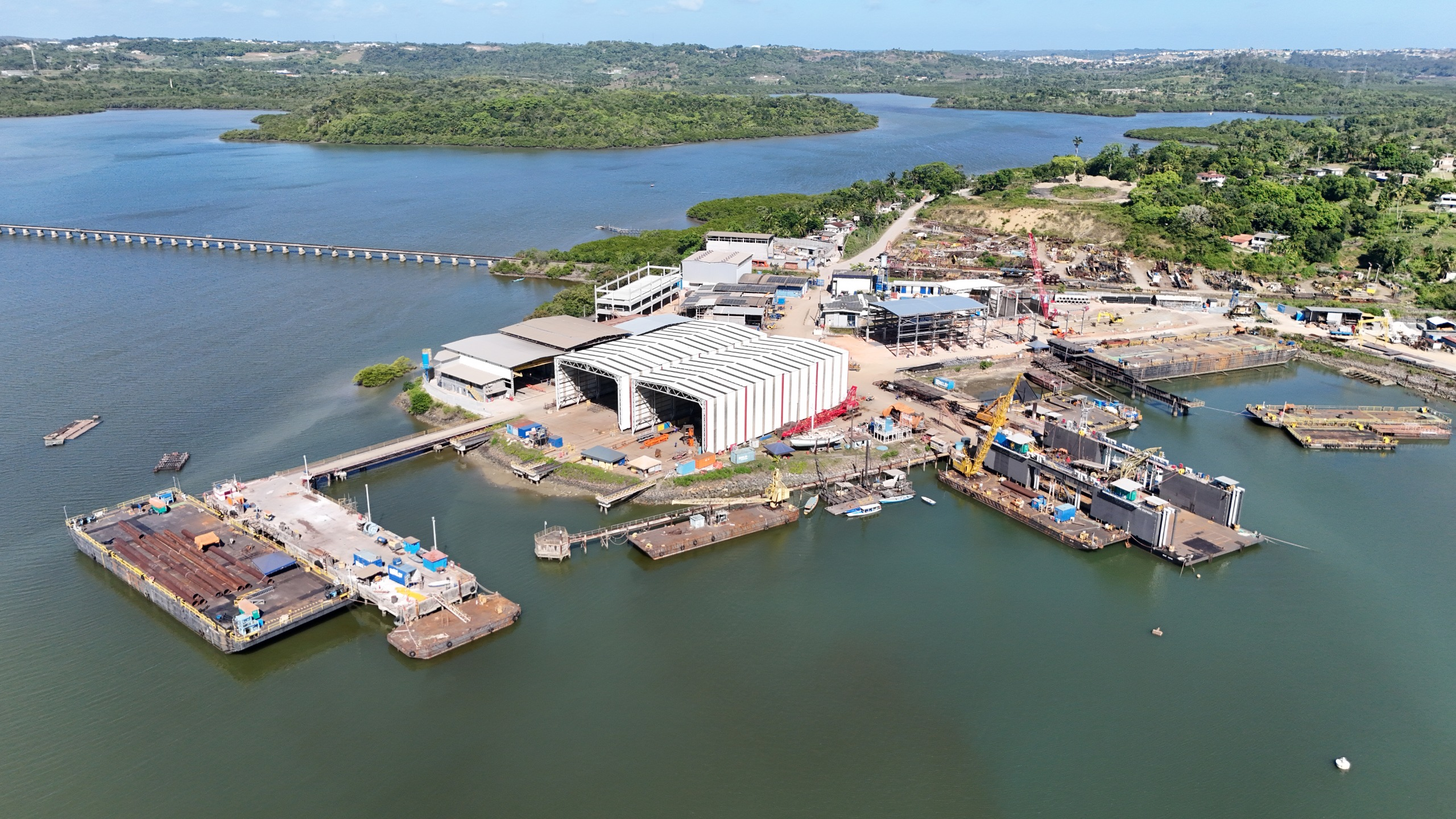
    Like Belov Amaralina and Belov Humaitá, Belov Arembepe is being entirely built at Belov Shipyard, located in the sheltered waters of Aratu Bay, within Todos os Santos Bay, Bahia. The shipyard’s strategic location—just 27 km from Salvador International Airport, 31 km from the Port of Aratu, and 9.5 km from highway BR-324—combined with its current production capacity of 5,000 tons per year, allows the company to execute highly complex projects in carbon steel and aluminum, for both newbuildings and ship repairs.

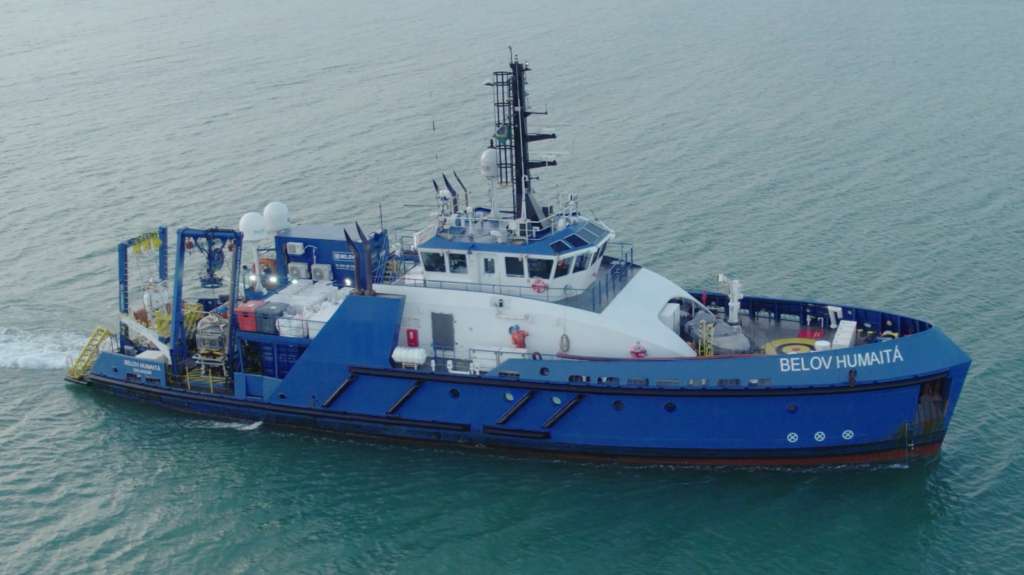
    Belov Humaitá (Source: Belov)

    The project has recently secured financing approved by the Merchant Marine Fund (FMM) in the amount of R$ 115 million, reinforcing the role of the Brazilian government in strengthening the national shipbuilding industry. For Guilherme Falcão, Project Manager at Belov Shipyard, the impact goes beyond technology.

    “Belov Shipyard reflects the company’s commitment not only to technical excellence, but also to regional development, by fostering jobs and innovation in the sector. Executing a disruptive, highly complex project with strong local content and a high level of technological integration has placed Belov and Bahia at the forefront of naval technology,” the executive comments.

    This commitment is already reflected in factual numbers. Since the start of the SDSV projects, approximately 600 direct jobs and more than 3,000 indirect jobs have been generated, during a period when Bahia’s shipbuilding industry was facing a severe downturn. In addition, around 230 direct jobs were created for vessel operations, boosting supplier development and workforce qualification.

    Belov’s tradition of naming its vessels after beaches in Bahia reinforces the company’s connection to the state where Aleixo Belov, founder of the company, established himself and concentrated his main assets. This relationship becomes even more relevant given Bahia’s strategic positioning on the Brazilian offshore map, between the Campos and Santos Basins to the south and the Equatorial Margin to the north.

    In a scenario where few companies in Brazil build vessels for their own fleets, Belov stands out alongside industry giants. On the eve of completing 45 years, in November 2026, the company reaffirms—through Belov Arembepe—its pioneering vocation and its confidence in the future of the Brazilian shipbuilding industry.

    BELOV AREMBEPE particulars

    – Delivery year: 2027
    – Current contract: Petrobras
    – Overall length: 40.50 meters
    – Beam: 10.98 meters
    – Deadweight: 518.10 tons
    – Gross tonnage: 499 tons
    – Installed power: 3,200 BHP
    – Propulsion: diesel-electric system with waterjets
    – DP class: DP2

    BELOV HUMAITÁ particulars

    – Delivery year: 2020
    – Current contract: Petrobras
    – Overall length: 40.50 meters
    – Beam: 10.98 meters
    – Deadweight: 518.10 tons
    – Gross tonnage: 499 tons
    – Installed power: 3,200 BHP
    – Propulsion: diesel-electric system with waterjets
    – DP class: DP2

    BELOV AMARALINA particulars

    – Delivery year: 2020
    – Current contract: Brava
    – Overall length: 40.50 meters
    – Beam: 10.98 meters
    – Deadweight: 518.10 tons
    – Gross tonnage: 499 tons
    – Installed power: 3,200 BHP
    – Propulsion: diesel-electric system with waterjets
    – DP class: DP2

    Q&A with Belov

    Tell us more about Belov Shipyard.

    Guilherme Falcão, Project Manager – Belov Shipyard

    Guilherme Falão (Source: Belov)

    “We are undergoing a phase of expansion and modernization at Belov Shipyard, which will increase our capacity to more than 11,000 tons per year. State-of-the-art infrastructure, combined with robust industrial processes and a highly qualified technical team, will allow us in the coming months to:

    • Execute multiple projects simultaneously with a high degree of electro-electronic integration and automation;
    • Position ourselves as one of the leading shipyards in electric and hybrid vessels, as well as complex conversions;
    • Achieve efficiency gains in cutting, assembly, welding, system integration, and commissioning, with strict compliance to schedules, costs, and class requirements;
    • Continuously advance in QSMS, productivity, and delivery timelines.

    This level of capability consolidates Belov Shipyard’s position as a reference in technologically complex vessels, reinforcing its vocation for delivering highly reliable specialized vessels to the Brazilian offshore, port, and inland waterways markets.”

    What was the average construction time for each SDSV?

    Guilherme Falcão:

    “Each project was executed within the contractual schedule, with the main milestones being contract signing and delivery to the end client: Petrobras. Belov Amaralina and Belov Humaitá were completed in parallel in just 16 months and delivered in the first quarter of 2020, at the peak of the pandemic—representing a milestone in the history of both the shipyard and the national shipbuilding industry.

    Belov Arembepe began construction in February 2026 and has a contractual timeframe of 18 months, consolidating Belov’s commitment to strict deadlines and technical requirements, with no cost changes throughout construction.”

    How was the financing through the FMM? What were the amounts?

    Juracy Vilas-Bôas, Director

    Juracy Vilas-Bôas (Source: Belov)

    “The projects relied on the essential support of the Merchant Marine Fund (FMM), reaffirming the Brazilian government’s commitment to strengthening the shipbuilding industry. As a reference for the investment value of each DSV (Diving Support Vessel), Belov Arembepe recently had its financing approved by the Fund in the amount of R$ 115 million. This financial support demonstrates institutional confidence in Belov’s governance and management, as well as in the technical capacity and delivery track record of the Shipyard, which have characterized the Group’s performance in the Brazilian naval market.”

    Were there any curiosities, challenges, or notable events during construction?

    Juracy Vilas-Bôas

    “Belov Amaralina and Belov Humaitá represented significant technological milestones on the global naval scene. To build the world’s first diesel-electric vessels equipped with waterjet propulsion and DP2 dynamic positioning, several established suppliers had to modify their products. Basic design companies, propulsion suppliers, engine manufacturers, DP system providers, and others did not have off-the-shelf solutions that fully met our requirements.

    Furthermore, integrating national and imported systems from multiple continents—along with all the challenges inherent to pioneering projects—highlighted the high level of engineering involved and Belov’s ability to lead technically demanding projects. This innovation was recognized by The Royal Institution of Naval Architects as the most significant small vessel of 2020, as well as by Work Boat World as the best vessel among all OSVs and DSVs of 2020. Another interesting fact: to launch Belov Amaralina and Belov Humaitá, the shipyard had to build a floating dock in tandem with the vessel construction. Today, this dock is responsible for dry-docking virtually all service vessels operating in Salvador and is essential for launching other shipyard projects.”