
Petrobras reported the interruption of exploratory operations at the Morpho well, about 175 km off Amapá, following a leak in auxiliary drilling fluid lines. The event involved water-based biodegradable fluid and no oil release was recorded. According to Petrobras, containment was completed, Ibama has been notified, and activities will resume after repairs and technical verification are concluded.
Tag: Shipbroking
-

Brent trades lower amid supply perception and geopolitical context
Global oil benchmarks moved lower as Brent crude for March delivery closed at US$ 60.70 per barrel, a 1.72% decline. Price behavior reflected expectations of ample supply combined with geopolitical developments and producer policy signals, moderating short-term bullish sentiment.
-
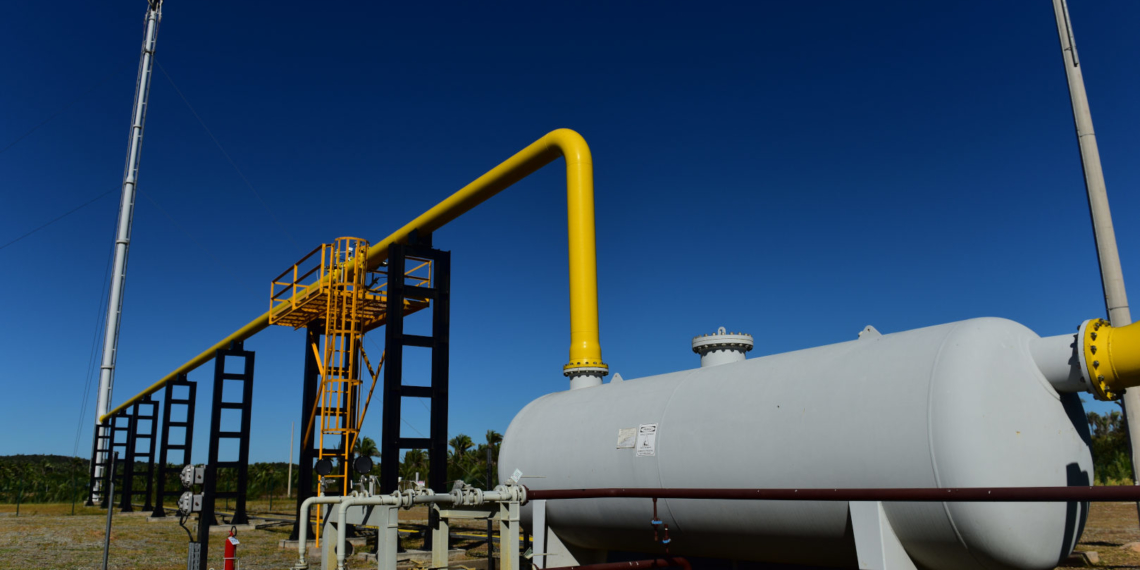
Eneva completes first natural gas import operations
Eneva confirmed that it concluded its first natural gas import operations from Argentina in December, expanding flexibility in regional supply access. The imported volumes support delivery to Brazilian industrial clients connected to the national transportation grid and contribute to diversification of sourcing and resilience in the domestic gas market.
-

Rio Oil & Gas 2026 confirmed
Rio Oil & Gas 2026 (ROG.e) has been confirmed for 21–24 September 2026 at Riocentro, Rio de Janeiro, with expectations of over 75,000 participants and more than 650 exhibitors. The program will integrate upstream, gas, energy transition, technology and supply-chain discussions, reinforcing Brazil’s role as a central platform for global offshore and energy dialogue.
-
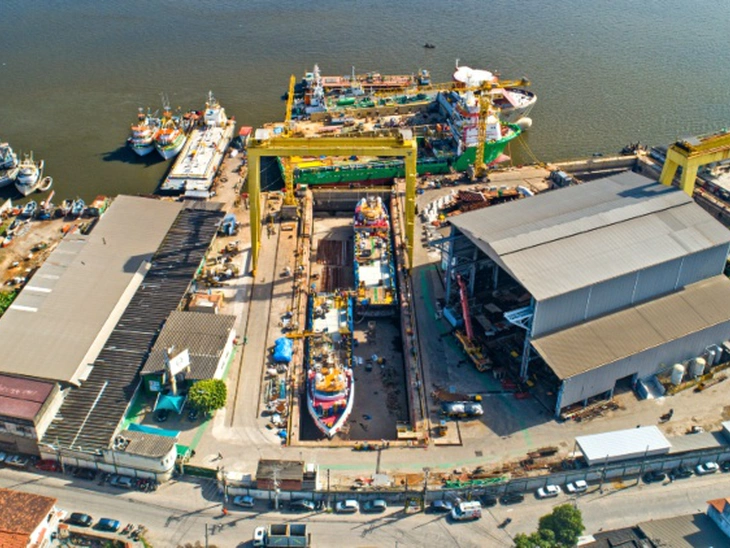
FMM approves R$ 218.8 million for Southern Brazil shipbuilding projects
At its 61st Council meeting, Brazil’s Merchant Marine Fund (FMM) approved R$ 218.8 million to support projects in Santa Catarina and Rio Grande do Sul, including shipyard modernization, inland waterways and passenger vessels, port support and offshore support assets. The decision forms part of the Ministry of Ports and Airports’ 2025 cycle, which closed the year with R$ 32.1 billion in total nationwide approvals.
-

Venezuela: Impacts on Brazil and the Equatorial Margin
Alexandre Vilela, CEO of WSB Advisors and Westhon, analyzes the developments of the recent tensions between the United States and Venezuela and their potential effects on the global oil market, with a particular focus on the implications for Brazil.
According to Vilela, despite the rise in geopolitical instability, the immediate effects on the Brazilian market are likely to be limited. The low level of direct trade integration between Brazil and Venezuela reduces short-term risks related to prices, supply, or logistics.
Vilela also emphasizes that Brazil currently occupies a more resilient position on the international stage, supported by stable production, long-term contracts, and greater regulatory predictability. In the medium and long term, this context could even strengthen the country’s role as a reliable oil supplier in the global market.

Allexandre Vilela holds a degree in International Relations and has nearly 25 years of professional experience 1. In practice, how could a rise in tensions between the U.S. and Venezuela affect Brazilian oil trade — in terms of price, supply, or logistics?
In the short term, it’s too early to expect any significant impact on Brazilian oil trade. Direct interaction of volumes between Brazil and Venezuela has historically been very limited, and any structural changes in Venezuelan supply would take time to materialize. Moreover, the current situation still lacks the political and operational stability needed to generate meaningful shifts in trade flows. In the long run, Brazil is more likely to benefit than be harmed, mainly due to its position as a stable producer.
2. Is Brazil today more vulnerable or more resilient to geopolitical shocks in the international oil market compared to other recent periods in history? Why?
Brazil is clearly more resilient today. The country has a solid production base, long-term contracts, greater regulatory predictability, and a growing national-flag fleet for transporting oil and derivatives. These factors reduce exposure to external shocks and contribute to greater logistical and commercial stability.
3. Could this new international context have any potential impact on investments or regulatory decisions related to the Equatorial Margin?
In the short term, no. There are also no significant regulatory impacts expected in the long term. Potentially, a reconstruction of Venezuelan production and refining could generate regional synergies, including in terms of knowledge and scale, which could benefit the development of Brazil’s Equatorial Margin. That said, it’s important to note that despite its name, the Brazilian Equatorial Margin is geographically distant from Venezuela and already follows its own logic, aligned with the proven FPSO model, as seen in Guyana.
4. If Venezuelan oil faces additional restrictions or export redirection, could Brazil benefit commercially, or would this likely put pressure on domestic prices and costs?
This scenario is unlikely. Recent developments point more toward a relaxation of restrictions rather than additional tightening. Therefore, no significant structural pressure on Brazilian prices or domestic costs is expected from this specific factor.
5. Could this international context accelerate or slow Brazil’s strategic decisions regarding exploration, refining, and energy self-sufficiency?
Petrobras headquarter (Souce: Petrobras) Rather than slowing them down, this context reinforces a broader strategic perspective. Brazil has previously been affected by asset nationalizations and unmet commitments in Venezuela, but today it possesses high technical, operational, and financial expertise. Energy self-sufficiency should be understood not only as domestic production but also as a national company’s ability to operate in an integrated way, both inside and outside the country. In this sense, Petrobras can, selectively, align itself with a regional market in reconstruction and capture value in a potential near-term international expansion.
*Questions made by Correio Braziliense
-

Open Tenders & More – Week 01, 2026
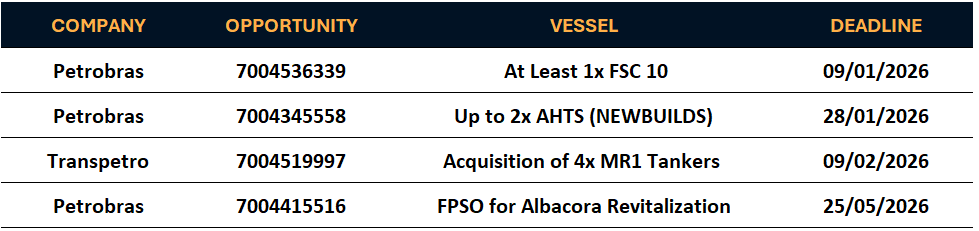
What has changed?
- Petrobras released at least 1x FSC 10 under Opportunity 7004536339, with deadline set for January 09th, 2026.
- Petrobras opened Opportunity 7004345558 for up to 2x AHTS (newbuilds), with deadline set for January 28th, 2026.
- Transpetro is receiving offers under Opportunity 7004519997 for the acquisition of 4x MR1 tankers, with deadline set for February 09th, 2026.
- Petrobras is progressing with Opportunity 7004415516 for the FPSO for Albacora Revitalization, with deadline set for May 25th, 2026.
-

Petrobras starts production at FPSO P-78
Petrobras announced that FPSO P-78 began production on the last day of 2025. The unit is instlalled in Buzios field at Santos basin. The FPSO has production capacity of 180,000 barrels of oil per day and 7.2 million cubic meters of natural gas per day.
With the start-up of P-78, installed production capacity in Búzios Field increases to approximately 1.15 million barrels of oil per day. In addition, the project enables natural gas exports to mainland Brazil through connection with Rota 3 gas pipeline, expanding domestic gas supply by up to 3 million cubic meters per day.
The FPSO arrived in Brazil in October after sailing from Singapore, is equipped with advanced technologies aimed at reducing emissions and improving operational efficiency. It is the seventh production platform in operation at Búzios Field — the largest in Brazil in terms of reserves — which surpassed 1 million barrels of oil per day in October 2025.
Búzios Field is located approximately 180 kilometers off the coast of Rio de Janeiro, in ultra-deep waters of Santos Basin, at water depths exceeding 2,000 meters.
“With this first oil, we are already starting the year making progress toward our main goal for 2026: increasing Petrobras’ oil and gas production. We expect to produce 2.5 million barrels of oil per day throughout the year, with a significant portion coming from Búzios, the country’s largest field in both reserves and production,” said Magda Chambriard, President of Petrobras.
-
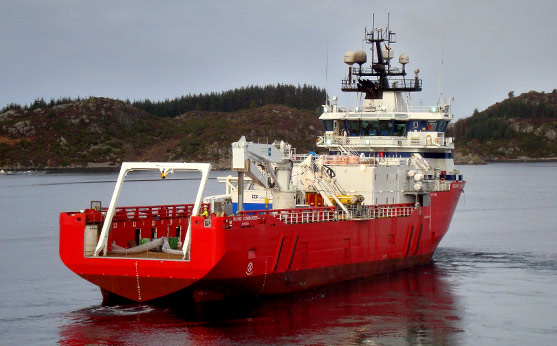
DOF secures new long-term RSV contract
DOF has signed a four-year contract with Petrobras for the vessel Skandi Commander, with operations scheduled to begin in January 2027. The agreement includes deployment of an Autonomous Underwater Vehicle (AUV) alongside the vessel’s Remote Operated Vehicle (ROV), enhancing subsea inspection, survey and intervention capabilities in offshore operations.
The contract adds to ongoing subsea support awards in Brazil, following multiple tenders secured by DOF in 2025 across AHTS, RSV and PIDF segments, cumulatively exceeding USD 2 billion in backlog.
Skandi Commander’s dual ROV-AUV configuration is expected to support inspection and integrity work across Petrobras’ offshore asset base. Mons Aase, CEO of DOF Group ASA, commented on the year’s achievements in Brazil and referenced a significant portion of the company’s fleet on firm contracts extending beyond 2030.
-
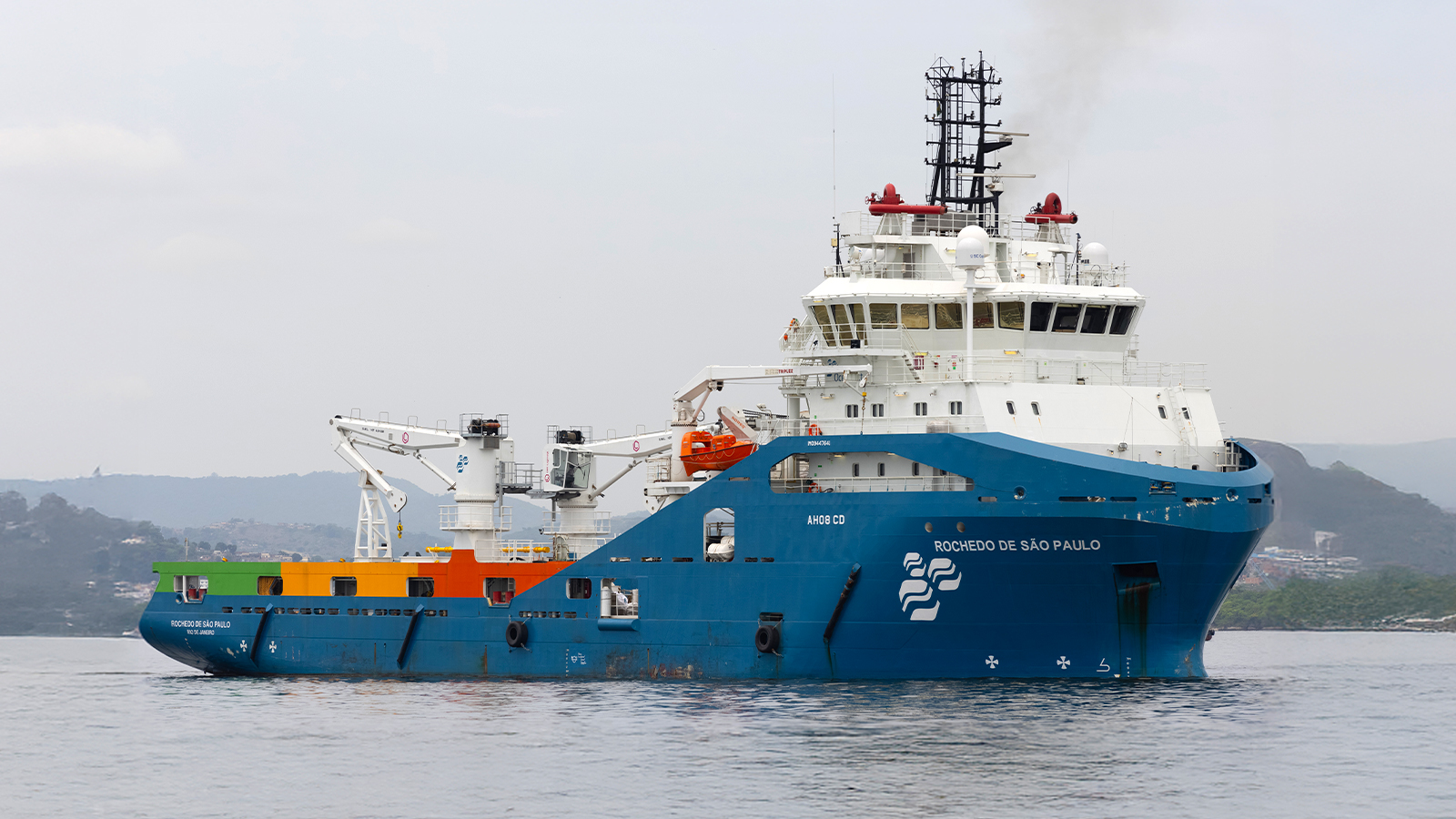
OceanPact signs contract with Petrobras
OceanPact has signed a four-year contract with Petrobras, estimated at approximately R$500 million, for the charter of the AHTS vessel Rochedo de São Paulo. The scope of the agreement includes the handling and maintenance of offloading hoses, an activity that is essential to ensuring the continuity, safety, and efficiency of oil transfers between offshore units and shuttle tankers.
In an official statement, the shipowner emphasized that the “signing of the contract strengthens OceanPact’s presence in strategic maritime operations and adds to other important commercial milestones announced throughout 2025.”
In August, the company signed four additional four-year contracts with Petrobras totaling approximately R$3.2 billion for the charter of RSV vessels. The following month, OceanPact announced two further contracts worth more than R$700 million for the provision of marine environmental monitoring services in areas operated by the oil company.
-
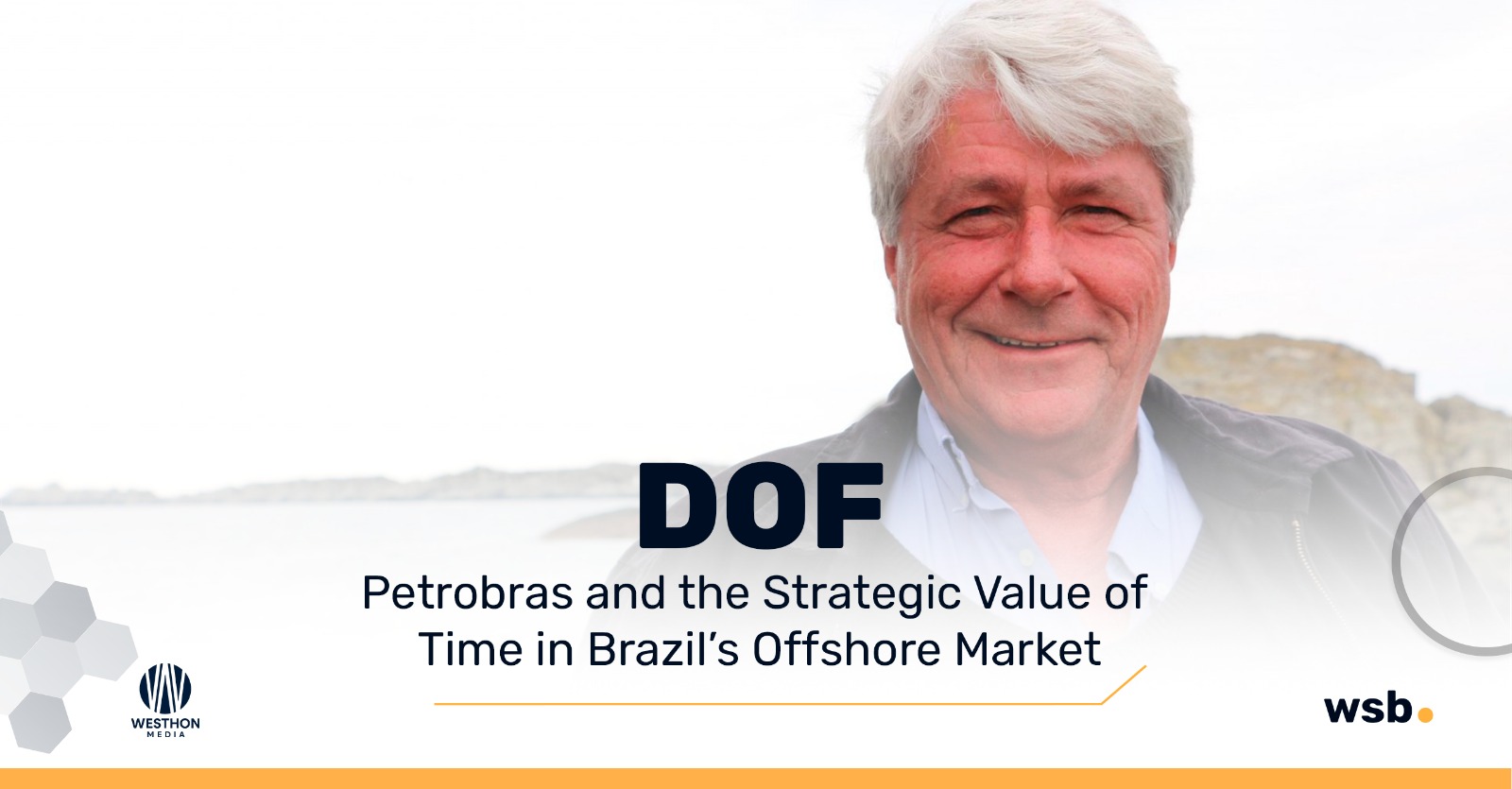
DOF, Petrobras and the strategic value of time in Brazil’s offshore market
DOF’s recent disclosure regarding the extension of seven contracts with Petrobras in Brazil deserves attention beyond the headline numbers. Not because the extensions themselves are unexpected, but because they illustrate, with unusual clarity, how timing, regulation and industrial legacy interact in the Brazilian offshore support vessel market.
Few executives are as closely connected to the history of this fleet as Paulo Rolim, Board Member and Advisory Services Lead of WSB Advisors. Paulo witnessed — and actively participated in — the construction of most of these vessels in Brazil, across the successive transitions from Promar’s Aker Yards- to STX- and VARD–, where he ultimately served as COO of VARD Brazil. These vessels are not merely assets on a balance sheet; they are the tangible outcome of a long-term commitment by the Norwegian maritime cluster to Brazilian shipbuilding, technology transfer and local capability development.
That legacy matters today.
DOF has now confirmed that the five Brazilian-flagged AHTS vessels with ROVs — Skandi Fluminense, Skandi Paraty, Skandi Angra, Skandi Urca and Skandi Iguaçu — will see their existing contracts extended to Q1 2027, while the new four-year contracts signed in 2025 will commence only thereafter, running to 2031. A similar logic applies to the RSVs Skandi Chieftain and Skandi Olympia, whose current contracts are extended through 2026, deferring the start of their new four-year charters to 2027.

Skandi Angra (Source: DOF Subsea) From Petrobras’ perspective, this is a rational and economically disciplined outcome. By extending current contracts and postponing the start of new ones negotiated at higher forward rates, Petrobras effectively locks in short-term cost savings, while maintaining uninterrupted access to a fleet that is already proven, compliant and operationally embedded in Brazil. In a market where day rates are structurally improving from the owners’ standpoint, time becomes a valuable negotiating instrument.
From DOF’s standpoint, the trade-off is equally clear. While the deferment delays the uplift in revenues associated with new contracts, it strengthens backlog visibility, adds more than USD 160 million in contracted value, and preserves fleet utilization in one of the company’s most strategically important regions. Balance sheet stability and long-term employment often justify moderation in near-term upside.
There is, however, a deeper structural layer. The AHTSs were built in Brazil, under Brazilian industrial policy frameworks that still shape today’s regulatory environment, and support the re-flag of foreign built tonnage. Whether by commercial preference or regulatory constraint, Brazilian-built and Brazilian-flagged assets retain a privileged — and in some cases unavoidable — position in Petrobras’ fleet planning. This reality reinforces the long-term value of earlier industrial investments, even when market cycles turn. Precisely the vision developed and delivered to DOF by a good friend of ours: Hans Falnes Ellingsen.
In this sense, the announcement is less about extensions and more about the strategic management of time. Petrobras secures operational continuity and postpones cost escalation. DOF extends backlog duration and mitigates risk. And Brazil’s offshore market once again demonstrates that vessels with deep local roots tend to remain relevant far longer than their steel alone would suggest.
At WSB Advisors, we view this episode as a reminder that in Brazil, industrial history, regulation and commercial strategy are inseparable — and that understanding their interaction is often more valuable than simply reading the headline.
-
Updates Transpetro: pusher and barges construction
Transpetro opens commercial bids for barges acquisition
As 2025 approaches its final stretch, Transpetro has opened commercial bids under public tender covering acquisition of barges, part of broader process that also includes pusher vessels. Results refer exclusively to opening of price proposals, with full list of bidders disclosed in official documentation.
The tender covers 18 barges, of which ten units are designed for 3,000 DWT and eight units for 2,000 DWT. According to Transpetro, the new acquisitions are expected to significantly expand its operational capacity in transportation of oil products and biofuels in Brazil.
Commercial proposals for barges were submitted across three lots. In Lot A, bids were presented by Navemestra Serviços de Navegação, IFM Construções e Montagens Industriais, Bertolini Construção Naval da Amazônia, Eram Estaleiro Rio Amazonas and Tropheus Montacon. In Lot B, proposals came from Navemestra, Bertolini, IFM, Eram and Tropheus Montacon. Lot C attracted bids from Bertolini, IFM, Eram, INC – Indústria Naval Catarinense, Navemestra, Tropheus Montacon and Fincantieri do Brasil.
At this stage, results reflect commercial ranking only. Transpetro’s bid committee will now proceed with negotiation phase, followed by qualification review, including legal, economic and technical documentation, as well as exequibility analysis of submitted prices, prior to final homologation.
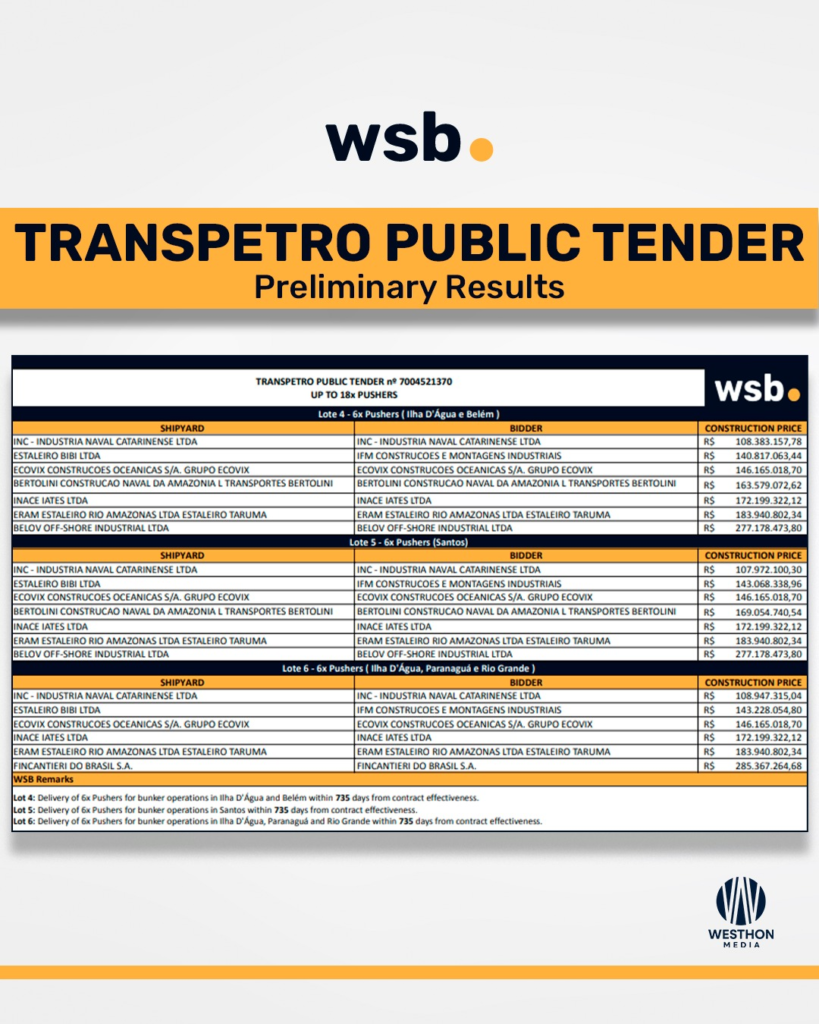
Transpetro releases tender result for pusher barges construction
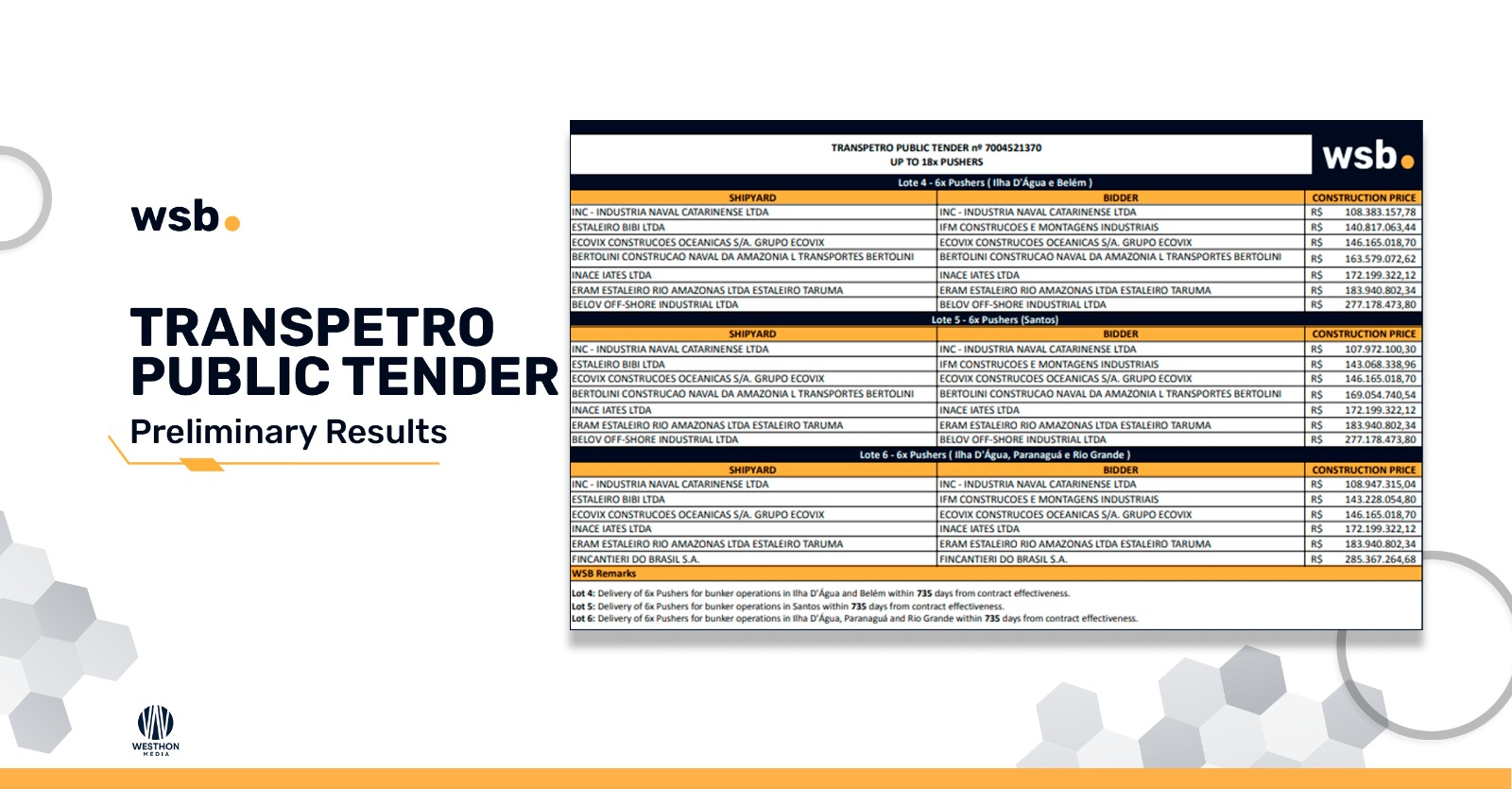
Transpetro has released tender result for public bidding process 7004521370, aimed at contracting shipyards for construction of pusher barges to support operations across different regions in Brazil.
Lot 4, covering construction of six pushers with planned operations in Ilha D’Água (RJ) and Belém (PA), attracted bids from seven Brazilian shipyards. INC – Indústria Naval Catarinense submitted lowest offer, totaling BRL 108.9 million, ranking first in this lot. Other bidders included Estaleiro Bibi, Ecovix, Bertolini, Inace, Eram, and Belov, with higher price levels.
Lot 5, also involving six pushers, with operations focused on Santos (SP), received proposals from six competitors. Once again, INC – Indústria Naval Catarinense presented lowest bid at BRL 108.9 million, followed by IFM, Ecovix, Inace, Eram, and Fincantieri do Brasil.
Next steps include final qualification review, exequibility analysis of submitted prices, and potential appeal phases, prior to formal award and contract execution.
Stay informed on key offshore developments — visit wsb-one.com, our data platform trusted by leading offshore companies.